Taxpayers & Strip Malls Pose Numerous Dangers
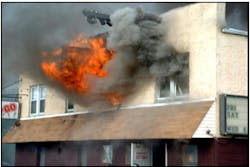
Strip malls and taxpayers can be found nearly everywhere in Anytown, U.S.A. These occupancies provide various commercial goods and services, and at times include residential living areas above the commercial areas. These structures possess an array of hazards that can injure and even kill firefighters working inside these occupancies. This month, we will take a look at some of the characteristics of these buildings, some construction issues regarding these structures, and some size-up considerations regarding operations in these buildings.
Over the years, the terms “taxpayer” and “strip mall” have be used interchangeably. However, there are specific, distinct differences regarding each type of building. A taxpayer is a mixed-use building that normally has commercial occupancies on the first floor, and living accommodations on the second floor. It is possible that the Taxpayer can have commercial occupancies on both floors, but for the most part, the upper-floor occupants may be mostly residential in nature (see Photo 1). It is called a “Taxpayer” because the owner of the main storefront occupancy rents out the areas in the additional stores and the upper floors to pay for the taxes on the lot the building rests upon.
These dwellings can possess a heavy fire load on the first floor with a severe life-hazard issue on the residential floor, directly in the path of least resistance for fire and smoke travel. Entrances to both units can be found in different locations, and can even be stacked right on top of each other. In many cases, the entrance to the commercial floor will be in the front of the building, while the residential access is in the rear of the building. Many times, these units are grouped together in clusters, and can share a common cockloft between units. Without some sort of fire separation or gap, each unit can be affected by a significant fire in one unit. These units may have cellars, and they may also be intertwined into these occupancies with no separation in between.
The strip mall can be broken into two groups, new-style and old-style occupancies. New-style strip malls have large open areas on the main floor, which can lead to significant fire loading of the building (see Photo 2). Construction will most likely be non/limited combustible, with the roof usually constructed of lightweight construction, including steel bar joists. In some cases, these bar joists can be wood chord metal web (WCMW) dual trusses, being located in areas that handle a significant loading on the roof, such as the HVAC system location (see Photo 3). There usually isn’t any cellar storage, with most of the storage in the rear of the unit, or in a large overhead storage area, almost a full story in height. This large cockloft will most likely run the entire row of stores, and possess a large artery for lateral fire spread. Drop ceilings will most likely be in each unit, causing an entanglement hazard to firefighters making entry into the unit.
Old-Style Strip Malls are the predecessor of the non/limited combustible strip malls. In these cases, the owner would buy a stretch of land, and construct a single building that may house a row of occupancies. With multiple occupants, the owner would maximize the rent to pay the taxes on the building and the land. These units are constructed of Ordinary Construction, with each unit separated by a masonry wall and a wood floor and roof assembly in each unit (see Photo 4). Unfortunately, this construction type will add a significant amount of fuel to the fire load. There will also be a cellar for material storage, and can possess a significant fire load with limited separation between occupancies. Finally, the drop ceilings in these buildings may hide a tin ceiling overhead, resulting in a void space for fire travel. Drop ceilings in old-style strip malls and taxpayers can be constructed of a wood frame, with sheetrock or plaster hung from this frame. The weight of this ceiling assembly falling on an advancing engine company can seriously injure and entrap these firefighters, requiring multiple resources to free them.
Size – Up Considerations
Construction: Most often, these will be either Ordinary or Non/Limited Combustible, with common void spaces either above or below the occupancies, dependent on construction type. Based on the significant potential for lateral fire spread, it is wise to concentrate the suppression efforts on keeping the fire in the involved unit, with handlines placed to cut off any fire travel. If there is lateral spread in the overhead area, be sure to open up all vertical arteries to allow the heat out of the building prior to pulling the ceilings (photo 5). If the ceilings get pulled prior to roof ventilation, the potential for a backdraft coming into the first floor area is significant.
Accessibility to these occupancies may be difficult, as many of these units are fitted with roll-down gates, which can hide the location of the fire, and allow the fire to grow exponentially. Rear access will be well fortified with multiple locks, including some homegrown varieties. It would be wise for the occupants to participate in a Knox-Box access program, which can save time making access into the building.
Roof recon may find the presence of cornices, facades, and parapet walls. Cornices and facades can be mounted to the front of the storefront exterior wall, placing an eccentric load on the wall. Mostly decorative in nature, these spaces can also hide a serious fire spreading from floor to floor, from the space between the floors, into the façade, and out to the upper-floor windows (see Photo 6). There may also be a parapet wall, a free-standing, non-load bearing wall extending above the roof line. This is considered to be a free-standing wall, sitting above the roof line on a lintel over a large opening, such as a large display window. These lintels can be constructed of steel, or can be a Glulam header or a Microlam beam. Excessive heat from the fire can cause the lintel to warp and fail, causing the parapet and front wall to collapse (see Photo 7). A good tactic to keep an eye on this situation leaves one front window intact for every two windows that are vented. Since the structural support on the front of these buildings rest substantially in the lintel, any weakening or buckling will break out these remaining windows. This is a good indicator that the front wall is about to collapse.
There may also be the presence of a rain roof, a new roof built over an existing roof. This can be a cheaper option than ripping off the old roof, and can even be constructed of lightweight materials, such as TJI’s or engineered lumber. The addition of the rain roof adds a significant load upon an already weakened roof, and since the rain roof acts as a heat accumulation point, this will allow the original roof to burn away, leading to a catastrophic collapse under fire conditions.
Occupancy: Depending on the use, there can be a large amount of issues to deal with. Presence of hazardous materials and flammable gases in these units can significantly increase the fire load and accelerate fire spread. Utility service can be compounded by multiple occupants; back-up generators can be in place; and gas may enter the structure at higher pressures to feed multiple meters.
Another problem with these buildings is the transient tenants that occupy the spaces within. Businesses moving in and out frequently, or expanding into multiple spaces can give these buildings a very interesting layout. Walls can be added or deleted, depending on the needs of the tenant. One of these occupancies in my response area has 12 units identified in the building, but walls were removed between three of them to facilitate the needs of the company. However, without proactive pre-planning, we would not have known it if we had an emergency there prior to the inspection.
Apparatus, Personnel & Equipment: Fires in these occupancies will be very taxing on personnel. How many is enough personnel? There should be enough personnel on-scene to proactively achieve six initial strategic operational functions: command, forcible entry, water supply/suppression, search and rescue, ventilation, and rapid intervention coverage. Be sure to consider a tactical reserve of at least two companies; having them on scene when they are needed is imperative to the overall success of the incident. If you, as the incident commander, turn to assign a critical task to a company and there aren’t any available, it will be a very long day.
Life Hazard: Most of the occupants will be transient: shoppers visiting the commercial occupancies. Most of them will be unfamiliar with the layout, and may panic in an emergency. Think about the buildings with commercial settings on both floors, such as dance studios, martial arts schools, and social clubs; the life hazard will be increased exponentially (see Photo 8). Exits may be limited, leading to a higher level of panic. In this case, mob mentality may take over, and the fire department has two options: provide escape or put the fire out, but the fire department won’t be able to cure the panic problem.
Water Supply: The hydrant in front is not usually the best choice, since the front of the building is best left for the truck company. Multiple water supply sources will be necessary, since firefighting operations will be utilizing larger handlines for suppression efforts.
Auxiliary Appliances: Many of these units were built prior to building code enforcement, and sprinklers may not be in place. If suppression systems are in place, then be sure to support the system with an engine company. Many of the older buildings do not have fire detection or suppression systems; couple this factor with a set of roll-down doors in front and this will give any fire a good head start on the building.
Street Conditions: Responding during business hours will have congested parking lots, illegal parking in fire lanes, and cars parked too close to the corners of the streets. Be sure there is room for the apparatus to get close enough to have a positive impact on operations.
Weather: This is an on-going consideration throughout the incident. It will have a significant effect on conditions and personnel on scene. Extreme conditions will require more personnel and time to handle the emergency.
Exposures: There will be significant extension from storefront windows by autoexposure. The upper residential floors will be directly in line with flame and smoke spread. Be sure to check the paths of least resistance for travel to upper floors. Lateral spread through the cockloft, cellar or ceiling plenum will require handlines in the bravo and delta exposures immediately to cut off vertical fire spread (see Photo 9). A great practice is to get into the habit of entering these occupancies with a pike pole and lift a ceiling tile immediately upon entering the door. This will give you a view of what the conditions are in the space between the ceiling and the floor above.
Area & Height: Commercial occupancies will usually dictate the use of 2 1/2-inch handlines. Think about the amount of hose needed to reach the seat of the fire; hoselines should be a minimum of twice the depth of the building involved, plus one additional length so the crew does not run short.
Location & Extent: This is the most important size-up factor, and will aid in determining strategy and tactics for the incident. Line assignment would be as follows:
The Primary Attack Line should go to the seat of the fire or between the fire and the life hazard through the path of least resistance.
The Secondary Attack Line should follow the path the primary line traveled, staged to protect the egress for the first-in engine company.
The Tertiary Attack Line should access the area from a different route, and cover the area of attack. Along with covering the egress, the crew on the third line watches for changing conditions and reports them to the attack line crews.
Additional lines will be needed to address lateral spread, multiple exposures per side, and continued protection of staff working on multiple levels of the building.
Time: Time of day and time of year are significant in determining strategic choices. However, the time of burn is a critical factor that must be considered. Simply put: How long has the fire been burning prior to the arrival of suppression crews? There will probably only be one shot at this operation. If there is not significant progress within the first few minutes, the incident may require a different operational mode, such as transitioning from an offensive attack to a defensive mode.
Hazardous Material Presence: Many of these occupancies can provide clues to the presence of large quantities of chemicals on site. Pool supply stores, hardware stores, dry cleaners, drug stores, and plumbing supply stores are some of the more volatile occupancies that can expose the firefighters to a high level of chemical exposure and fire involvement (see Photo 10). Be sure these hazards are identified in the pre-plans for the buildings.
Conclusion
Responses to these occupancies can overtax the initial units that arrive on the scene of the emergency. Any type of incident in these units will be significant; it is imperative that responding companies to these buildings identify the potential hazards these possess, and be sure that the appropriate resources are on scene to handle these hazards.
Until next time, stay focused and stay safe.
- See Michael Daley Live! Michael P. Daley will be teaching "Firefighting Operations in Strip Malls and Taxpayers" at Firehouse World, in San Diego, on March 1, 2011.
MICHAEL P. DALEY is a lieutenant and training officer with the Monroe Township, NJ, Fire District No. 3, and is an instructor with the Middlesex County Fire Academy, where he is responsible for rescue training curriculum development. Mike has an extensive background in fire service operations and holds degrees in business management and public safety administration. Mike serves as a rescue officer with the New Jersey Urban Search and Rescue Task Force 1 and is a managing member for Fire Service Performance Concepts, a consultant group that provides assistance and support to fire departments with their training programs and course development. Mike has been guest on several Firehouse.com podcasts including: Successful Rescue Operations in Today's Fire Service, Preparing for Tomorrow's RIT Deployment Today and Basement Fire Tactics Roundtable podcasts. View all of Michael's articles and podcasts here. You can reach Michael by e-mail at: [email protected].
About the Author
 Michael Daley
Michael Daley
MICHAEL DALEY, who is a Firehouse contributing editor, recently retired as a 37-year veteran who served as a captain and department training officer in Monroe Township, NJ. He is a staff instructor at multiple New Jersey fire academies and is an adjunct professor in the Fire Science Program at Middlesex County College. Daley is a nationally known instructor who has presented at multiple conferences, including Firehouse Expo and Firehouse World. His education includes accreditations as a Chief Training Officer and a Fire Investigator, and he completed the Craftsman Level of education with Project Kill the Flashover. Daley is a member of the Institution of Fire Engineers and a FEMA Instructor and Rescue Officer with NJ Urban Search and Rescue Task Force 1. He operates Fire Service Performance Concepts, which is a training and research firm that delivers and develops training courses in many fire service competencies.