Building Collapse Operations - Part 2
This month we will continue our discussion regarding building collapse with a look at the different types of building construction, and some specific collapse inherent hazards that are associated with each type. We will also examine different types of collapse patterns that result from the failure of the building's "gravity resistance system," and the problems that each present to the rescuer.
One of the most significant areas of proficiency for all firefighters is the methods of building construction. While it is imperative to understand construction for fire spread and structural behavior, it is just as important to be able to identify potential problems within structures before the fire begins to attack the structure. From a rescuer's standpoint, it will become necessary to push, pull, cut, breach, lift, or tunnel through the materials that make up the collapsed structure. Knowing what materials were used in the construction process of these buildings will better prepare the rescuer to defeat the materials (see Photo 1).
That being said, let's take a look at the five types of building construction, and some of the inherent problems that each present to the rescuer:
Type I Construction: Fire Resistive - These structures are made from non-combustible materials that do not add to the fire load of the structure. They are usually massive steel components that are encased in concrete, that provide a higher fire rating on the components. There may be cast-in-place concrete, or the slabs may be poured off-site and hoisted into place. These structures are considered to be the most resistant to collapse.
Type I: Inherent Hazards - Concrete takes approximately 28 days to fully cure to a point that collapse is no longer a threat. However, the pace of construction moves much faster than that. There have been cases where collapses have occurred when the formwork has failed when the compressive load from the upper floors have over taxed the pre-cured floor (see Photo 2). Secondly, when the slabs are laid into place, they are connected in a variety of methods; some of these connection points have been the result of a catastrophic failure of the structure. Inspection of these types of structures may reveal deteriorating concrete, spalling that is deep enough to expose support rods and cracks that can lead to a collapse.
Type II Construction: Non/limited Combustible - These structures are similar to Type I structures, with one major difference: The structural steel is encased with a light fire-resistive coating such as sheetrock or a sprayed-on coating. These structures employ a lightweight parallel steel bar joist system that holds up a corrugated steel roof deck. Due to the fact that much of the structural steel can be exposed to the properties of fire, these types of structures are considered to be the least resistant to collapse.
Type II Inherent Hazards - The classification of "limited" combustible comes from the materials that make up the roof covering, which, when involved in fire, can lead to a rapid failure of the roof. This type of structure is commonly used for commercial occupancies that require a large open space, such as strip malls. These malls have a large amount of windows in the front wall and that opening is spanned with a steel lintel that will support a free-standing parapet wall. If this lintel is compromised in any fashion, it can result in a complete failure of the parapet wall. Furthermore, there are larger buildings of this type that employ a tilt-slab construction method, which employs a pre-cast wall slab that is tilted into place (see Photo 3). Each slab is braced with steel rods or rebar and insulated at the sides with each other, using a foam insulator strip and caulking. Anchor plates are then used to attach the roof steel bar joists to the exterior walls, tying the integrity of the walls and the roof into each other. The result will be a catastrophic failure of either a large portion or all of the structure.
Type III Construction: Ordinary - These structures use load bearing walls of masonry construction, while the roof and the floor can be made of wood. Older buildings of this design can be either balloon frame or braced frame construction on the interior.
Type III Inherent Hazards - Similar to Type II structures, older buildings may also have a parapet wall at the roof line, but with a twist: there may also be a cornice, a decorative extension of the roof boards to give the appearance of an overhang from below. The cornice may also stand alone without the presence of a parapet wall. But, the cornice may be as old as the building and be unstable due to its age and its exposure to the elements. Also, these structures that span over 25 feet will have an additional steel I-beam support called a channel rail installed in the walls to aid in supporting the compressive load of the floors. Braced walls are another sign that the wall has been compromised. Spreader plates, in the shape of stars, plates, or channel sections, are used on the outside of masonry walls to provide some stability to the structure. These plates are connected with the use of unprotected steel or steel cable. Generally, spreader plates that were installed when the building was designed will be in some symmetrical fashion; but beware the spreader plates that are irregular in placement, they will signal a severe problem.
Type IV Construction: Heavy Timber - These structures resemble the construction methods as described in Type III buildings, but the difference is in the size of the materials used in construction. Exterior walls are brick or other type of masonry, but are often doubled in width, compared to similar Type III construction. The interior wood members are larger as well, with the columns being a minimum of eight inches by eight inches in diameter and joists must be at least six inches by 10 inches in diameter. These buildings used to house commercial occupancies, but can now be found as condominiums, churches and museums. The large materials used in their construction make these structures the second-most resistant to collapse.
Type IV Inherent Hazards - The larger surface-to-mass ratios of their structural components make these buildings more resistant to collapse. However, years of neglect, shoddy renovations, and weak connection points can cause complete failure of these buildings. The floor systems are of the self-releasing type, made up of fire-cut beams. The ends of the beams are cut at an angle and sit in a pocket in the wall. The principle here is that if the floor were to fail, the joists would not lever the exterior masonry walls, causing them to break and collapse. However, these fire-cut joists limit the amount of operational time that suppression crews have during a structural fire. Furthermore, once the floors fail, these massive walls become free-standing and can fail.
Additional hazards in these structures include the heavy timber truss. These trusses can be parallel chord or bowstring. Many times they are hidden behind a parapet wall, but identifying these hazards is vital. These trusses can span up to 20 feet on center, so if one section fails, it will open up a hole in the roof that spans 40 feet wide. These trusses incorporate the use of hip rafters, which connect the last trusses to the front and rear walls of the structure. When the roof fails, these rafters transfer the roof load to the front and rear walls, pushing them out violently (see Photo 4). Anyone that is in this collapse zone is in immediate danger.
Type V Construction: Wood Frame - These structures contain walls, floors, roofs, and other structural members are made up entirely of wood. Wood is the primary load bearing material within the structure. The size of the wood board will vary, dependent on its use and type of construction. These structures can be made up in one of the following methods:
Braced frame: Also referred to as "post and beam" or "post and girt," these buildings are made up of vertical posts and horizontal beams/girts. They are held in place using a "mortise and tenon" connection, pinned together with a pin called a trunnel.
Balloon frame: This structure incorporates wall studs that run continually from the foundation all the way up to the eaves line, with no inherent fire stopping between floors.
Platform frame: This type is constructed using a framing system which all studs terminate at onestory in height and the floors provide some sort of fire-stopping.
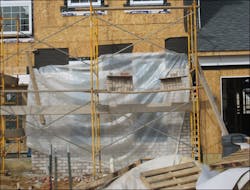
Type V Inherent Hazards - As these structures are all wood, there is no consideration made to the lower floors to help support the additional load of the upper floors. Two-by-four studs may in fact be holding up an entire upper floor, with no built-in compensation supports to consider. Secondly, many of these structures have a veneer wall, made of decorative masonry materials, to accent the front side of the building (see Photo 5).
These walls are attached to the wood wall, placing an eccentric load on the wall that it is not designed to handle. Lightweight construction components, such as trusses, truss joist I-beams (TJIs) and Oriented Strand Board (OSB) can be found in all types of construction, but are much more prevalent in Type V buildings. Furthermore, buildings are being built with larger square footage, but are being constructed with half of the materials that were used in the past, creating a structure that will collapse much faster than earlier construction methods.
Collapse Patterns
After responding to the collapse, identifying the type of collapse that occurred will be vital. Knowing the type of collapse will help identify the type of voids created, that may provide some safe havens for victims to be trapped in. It will also help identify the shoring that will have to be incorporated prior to the rescuers making entry into the debris pile. It will also allow the incident commander to evaluate the scene to determine the safest areas for operations, staging, and logistical needs of the incident.
Lean-to Floor Collapse: This collapse occurs when the roof or floor supports fail on one side of the structure, and the opposite side of the floor is still connected to the wall. It results in a void space that is close to the remaining wall (see Photo 6).
V-shape Floor Collapse: This collapse occurs when lower walls or floor joists fail, due to heavy loads located in the center of the floor. It results in two voids, one near each exterior wall (see Photo 7).
Pancake Floor Collapse: Destruction of the load bearing walls will cause the floor supports to fail, dropping the floors and the roof on top of each other. Voids will be created between the floors, where there is debris allowing for spacing between floors (see Photo 8).
Cantilever Floor Collapse: This collapse occurs when one or more walls have failed, and the other end of the floor is still attached to the other bearing wall. Voids will be sporadic throughout the debris. This is the most dangerous type of collapse to operate in, and adequate shoring must be in place before operations can commence (see Photo 9).
A-frame (Tent) Floor Collapse: This collapse occurs when the flooring separates from the exterior bearing walls, but still is supported by one or more interior walls or partitions. Voids are created near the center of the structure.
90-degree (Full Wall) Collapse: In this collapse, the entire wall falls out as one unit, falling outward the full height of the wall. Masonry walls collapse more commonly in this fashion, but Type V structures with veneer walls can fall victim to this collapse as well.
Inward-Outward Wall Collapse: This collapse occurs when the wall literally breaks in two, with the bottom section of the wall falling outward, and the top floors falling inward. Braced frame buildings are known to fail in this fashion. This type of collapse occurs more commonly in wood frame buildings, many times without warning.
Curtian Fall Wall Collapse: These collapses occur when a masonry wall falls almost straight downward, resulting in a large rubble pile close to the original structure. This is often associated with brick veneer walls.
Lean Over Collapse: Common in type V structures, this collapse occurs when the building shifts at the upper floor area, which results in the structure leaning onto adjacent buildings or totally collapsing sideways.
Conclusion
It is imperative that emergency responders have a secure grasp on the types of building construction in their respective communities. Identifying the types of materials and the type of collapse that occurred will help prepare the responder to operate accordingly on scene, utilizing the optimum resources that will be necessary on the incident. In September, we will discuss identifying the collapse potential in your community, strategic considerations on the collapse scene, and safety operations while operating at the incident.
Until next time, stay focused and stay safe.
MICHAEL P. DALEY is a lieutenant and training officer with the Monroe Township, NJ, Fire District No. 3, and is an instructor with the Middlesex County Fire Academy, where he is responsible for rescue training curriculum development. Mike has an extensive background in fire service operations and holds degrees in business management and public safety administration. Mike serves as a rescue officer with the New Jersey Urban Search and Rescue Task Force 1 and is a managing member for Fire Service Performance Concepts, a consultant group that provides assistance and support to fire departments with their training programs and course development. Mike participated in several Radio@Firehouse podcasts: Successful Rescue Operations in Today's Fire Service, The Buzz on Technical Rescue: A Look at the USAR Equipment Cache and The Buzz on Technical Rescue: Hackensack Parking Garage Collapse. You can reach Michael by e-mail at: [email protected].
About the Author
 Michael Daley
Michael Daley
MICHAEL DALEY, who is a Firehouse contributing editor, recently retired as a 37-year veteran who served as a captain and department training officer in Monroe Township, NJ. He is a staff instructor at multiple New Jersey fire academies and is an adjunct professor in the Fire Science Program at Middlesex County College. Daley is a nationally known instructor who has presented at multiple conferences, including Firehouse Expo and Firehouse World. His education includes accreditations as a Chief Training Officer and a Fire Investigator, and he completed the Craftsman Level of education with Project Kill the Flashover. Daley is a member of the Institution of Fire Engineers, a FEMA Instructor and a former Rescue Officer with NJ Urban Search and Rescue Task Force 1. He operates Fire Service Performance Concepts, which is a training and research firm that delivers and develops training courses in many fire service competencies.