A Simple Tool for Complicated Tasks: The Rescue Loop
Today's fire service operates in a very volatile environment -- both on and off the fireground. A question that we have to continually ask is: are we ready for these challenges and how do we overcome them? Learning the basic core skills of our work and being able to apply them in a manner to fit the various situations that we encounter is what makes us successful when confronted with a challenge on the fireground.
With the numerous tasks being required of firefighters in today's environment, one would think that it is necessary for a firefighter or department to spend a small fortune equipping each firefighter with personal tools. When it comes to personal equipment, it is imperative that a firefighter get the "most bang for their buck." Let's face it, who wants to carry an extra 10 pounds of equipment in their bunker gear pockets? Excessive equipment hanging from belts or on top of helmets also creates entanglement hazards for firefighters.
Each and every firefighter must be prepared to overcome whatever challenges they face. A simple and easy to carry, but very versatile piece of personal equipment that can be carried in bunker gear is a rescue or prussik loop. A rescue or prussik loop is a piece of cord or rope that has a loop formed in it by the use of a double fisherman's knot. The double fisherman's knot is utilized in joining the two ends of cord or rope due to it's ability to retain a great deal of the cord's original strength -- it is estimated to be as high as 70 percent -- and, because once it is tied and set by weight being applied, it is extremely difficult to untie.
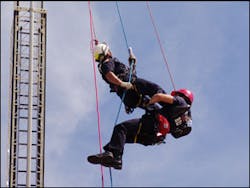
Traditionally the prussik loop has been used in the high angle rescue environment for numerous tasks such as ascending, anchor attachments, victim "pick offs," load releasing and safety devices and self rescue (see photo 1).
Using prussik loops outside of the technical rescue environment for firefighting was first introduced by members of the Phoenix Fire Department. The loops were issued as a solution to the challenges faced when trying to remove a downed firefighter as experienced by the removal of Brett Tarver at the Southwest Supermarket fire in 2001. Securing a loop to each extremity of the downed firefighter would allow them to be carried by the loops as if they were handles, eliminating slipping caused by turnout gear that was wet.
Creating The Prussik or Rescue Loop
Forming the prussik or rescue loop is quite simple, it is just a double fisherman's knot used to tie the rope or cord into a loop. A triple fisherman's knot is also acceptable:
- Wrap one end of the rope over the other two times. The second wrap should cross over the first. Pull the working end through the wraps. Basically, this is a double overhand knot (see photo 2).
- Repeat with the opposite rope end (see photo 3).
- Tighten both sides down to cinch upon each other (see photos 4 and 5).
- A piece of rubberized shrink wrapping can be applied over the knot to provide a gripping surface as well as provide protection for the knot (see photo 6).
Uses of the loop can include but are not limited to;
Secured in a girth hitch to a downed firefighter's self-contained breathing apparatus (SCBA) harness, a prussik can provide a sling to pull the firefighter as a horse would pull a cart. Whenever the loop is used as a sling, it is important to keep in mind that the longer the distance from the downed firefighter to the rescuer, the more difficult that controlling and dragging the downed firefighter will be (see photo 7).
Prussiks can be used to establish handles and grab points to move downed firefighters. Placing the loops into a girth hitch on the extremities of the downed firefighter provides points that enable multiple rescuers to move a downed firefighter above obstacles and debris (see photo 8)
Prussiks can be utilized in helping to move a firefighter or victim up a staircase. They are especially effective in helping to clear a downed firefighter's SCBA bottle stem from getting caught on the stair treads while moving (see photo 9).
To use rescue loops to help move a firefighter up a staircase;
- Locate and assess the downed firefighter placing them on their back.
- Drag the downed firefighter to the base of the staircase positioning them facing away from the stairs in a seated position.
- Rescuer 1 will take position behind the downed firefighter and will grasp both shoulder straps of the downed firefighter's SCBA.
- Rescuer 2 will take a rescue loop and place it in a girth hitch on the downed firefighter's leg as high up in the groin area as possible.
- This will be repeated for the second leg also.
- Rescuer 2 will position themselves inside the downed firefighter's legs grasping a rescue loop in each hand.
- On command, Rescuer 1 will pull straight up on the SCBA shoulder straps while Rescuer 2 will pull straight up on the rescue loops. At this point, the SCBA of the downed firefighter should be up high enough to clear the stair treads easily.
The rescuers should be able to navigate the stairs quite easily with proper execution of this maneuver. If needed, they can stop on their way up periodically to regroup or get a better hold. Just remember, once committed to going up the staircase, it must be performed quickly -- the staircase is a ventilation outlet for any conditions on the lower level!
Prussiks can also be an effective tool for fireground search procedures.
Holding onto a boot and following one another in a line on the wall is not an effective search pattern as it is very slow and leaves a large amount of area not searched. If conditions force firefighters to search while contacting one another, using a prussik can extend their reach to help cover more area (see photo 10).
Accessing a bedroom by performing VES can be easier and quicker as opposed to looking for access from the interior in hostile conditions. If the window being entered is on the first floor or street level, the firefighter will need to make the proper provisions to enable themselves to get up and over the windowsill. A prussik used in combination with a steel hook can come in handy for this task.
The benefit of the knot used in the prussik is that it when weighted, it grips the object that it is fastened around. This allows the loop to be used as a step for the firefighter when placed at the proper height on the hook. When the firefighter removes their weight from the loop, it is free to slide once again. Not only is this an effective technique for entry but could also be a lifesaving technique that allows a firefighter to escape from a lower level if they are trapped (see photos 11 and 12).
One of the key points to forcible entry practices is to control the door that is being forced. A prussik applied to the door handle with a girth hitch on an inward swinging door can help accomplish this in a safe manner also (see photo 13).
When using a power saw to cut through padlocks, it is recommended that a second firefighter assist by holding the lock from moving. The traditional way of accomplishing this task is to grip the lock with a pair of vise grips that have been modified with a chain welded to them to allow the second firefighter to stand safely out of the way. This same task can be accomplished with the use of a prussik. It is important to note, however, that the prussik may burn through from the sparks emitted from the saw but the prussik is easy to replace and much lighter to carry in a pocket than the vise grips (see photo 14).
Setting up a rehab or preparing for operations at a high rise fire incident will require an abundance of SCBA cylinders to be carried to a less than convenient place. Prussiks can be utilized to help accomplish this task. Placing girth hitches on the stems of two cylinders and draping them over the firefighter's SCBA being worn on the back or over their shoulder allows them to transport two spare cylinders in a hands-free manner (see photos 15 and 16).
In a pinch, a prussik can also help control a larger diameter handline much like that of a traditional rope hose tool. The prussik is applied to the hoseline with a girth hitch and the firefighter simply turns into the loop allowing it to position across their body. Their body weight, in combination with the prussik, will help control the line (see photo 17).
These are just a very few of the effective ways that a prussik or rescue loop can be utilized to make operating on the fireground safer or more efficient. When it comes to this regard, it is important that we remember that we are only limited by our imagination.
Please share any additional thoughts or uses for this simple but extremely versatile tool. The fireground is a very dynamic and dangerous environment. As with all aspects of firefighting, practice and training prior to an emergency will only increase our chances for success and survival. Are you ready for that challenge?
JEFFREY PINDELSKI, a Firehouse.com Contributing Editor, is a 18-year veteran of the fire service and currently serves as a battalion chief with the Downers Grove, IL, Fire Department. He is the Western Regional Director for the Fire Department Safety Officers Association and a staff instructor at the College of Du Page in Glen Ellyn, IL. Jeff is co-author of the text R.I.C.O., Rapid Intervention Company Operations and is a revising author for Delmar/Cengage Learning where he is also a member of their fire service advisory board.. Jeff presented the webcast Rope Essentials for Rapid Intervention and Survival on Firehouse.com and he has participated in Training & Tactics Talk and Training & Tactics Talk: Training Philosophies on [email protected]. To read Jeff's complete biography and view his archived articles, click here. You can reach Jeff by e-mail at [email protected].
About the Author
Jeffrey Pindelski
JEFFREY PINDELSKI is the Downers Grove, IL, Fire Department Chief (Ret.) and has been a student of the fire service for more than 30 years. He served as a chief officer for more than 15 years of his career, during which time he directly managed every aspect of the fire department at one time or another. Pindelski holds a master's degree in Public Safety Administration from Lewis University and earned a Graduate Certificate in Managerial Leadership and a bachelor's degree from Western Illinois University. He is the co-author of "R.I.C.O.- Rapid Intervention Company Operations" and was a revising author of the third edition of "Firefighter's Handbook." Pindelski presented at numerous fire service conferences and had more than 55 articles published in trade journals on various fire service-related topics. He is a recipient of Illinois' Firefighting Medal of Valor.