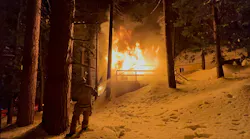
While at one of the funerals, I met a friend, Keith Cullom, who is a Firehouse® contributor and photographer who was visiting from California. He introduced me to one of the Hackensack firefighters. I didn't think I knew anyone in Hackensack, but the firefighter said he had met me 10 years earlier in the Bronx at FDNY Rescue 3. It was like old home week.
I interviewed many of the firefighters who were on duty or came in on recall for the fire. I also interviewed the fire chief. Some firefighters told me things they never told their wives. I spent many hours interviewing the members and wound up writing three stories.
Norwich. I traveled to eastern Connecticut to cover a fire that occurred in a block of buildings in downtown Norwich. After interviewing several chiefs, officers and firefighters, I was ready to leave. I was talking with a dispatcher when an alarm came in. They asked whether I would like to ride with them. I said sure and hopped into jump seat of a tractor-drawn aerial ladder. The driver told me to climb into the cab. I did so and moved to the middle of the front seat. I thought an officer was going to get in, but the driver said move over and close the door. Off we went with the driver, myself riding in the officer's seat and the tillerman. The alarm, at a nursing home, turned out to be nothing.
Malibu Fires. A series of wildland fires struck Southern California during the fall of 1993. A fire that began on Nov. 2, 1993, eventually required the response of more than 950 engines from all over the state. The fire destroyed numerous houses and traveled many miles, fanned by high Santa Ana winds all the way to the coast.
I interviewed firefighters, officers and chiefs from Los Angeles and Los Angeles County. When I was with Chief Don Anthony, he asked if I would like to take a ride in an LAFD helicopter to survey the damage from the air. I said it was OK with me if it was OK with him. He said when we visit with Chief Engineer Don Manning, we'll ask him. (I had already made arrangements to interview the helicopter pilots to get their view on the fire.) The chief engineer said it was all right to fly. When Anthony introduced me to the pilots, he told them "Harvey makes us look good, give him a good ride."
Off we went, lifting off the roof of the City Hall annex. We flew over the hills and I was directed to view the brush problems, mountains and steep terrain. The pilot I was with was the pilot who spotted the man in the window at the First Interstate Bank Building fire reported on earlier. I told him I had interviewed the company that he had dropped off on the roof to remove the man from 12 floor below the roof. We landed, refueled and he took me back to the fire department headquarters.
Indianapolis Military Jet Crash. A military jet lost power to its engine and was making an emergency landing into the Indianapolis airport on Oct. 20, 1987. The jet was coming in too high and too fast, so the pilot tried to come around for another landing. He was too low and bailed out. The jet hit the roof of a bank building and skidded across the street, crashing into the main entrance of a hotel across the street from the airport. Crash trucks responded off the airport and arrived at the scene. Several people in the lobby were killed. Foam was applied and the Wayne Township Fire Department was notified of the incident. WTFD had just had a drill with the airport and supplied the crash units with water and foam.

At the time, I was in Detroit to report on Devil's Night and from there I went to cover a training tragedy in Milford, MI, where three probationary firefighters were killed. (I had interviewed the Milford fire chief by phone, but visited the site when I was in Detroit for Devil's Night. A training fire and an arson-recognition drill attended by several departments killed three probationary members, including the wife of one of the chiefs who was setting the training fire.) My flight was delayed and I missed breakfast. When I arrived at the Indianapolis airport, it was just after lunch time. I was taken across the runway to the fire station. I was given a ride in a crash truck and shown how they can pump and roll.
I started to interview the firefighters who had responded to the jet crash. It took a while for them to warm up to me, but when I told them I had reported on the crash in Kenner, LA, and the Air Canada jet that had an inflight fire that flashed over after an emergency landing at the Cincinnati airport, they couldn't stop talking and kept asking me about other incidents I had reported on.
The Happyland Social Club Arson Fire. The deadliest fire in New York City in 79 years killed 87 people March 25, 1990, at the Happy-land Social Club in the Bronx. This fire occurred exactly 79 years to the day from when the Triangle Shirt Waist fire killed 145 sweatshop workers in New York City on March 25, 1911.
The one-alarm fire at the social club was sparked by an angry man who poured gasoline in the entrance way and ignited it. The building had only two entrances, nearly next to each other. There were no windows or rear exits. A portion of the mezzanine had a working sprinkler system. Most of the dead died from carbon monoxide.
I received a telephone call stating that as many as 50 people might be dead in a fire in the Bronx. I turned on my scanner and heard every single- and double-digit car number assigned to the top FDNY chiefs and fire commissioners responding to the scene. I guessed it was true. I eventually wound up inside the building. I was amazed, not only by the death and minor destruction, but after hearing and reading about tragedies for so many years and through history, here was a fire that was the worst in New York City in 79 years. How could something like this happen with all our fire prevention efforts and firefighting capabilities? The fact that it did not have to happen was what startled me.
Worcester. Six firefighters were killed while battling a fire in a vacant warehouse in Worcester, MA, on Dec. 3, 1999. I traveled to Worcester and marched with the more than 30,000 firefighters who attended the memorial service, even though the bodies of some of the firefighters had not yet been recovered from the collapse. I felt very proud to march with firefighters from all over the country.
I returned to Worcester a few more times to interview Chief Mike McNamee, the first incident commander. It was tough for all involved, but I wanted to report what had happened to the American fire service. We first reported on the fire, memorial service and the funerals. The report on the fire and what was known at the time was published a few months later. McNamee and several union members from Worcester traveled to Baltimore to make a presentation following the opening ceremonies at the 2000 Firehouse Expo. Moving video and audio clips from the fire and memorial service were presented.

Passaic Conflagration. A conflagration raced through four blocks of an industrial section of Passaic on Sept. 2, 1985. One firefighter was killed, 11 others were injured and the fire left an estimated $400 million in damage. The fire destroyed 18 factories in a 40-acre site and 15 adjacent homes. I spent seven hours at the fire taking pictures from numerous locations. At one point, the fire jumped the street and ignited the roof of a warehouse. The police told me to move back, it's a dynamite factory. (Yeah, right!) The fire in this exposure created its own firestorm and the fire venting out one side of the building was being sucked in to windows on another side of the structure. A photo that became the cover shot showed several pieces of apparatus battling the blaze. When the fire became too intense these units unhooked, took down their ladders and moved to another position.
Months after the fire, a fire inspector for the State of New Jersey was making his rounds in Passaic. He was to inspect a building, but could not locate the address. All he could see for block and blocks were bricks from the collapse and demolition of the buildings consumed by the fire. Way in the distance, off the road, the inspector saw an auto repair shop. He drove over and asked inside if anyone could help him find this certain address. The shop owner said, "Are you kidding? Because you're a little late - that address was for one of the buildings that burned down!"
Devil's Night In Detroit. I traveled to Hamtramck, MI, in September 1984 to cover a fire in an 1,100-by-700-foot, multi-story, two-building complex that housed among other items numerous classic cars. Detroit sent 25 engines and seven ladders to the scene on mutual aid to Hamtramck. One of the Detroit ladder companies had to reposition seven times during the fire because the complex was so large.

While in Detroit, I was told, "If you want to see some action, come back in a month to see Devil's Night," the night before Halloween. I talked to the editor and he said OK. I went to Detroit a few days early. Over the next three-day period, there were over 900 alarms, of which 250 were for building fires. In one night, I went to more than 20 building fires. At some of the fires a few companies were operating, but at others there were no companies on the scene for quite some time. (From 1968 through 1984, Detroit units had gone out to surrounding communities on mutual aid 75 times. On this night, for the first time, nearly 20 neighboring departments were requested into Detroit to battle the blazes.)
After seeing the national news coverage in the morning about the fires in Detroit, the publisher, Bruce Bowling, told the editor that we should get someone out there. He was told "Harvey's already there, he's been there for three days." The coverage appeared in our February 1985 issue. In his editorial, Dennis Smith wrote that we normally cover fires after they occur - this was the first time we covered any fires before they happened! The following year, as I stepped off the jet in Detroit, I was met by a reporter who wanted to interview me immediately. Because we told the truth, there was coverage from all over the world. I traveled to Detroit from 1984 to 1987 and each year the activity dropped. The Detroit firefighters certainly had their hands full.
"Backdraft." I received a call from actor Robert DeNiro's office. They wanted someone to review a script for an upcoming movie titled "Backdraft." I said I would look at it. I met with DeNiro in his office and we went over the script, especially his part, line by line for two hours. I gave him photos, articles and other material about his role as a fire investigator.
When we finished, I felt that I had told him as much as I could regarding his part and firefighting, investigation and the fire service. I was going to ask him for an autographed picture for the people in the office and others when he asked me, "Do you go these fires often?" Yes, I answered. He said, "Here's my home number. Give me a call and I'll go with you."
Chernobyl. The fire chief from Chernobyl, where more than 20 firefighters died following a nuclear plant accident, made a presentation at the Firehouse Expo. The chief had been on vacation at the time and was called in to the scene. He was accompanied by a Soviet general and a Russian-language interpreter. A reporter from People magazine followed his every move for two or three days. Editor Janet Kimmerly and I sat in on a portion of the interview. We were scheduled to interview the chief the following morning.

The interpreter asked the reporter how long the article in People was going to be and did she want to know everything from when he was in kindergarten?
During this time, a photographer from UPI asked if he could take a picture of the chief standing on the back of an American fire truck. The chief told him, "UPI, you're the group that said we killed 20 million people. No, I don't think we want to have our picture taken by you." They finally said OK after the photographer apologized. The following morning, an article about the chief appeared in a newspaper. We asked to begin our interview, but were told the Soviet delegation didn't like the newspaper article. I explained to them that we are both firefighters and want to hear from them what happened, so we can tell their story to the American fire service.
We proceeded, but it took a while for the interpreter to figure out how to translate our technical firefighting-related questions into Russian. As the fire chief heard each question, he responded immediately, but it took the interpreter a while to translate each of his answers into English.
After we had met for an hour, the chief told us this was the best interview he had conducted, and that the only aspect of it that could have made it better was if the interpreter had been more efficient - and he made the interpreter tell us that. Firefighters separated only by a different language.

Harlem Church Fires. I heard an alarm being transmitted over the Manhattan fire radio. The dispatchers were receiving numerous calls for a fire in a church on West 104th Street.
I responded and picked up a friend on the way. The fire went to a second alarm, then a third. We arrived on the scene as the deputy chief was saying over the handie-talkie, "Transmit a fourth alarm."
Because of the conditions, they went right to a fifth alarm. That brought 18 engines, seven ladders and numerous special units. As I was busy putting my flash batteries in the flash, loading the right film in the camera and setting my scanner to listen to the fireground traffic, my friend asks, "Hey, do you have a light for my cigar?"
A few days earlier, I went to a church fire on East 119th Street, and the first-due tower ladder was positioned in front. The other firefighters warned the chauffeur that he had parked the rig too close to the fire building, but the chauffeur said it was OK. Then, the radiant heat became intense, the truck's windshield cracked and the chauffeur said, "We're too close!" A dog that always rode the rig with the firefighters was last seen heading up East 119th Street away from the fire in a fast trot. I'll bet he said to himself, "I'm outta here!"

Aluminum-Bat Factory Fire. On May 26, 1986, I heard from a friend that he was on the scene of a fire and explosion in an aluminum-bat factory in Kearny, NJ. Eventually, the general-alarm fire required the evacuation of 150 people and left 150 others out of work. The initial explosion killed two workers and the fire spread to numerous buildings in the large industrial complex. The fire grew to involve a large heavy timber constructed building. I took all types of pictures - flash, no flash, wide angle, telephoto, existing light. The intense radiant heat was incredible. The rubber guard to the ladder pipe fog nozzle on one of the aerial ladders was smoking from the heat. Tremendous explosions inside the building forced me to move a great distance from the building.
Related: