The Apparatus Architect – Part 8: Designing Engine Company Apparatus
Not so long ago, it was fairly common practice to simply “buy up” one pump and tank size from the last-purchased apparatus. For example, if the engine purchased in 1992 was equipped with a 1,500-gpm pump and a 500-gallon booster tank, the next vehicle purchased would be provided with a 1,750-gpm pump and a 750-gallon water tank. This practice has continued to the point where in some cases we are buying rigs with 2,250-gpm pumps and 1,000-gallon water tanks simply because we can! In Part 1 of The Apparatus Architect series we talked about defining the job of the apparatus and clearly defining the mission of the unit. Only after doing this can the apparatus committee start out on the right foot to adequately design the engine company apparatus.
Several strategies can be applied when designing engine company apparatus. It is important to consider that anything that the committee does to change or improve upon the previously accepted standard within the fire department may not be met with universal appeal. Remember to engage the other officers, members, training and maintenance personnel when developing the specifications for new apparatus.
One very successful strategy for designing new engines is to look at the unit in terms of a box – a tool box, to be more descriptive. This container has four sides and a top, each component of which is vital to the overall mission of the container. The equipment carried on the apparatus or the lack of equipment can make or break the whole operation. Some departments have chosen to limit themselves by loading up crosslays with two-inch hose and loading up the hosebed with five-inch hose and calling it good. This could be a serious tactical and operational mistake.
Engine companies should be equipped with a variety of hose sizes so that firefighters can deploy the right-size hose with the right fire flow to extinguish the fire in the shortest amount of time. The more tools in the tool box, the better able we are to do the job.
The front of the engine must be capable of deploying suction and discharge lines, as well as having impact protection for the crew. The left side of the pumper will house the fire pump and controls, which must be laid out in a logical manner to enable the operator to safely get water under all types of weather and fireground conditions. The rear contains one of the most valuable pieces of real estate on apparatus that allows us to develop an uninterrupted water supply and extend hoselines for fire control. Coming around to the right side we often find misplaced equipment or ground ladders that are difficult to remove from the engine. Finally, the top of the apparatus carries everything else that we need on our giant pumping machine and often gets overlooked when considering personnel climbing up or down on the engine to deploy equipment or repack hoselines.
By giving careful consideration to each of the areas or sides of the apparatus, we can end up with a much-refined engine company that will successfully meet our needs and make the unit safer for all operating personnel. The goal is not to get bogged down on any one design issue, but rather to focus on the entire unit and how, through a combination of many smaller items and components, the completed vehicle will achieve the desired results using this integrated process. Several fire departments have successfully designed new engine company apparatus with very different rigs. We will take a brief look at each unit and how the design process evolved into the apparatus that they placed into service.
The Allentown Road Fire Department in Prince George’s County, MD, operates two engine companies, a heavy rescue and several ambulances from two stations. Each station serves a large first-due area comprised of several commercial strip malls, single-family dwellings and large garden apartment complexes with many tight areas. The department’s previous twin units were four-door-cab custom pumpers that were equipped with two crosslays, high side compartments on the left side, ground ladders on the right side and a normal-height hosebed off the rear of the apparatus.
After several years of service, it became apparent that the engines were not always obtaining the best position on the fireground due to their size and maneuverability. Ladder trucks and other special-service units are often placed out of position if the first-due engine company cannot leave room for these units. The positioning of the first-due units consistently makes or breaks the whole operation. If the first-due units are positioned properly, the operations tend to go well. Poor positioning of the first-due units leads to other vital other units being left out and then Murphy’s law sets in and the whole operation is circling the drain before we even get off the apparatus. How many fires have you observed with aerial apparatus that cost $600,000, $700,000 or $800,00 parked remote from the fire because they were blocked out by the engine companies or other vehicles? Aerial apparatus would have to be equipped with 500-foot ladders in order to reach.
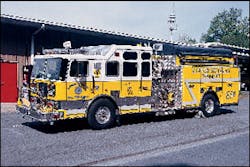
The department set out to rectify these concerns and recently placed in service twin Spartan Gladiator/Luverne pumpers. What makes these units unique is their size. Built on 155-inch wheelbases with an overall length of 26 feet, 10 inches, these pumpers can maneuver anywhere. Additionally, they were built with a low-hosebed design using a bulk-style water tank at the front of the body. Each of the pumpers is equipped with a 1,250-gpm pump, 300-gallon water tank and a 20-gallon Class B foam tank. Since the department’s response areas are fully protected by hydrants and each engine is responsible for its own water supply by laying a supply lines on all calls, the need for larger water tank was minimal.
One of the most innovative features is the hosebed design where four preconnected attack lines in various sizes from 13¼4-inch to two-inch to 21¼2-inch together with split supply line beds occupy the rear. The attack line beds are placed at shoulder height so there is no need to climb up on the tailboard to stretch the line. Light switches are placed low to enable the hose body lights to be activated from the ground.
These stainless steel body pumpers can outperform and outmaneuver the older units, keeping everything in a nice compact length. This was Allentown Road’s answer in response to its concerns of congested tight streets that could not safely accommodate large apparatus.
Another fire department’s problems were answered using the same process, but resulted in a very different pumper.
The Lower Swatara Township Fire Department in Dauphin County, PA, operates two engines, a heavy rescue unit and a tanker from one station in an area just south of the state capital in Harrisburg. Its first-due area has been expanding with new developments and housing areas, and when it became time to replace a 1984 pumper, much thought was given as to how to design a pumper that would have more fire attack capabilities with limited personnel.
The result was dramatic, with the design of a new Seagrave pumper with a compressed-air foam system (CAFS). The pumper was built on a 216-inch wheelbase and is equipped with a 2,000-gpm pump, 750-gallon booster tank, 50-gallon Class A foam tank and a 150-gallon Class B foam tank.
With the department’s response area covering portions of the Pennsylvania Turnpike and Harrisburg International Airport, the need for additional foam capabilities was apparent. The pumper is equipped with nine different preconnected attack lines as well as a supply line bed capable of carrying up to 2,000 feet of five-inch hose. Five of these attack lines are carried in a crosslay arrangement. Each equipment compartment was designed to carry specific tools and equipment.
While the design process was lengthy, the result was a piece of apparatus that met the needs of the department and provided new fire attack capability that was not available on the older apparatus.
These are just a few of the success stories of how fire departments and their apparatus committees can work to design new engine company apparatus to meet the challenges that they face in their response areas.
In the next installment of the Apparatus Architect we will begin our tour around the pumper to cover all of the sides of the box.
Tom W. Shand is a firefighter with the Newton-Abbott Volunteer Fire Department in the Town of Hamburg, NY. He is a senior instructor with the Onondaga County Fire Rescue Institute and is employed by American LaFrance and is assigned to the Hamburg Facility in the apparatus sales department. Michael Wilbur, a Firehouse® contributing editor, is a lieutenant in the New York City Fire Department, assigned to Ladder Company 27 in the Bronx. He has served for the past five years on the FDNY Apparatus Purchasing Committee. Wilbur is also a consultant on a variety of apparatus-related issues throughout the country. Previous installments were in the August, October and November 2000, and February, May, June and July 2001 issues.About the Author
 Tom Shand
Tom Shand
TOM SHAND, who is a Firehouse contributing editor, is a 36-year veteran of the fire service. He works with Michael Wilbur at Emergency Vehicle Response, consulting on a variety of fire apparatus and fire department master-planning issues. Shand is a member of the Firehouse Hall of Fame.
 Michael Wilbur
Michael Wilbur
MICHAEL WILBUR, who is a Firehouse contributing editor, retired as a lieutenant in FDNY, where he was last assigned to Ladder Company 27 in the Bronx. He has served on FDNY's Apparatus Purchasing Committee and consults on a variety of apparatus-related issues around the country. Wilbur is a member of the Firehouse Hall of Fame. For further information, access his website at www.emergencyvehicleresponse.com.