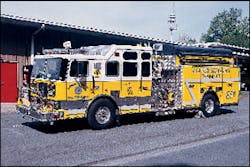
The Lower Swatara Fire Department in Pennsylvania placed in service this Seagrave CAFS-equipped pumper. The pumper maintains both Class A and Class B foam capability and is equipped with nine preconnected attack lines of various sizes and lengths.
The Lower Swatara Fire Department in Pennsylvania placed in service this Seagrave CAFS-equipped pumper. The pumper maintains both Class A and Class B foam capability and is equipped with nine preconnected attack lines of various sizes and lengths.
No matter what the size of your fire department or other operational characteristics that may influence the makeup of your apparatus fleet, every department generally operates some type of pumping apparatus. In your area it may be referred to as an engine, pumper, wagon or triple, but the mission of the engine company apparatus is to successfully deploy personnel, a fire pump, hose and water to the incident in a safe and controlled manner. For this reason we will spend the next several articles describing some of the concepts that you should consider when developing specifications for engine company apparatus.
Not so long ago, it was fairly common practice to simply
TOM SHAND, who is a Firehouse contributing editor, is a 36-year veteran of the fire service. He works with Michael Wilbur at Emergency Vehicle Response, consulting on a variety of fire apparatus and fire department master-planning issues. Shand is a member of the Firehouse Hall of Fame.
MICHAEL WILBUR, who is a Firehouse contributing editor, retired as a lieutenant in FDNY, where he was last assigned to Ladder Company 27 in the Bronx. He has served on FDNY's Apparatus Purchasing Committee and consults on a variety of apparatus-related issues around the country. Wilbur is a member of the Firehouse Hall of Fame. For further information, access his website at www.emergencyvehicleresponse.com.