Display Fireworks Require Common Sense and Distance to Keep FFs Safe
Some firefighters seem to lose all common sense when it comes to fireworks. T-shirts, shorts and flip-flop footwear become acceptable apparel, and parking apparatus within the fallout area is suddenly OK.
They seem to forget that professional grade, display fireworks can detonate with the same force as dynamite and hand grenades.
"You need to have a little common sense and present in a professional manner," said Shawn Allison, a career firefighter and licensed pyrotechnician who has developed a fireworks safety course explicitly for firefighters.
"Conduct yourself at a fireworks site just like you would at a blasting zone. These are explosives. I don't care if they're pretty when they go up in the air."
Moreover, firefighters need to remember that fireworks are merely entertainment, nothing more, he said.
A Unique Training Course
Allison is a 24-year career firefighter and captain with the Merrimack (N.H.) Fire Rescue Department and also works for Atlas PyroVision Productions, headquartered in Jaffrey, N.H. He has developed what is possibly the only course of its kind in the nation to teach fireworks safety to public safety responders. It's a course taught by a firefighter for firefighters.
For more than a decade, Allison has been shooting professional fireworks and has attended many shooters' courses hosted by professional trade organizations. All touch on fireworks safety, but they are primarily targeted toward the people who set up displays and set them off, not the firefighters who must inspect them and standby while they're being shot off.
He decided to fix that and developed a curriculum for responder safety and has been teaching it primarily in New Hampshire from where he hails, and in the Northeast.
Allison is uniquely qualified to teach the topic, as someone in the fire service as well as licensed in the use of professional display fireworks.
He's also taken a five-inch shell in the chest and has had close calls in the 11 years he's been working with fireworks.
"I know what I'm talking about and that's why you're here," said Allison, who hooked up with the New Hampshire Office of the State Fire Marshal and the New Hampshire Association of Fire Chiefs to sponsor and promote the class.
In the all-day class, held at four locations in New Hampshire this spring, Allison lectured along with New Hampshire Fire Investigator Chris Wyman, showed videos, and in true fireworks tradition, ended with a finale of live fireworks. They were set off in improper ways to clearly illustrate why firefighters shouldn't be anywhere near displays when they're being launched.
"Time, distance and shielding are firefighters' best friends when it comes to fireworks," Allison said.
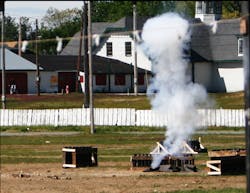
To prove his point, he fired a three-inch shell in a mortar at the Rochester, N.H., fairgrounds. A thunderous boom rang out and shards of high-density plastic pipe and wood flew across the track infield, chased by a searing fireball.
"That was a catastrophic display failure," said Allison.
The three-inch salute, which is nothing more than black powder launched in the sky for a loud report with no color, detonated in a mortar rack virtually vaporizing the wood framing and the plastic pipe mortar.
"If that doesn't convince you that you need to stay back, I don't know what will," Allison said to the group of about 50 firefighters who were hosted by the Rochester (N.H.) Fire Department. The small army of firefighters, in full turnout gear, were abuzz with laughter and expressions of amazement over the power that a simple three-inch shell can have.
"I'm here trying to show you guys what you do wrong and why you shouldn't do it," Allison said.
"The nice thing about me being in the fire service is I can talk to you the way I do. Firefighters don't always listen to people in the industry because the industry doesn't know about the fire service and firefighters think that industry people don't know anything."
Matt Shea is in the fireworks industry and does know a thing or two about safety, and cares enough to want to keep firefighters safe. Shea is the general manager of Atlas PyroVision Productions. He said his company is proud to be one of the class sponsors. Atlas does 600 shows in the USA and 10 international shows annually, and anything the company can do to make firefighters safe is worth it, he said.
"The safer the show, the less likelihood of spectator and firefighter injury," Shea said. "We want to show firefighters what can happen in a worst case scenario and present it in more of a hands-on manner, showing them what it would look like in the field."
When Fireworks Go Wrong
When things do go wrong in the field during a fireworks show, the results are often not pretty.
Allison said fireworks can have the same force and destructive power as any blasting zone material found in construction or in the military.
"If you were to get a call for a guy standing in the middle of a field throwing sticks of dynamite up in the air, how are you going to respond to that?" Allison asked. "Are you going to run in and say, 'Give me a match?'"
Obviously, the answer is no and Allison said firefighters need to exhibit that same precaution and standard operating guidelines (SOGs) as they would for explosives responses and hazmat responses.
"Who wants to be responsible for going to tell someone you had a line of duty death (LODD) in an entertainment venue?" Allison asked. "There's absolutely no reason for it. Everyone forgets about safety because fireworks are an entertainment venue, but it's an entertainment venue with explosives. Everybody forgets about safety because we're all having a good time; it's a holiday; it's the Fourth of July. …I don't want anyone to have to explain why a firefighter is dead because you did something stupid."
The Show Site
From inspections to standby during the show, firefighters ought to conduct themselves in a professional manner, Allison said.
A loaded professional fireworks show site is perhaps one of the most dangerous places a firefighter can be, and most don't even realize it.
Electrically fired shows have electrically-fired matches, or ematches, which can be set off with radio transmissions and batteries from cellphones and portable radios. He said firework charges can be set off just like blasting caps.
"What's your SOG for a bomb threat?" Allison asked. "Stay back and stay off the radio, right? …Yet when we show up at a fireworks site, all bets are off. Please guys, just use a little common sense."
Rules and Regulations
Along with common sense, firefighters can refer to the rules for fireworks use in the National Fire Protection Association (NFPA) 1123 "Code For Fireworks Display" 2010 Edition.
Many state regulations are based upon the NFPA 1123 rules, but states have their own regulations that may supersede the NFPA rules.
N.H. State Fire Investigator Chris Wyman has been with the New Hampshire State Fire Marshal's office for 10 years and has seen a lot of unsafe practices in his years inspecting and monitoring fireworks displays.
While he discussed rules and regulations for using fireworks in New Hampshire, he offered a lot of practical safety tips and general rules of thumbs that will help keep firefighters safe nationwide.
Wyman said firefighters called upon to inspect and monitor fireworks need to be intimately familiar with the rules governing their jurisdictions.
Wyman stressed the importance of distance between the shoot site and the audience. NFPA, and many states, have tables of distances which should keep audiences out of harm's way in the event of fireworks mishaps, he said.
For each shell being fired, there are prescribed distances the audiences should be away from the firing zone, Wyman said. As a rule of thumb, a shell will travel 100 feet for every inch in diameter, he said.
For example, a 10-inch shell will travel about 1,000 feet in the air and then break in a 400- to 500-foot burst.
"You need to keep size in mind when you start thinking about distances," Wyman said, adding that really expensive shells can be up to 12 inches in diameter.
Consumer Vs. Professional Grade Fireworks
Wyman also offered a way to easily tell the difference between consumer grade fireworks and professional display fireworks. Typically, consumer items have fancy and colorful paper labels meant to attract retail customers with marketing slogans. They'll also have warning labels that are not necessary on professional grade fireworks.
Commercial grade fireworks are traditionally constructed of brown paper material and are very plain, he said, noting they will also have a label that reads UN0335 and will likely say 1.3G Explosive. They may also have a U.S. Department of Transportation (DOT) EX number affixed. Firefighters inspecting shoot sites and the products that will be shot need to know if the fireworks are permissible in their coverage area.
Mitigating Risks
Wyman said that even the vehicle used to transport the fireworks has to be placarded with the appropriate DOT markings indicating it contains hazardous materials.
The vehicles must be in good repair too, Wyman said.
"Do you really want the truck carrying fireworks sputtering and popping?" Wyman asked. "Worse, do you want it to break down in the middle of your town? No. You want it to smoothly and safely get from its point of origin to its destination." Wyman said a vehicle break down will unnecessarily expose people to risk.
Risk is something each community will need to assess when fireworks are going to be displayed, Wyman said. He recommends each town adopt SOGs on how fireworks will be inspected, what resources will be need for standby crews and, most importantly, what the response will be in the event of a display failure or emergency.
"If you're not going to have standby fire personnel and equipment on site, once the crowds are in place and the fireworks are going, how easy is it going to be for you to get apparatus and other types of emergency equipment to the scene?" Wyman asked. "It's probably not going to be that easy."
That's why both Wyman and Allison recommend emergency personnel stand by in the audience and not near the display itself.
Selecting Your Distance
A display failure could potentially send fireworks products into audiences, causing burns and traumatic injuries.
Shells that go off parallel to the ground because of an improper installation or a display failure, will travel just as far as they would in the air, and perhaps further if they skip off an object in their path, Allison said.
So, an eight-inch shell will travel along the ground 800 feet and, the burst "will reach out and touch you well beyond that," Allison said.
Shells travel at 200 feet per second, or approximately 136 miles per hour, he said.
"Who here think they can run that fast?" Allison asked. "This is the whole point of the class guys. Think about the size of the shell, how fast it is going and can you out run it. That's why you shouldn't be anywhere near the display site."
Allison is a firm believer in leaving the shooting of displays to professionals and not firefighters. And when the SOGs are written, they need to state clearly that fire apparatus and personnel need to be far, far away from the shooting site.
"There's no place to be safe when these things go off," Allison said, holding up an eight-inch shell that resembled a paper cannonball in size and shape. "Believe me, if you get caught in the head with one of these things, you're going to get coloring books for the rest of your life, if you make it."
Having fire apparatus close to the launch site just doesn't make sense either, Allison said. Errant shells, and they do happen, can mess up a $500,000 pumper pretty quickly.
"How do you handle a truck fire on the highway that's placarded with (explosives)?" Allison asked. "You stay away… So why do you park a fire truck right next to the display? It makes no sense."
Responding to a Problem
An errant fireworks should be expected, at least one or two at every big show, Allison said.
"If they can't get a Toyota to come over here without the throttle sticking, what the hell makes you think fireworks are going to work perfectly every time and the way it's supposed to?" Allison asked.
When something happens during a show, there's nothing the fire department can do about it. The show will run its course and then the fire department can come in and take care of the spot fires, the aftermath and the casualties, but should not risk firefighter safety.
"We have brush fires and all kinds of stuff that happens, we need to plan for them, but we don't need to be in the area when they happen," he said.
Signals between the lead technician and the fire protection crews must be worked out in advance so the firefighters can tell the technicians to stop the show, if necessary, and for the technician to let the firefighters know when it's safe to enter. He doesn't, however, see the need to rush in to put out a brush fire.
"We have cans," Allison said. "We can take care of that stuff." Or, they can wait until after the show, he added. "If there's only two minutes left to the end of the show, the brush fire isn't going anywhere."
Flashlight signals work the best, Allison said, and he typically works with one representative of the fire department to give instructions and work out the signaling. Allison also reminded the class attendees that as firefighters and fire officials and "authorities with jurisdiction," they have the right to call the show off if conditions change, or the situation is just plain unsafe.
For instance, burning shards of shells and fireworks material raining into an audience because of a wind change, or a miscalculation about distances, would be grounds to call the show.
"That's yet another reason why we want firefighters out in the audience, to monitor conditions out there," Allison said. "You guys might see something that we don't."
Allison also reminded the class that there's no saving fireworks. "As soon as you get them wet, they're junk. You're not saving anything," Allison said. Therefore, there's no reason at all to park an apparatus close to the racks and mortars, he said.
"If we have a display failure, there's going to be product everywhere," he said. "There's going to be a few guys hurt, but the biggest chance there's going to be problems is in your audience…You drop an eight-inch shell in the audience, there's going to be some problems."
After the Show
After a show, there's always the chance that products will be unspent, or duds, Wyman said. That's why the shooters need to do sweeps of show sites to make sure there are no shells left behind. The sweeps are done by regulations immediately after the show and at "first light" the next day after the show, Wyman said.
Allison said firefighters who feel comfortable helping with looking for the shells, and have been trained to do so, can flag them, but they should not pick them out or handle them.
"If you come walking up to me with a shell in your hands, I'm going to be headed in the opposite direction at a very high rate of speed," Allison said.
The only way to make sure shells are completely dead is to wait at least 15 minutes and then to completely submerse them in water, explained Wyman.
The leftover fireworks then have to be taken back by the display shooter, in a re-placarded vehicle, for proper disposal with the maker.
Wyman related a story about a fireworks mishap in his home town where a three-inch shell was left behind in the middle of the athletic field after the Fourth of July show. The shooter missed it, but the person mowing the lawn on July 5th didn't, he said.
"The mower hit it and there was a hell of a boom and the shower of stars," Wyman said. The force of the detonation, which was contained in the mowing deck, destroyed it and scared the mower operator, but fortunately didn't injure anyone.
"The mowing deck was all bent and pretty much wiped out," Wyman said.
That's the kind of force fireworks can create, destroying heavy metal equipment with just a three-inch shell.
"We worry about it on everything else, and then we get to fireworks and everything goes out the window," Allison said. "We should never lose firefighters in the name of entertainment."
About the Author
Ed Ballam
Ed Ballam served as associate editor for Firehouse. He is the assistant chief of the Haverhill Corner, N.H. Fire Department, and a National Registered EMT. He is also a Deputy Forest Fire Warden for the New Hampshire Division of Forests and Lands. Professionally, he's been a journalist for over 35 years working for a variety of publications, including employment as managing editor of a national fire service trade journal for more than a decade.