Innovative Rigs on the Street: Hollywood's Short Wheelbase Pumper
When we hear the location of Hollywood most of us think about the movie industry, sunny southern California and maybe even the days when Crown Fire Apparatus was the predominant fire truck on the west coast. However the Hollywood covered in this article can be found in Saint Mary's County in southern Maryland where the Hollywood Volunteer Fire Department operates a well designed fleet of apparatus.
The Hollywood Fire Department operates from a single station under the command of Chief Robb Albert. The department was formed in 1957 and currently staffs three engine companies, a ladder truck, one heavy squad and two brush units with all volunteer staffing. During 2008 the department responded to 773 incidents including mutual aid responses to other departments in both Saint Mary's and Calvert Counties. Approximately 285 of these incidents were for reported building fires, so the department has placed particular emphasis on purchasing apparatus that are safely designed to operate at the multitude of target hazards in their response area.
The host for our visit to Hollywood was Assistant Chief Doug Insley, who works for the Arlington County, VA, Fire Department as a battalion chief and overseas their apparatus specification and purchasing program. As a result Chief Insley is well versed in the numerous details of the apparatus procurement process and was instrumental in the design of Hollywood's current fleet of units.
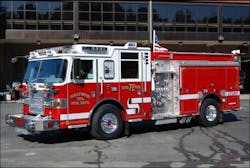
The newest unit is Engine 72, which was designed by the department's apparatus committee working closely with the sales representative from Singer Associates, the local Pierce dealership. The apparatus is based upon a Pierce Arrow XT cab and chassis with a short 184.5-inch wheelbase and an overall length of 30 feet, nine inches. The unit is powered by a Cummins model ISM engine rated at 500-horsepower through an Allison EVS-4000 transmission. The aluminum body is 136 inches long and is equipped with six enclosed compartments with hinged body doors on the side and a single roll-up door at the rear.
The fire attack capability of this apparatus is provided by a Hale Q-Max single-stage pump rated at 1500 gpm. which is equipped with a Feecon APH 400-gpm around the pump foam system that can supply any of the 11 pump discharges on the unit. Engine 72 is equipped with six pre-connected lines including a bumper trash line, two 200-foot 1 3/4-inch and one 200-foot 2-inch attack lines in crosslay beds. The two 1 3/4-inch lines are equipped with combination nozzles with the 2-inch line equipped with a one-inch smooth bore tip. The three crosslays were specially designed to be lower to the ground than standard for easier deployment. The rear hose bed is outfitted with a 200-foot 2 1/2-inch attack line and a 350-foot 1 3/4-inch line for buildings with longer set backs. The supply line hose bed carries 1,500 feet of 4-inch supply line together with 400 feet of 3-inch hose. The department utilizes a Humat hydrant valve on the four-inch supply line which enables the engine to develop a continuous supply of water for initial attack when laying out from a hydrant. The initial attack capability of this unit is provided by a 750-gallon water tank. The foam tank carries 30 gallons of Class B concentrate. Master stream capabilities are provided by a top mounted deck gun supplied by a three-inch discharge with a Task Force Extenda Gun.
The front bumper is a heavy duty stainless steel design with full width steel channel reinforcement. In addition to the trash line, the bumper is equipped with a fuive-inch front inlet controlled at the pump panel with an Elkhart electric valve. The right side six-inch steamer inlet is equipped with a Hale MIV with a manual override. An additional fuve-inch gated rear intake is provided as well. Special emphasis was placed on the layout and design of the pump panel to include six-inch master pump gauges, a pressure relief valve and all discharge gates and gauges in a straight line to make pump operations easier and safer. A unique feature of the apparatus is the use of a Safety Vision camera system with additional cameras located at both the left and right side pump panels. The cameras not only monitor these sides of the apparatus during responses but are utilized for pump operator training by recording the routine activities and operations that are conducted by the driver and pump operator during incidents.
Each of the cab doors is protected by two LED warning lights and reflective stripping. Hand tools mounted inside of the cab include irons and a maul that are secured with 9G brackets. Roof hooks are located at the rear of the cab on each side together with four LED water tank level lights that are activated when the fire pump is engaged. Other safety features on Engine 72 include a windshield mounted down view mirror, Whelen 88-inch wide LED light bar together with a Roto Ray and Mars warning lights mounted on the cab front. Additional LED strip warning lights are recessed mounted in the rub rails on each side of the apparatus and along the rear step. A special access ladder was fabricated and installed at the left rear of the apparatus to provide safe access to the hose bed area. A LED traffic advisor was built into the underside of the aluminum tread plate hose bed covers.
The right side of the engine is equipped with the standard compliment of ground ladders and standpipe packs which are carried under the ladders in aluminum tread plate tray with seat belts. All tools and equipment were mounted by First Due Apparatus Solutions including custom made slide tray mounts for adapters and fittings. The rear-step compartment carries a small hydraulic tool and motor for minor vehicle accidents where the engine company would be first due. The rear walls in each compartment on the left side of the body were lined with pegboard for additional tool mounting and flexibility in the future.
Scene lighting is provided by two forward facing 750-watt lights mounted above the windshield and two side facing 750-watt lights above each crew cab door. Rear body lighting is provided by two fixed 750-watt lights on each side of the hose bed. The 120-volt power supply for these lights and a right side electric cable reel is provided by an Onan 10.0 Kw hydraulic generator recess mounted above the fire pump.
Engine 72 is an excellent example of a short wheelbase engine company that packs a punch from the bumper to back step. The members of the Hollywood Fire Department designed a well thought out engine that will more than meet their needs for many years to come and really enhanced the safety and operations of the fire company.
I would like to acknowledge the assistance of Assistant Chief Doug Insley and the members of the Hollywood Fire Department for their kind help with this article.
TOM SHAND is a 37-year veteran of the fire service having served with departments in Maryland, Pennsylvania and New York. He has worked in the fire apparatus industry since 1985, including 15 years with Saulsbury Fire Apparatus. He is a contributing editor to Fire Apparatus Journal and Firehouse Magazine and works with Mike Wilbur at Emergency Vehicle Response. He co-hosts the Apparatus Architects podcast with Wilbur, based on their column in Firehouse Magazine.