Emergency Egress on the Fireground: The Ladder Bail
When conditions inside a fire building change rapidly, the conventional methods to exit a window can be hampered by heat, window size and the firefighters profile.
Your crew is performing a primary search of the floor above the fire when you hear the evacuation tones over your portable radio. Turning to exit down the stairway, you unexpectedly realize that your crew is cut off from the stairs by rapidly spreading fire conditions. Luckily, you remember hearing the rapid intervention team (RIT) announce that they proactively set a ladder to a second floor window on the "Bravo" side of the structure and you recall just seeing it as you marked your orientation as you passed a window in your search pattern. Conditions are worsening and the heat is driving you and your crew lower to the floor. Are your crew members properly prepared to safely exit?
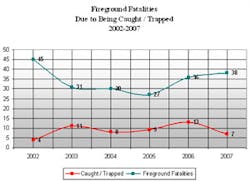
Looking back from 2007 to 2002, we have averaged 112 line of duty deaths each year. Out of those 112, an annual average of 35 can be attributed to actual activities taking place on the fireground. An average of 26 percent, or 9, of those per year can be linked to firefighters getting caught or trapped on the fireground (see Figure 1).
The best way to overcome this problem is to focus on the key areas of our job to prevent us from getting into trouble on the fireground. This includes command personnel as well as the people on the line. A lack of recognition of key aspects related to fire behavior continues to be one of the top five reasons firefighters get killed or into trouble on the fire ground. Everyone working on the fireground needs to be aware of the conditions that can create the need for emergency escape and prevent them from occurring.
- Register Now! Rope Essentials for Rapid Intervention and Survival Webcast
Conditions in a structure fire can change very rapidly. These conditions can prevent a firefighter from being able to stand up and exit a window in a conventional manner. Small windows or a firefighter's profile with an SCBA in place may also not allow them to exit onto the ladder in a conventional manner.
The only way that a firefighter may be able to escape is to exit the window head first onto the ladder. The techniques to accomplish this have been the subject of much undeserved controversy in the fire service community. Unfortunately, firefighters have been injured and in one case even suffered fatal injuries in training while performing these maneuvers. Because of this, many chiefs and training officers will not allow their members to train on techniques such as this which, in the opinion of this writer is more of a disservice. These techniques have been proven to make a difference by saving countless firefighter's lives on the fireground and if trained on with the proper safety measures taken, they can be accomplished relatively safe.
Training Increases Abilities
Training is the one and only time that we have control over the conditions and environment that we work in. Safety parameters for training in these techniques include the use of a rated safety line that is attached to a rated safety harness worn on the firefighter. This line shall be belayed in order to prevent any accidents that may be caused due to loss of handholds on the ladder or falling. This safety line shall be set up and operated at all times by a member properly trained to do so. Safety lines shall also be checked prior to each and every participant taking their turn. The ladder shall always be secured from movement at all times when training on these techniques.
Proper Ladder Placement
Our RIT teams should be trained and allowed to operate in a proactive manner on the fireground as long as it does not prohibit them from being ready and available for deployment at a moments notice. This proactive behavior includes placing ladders to upper floor windows around a structure to provide an alternate means of egress for interior companies. An exterior team should also make certain that a ladder is properly heeled if they hear that firefighters will be making a rapid egress (see Figure 2).
When placing ground ladders for emergency escape purposes, the angle that the ladder is positioned will need to be less than the recommended 75 degrees or one-quarter of the distance from the ground to the window that is traditionally instructed for ladder placement. If the ladders are placed at 75 degrees or greater, an escaping firefighter would have an increased chance of sliding down the ladder too quickly or, even worse, missing it completely because of their momentum caused by gravity. A firefighter with an SCBA. on their back has a center of balance that can pull them "head over heels" if the angle is to steep. By placing the ladder less than 75 degrees it will ensure a more controlled technique by the firefighter exiting the window.
The tip of the ladder will need to be placed just below the windowsill (see Figure 3). If the ladder is placed at the window with the rails above the windowsill, it would be very difficult, if not impossible, for a firefighter to exit the window. The firefighter will be forced to bring themselves up into the deteriorating conditions to get onto the ladder and window opening size will be decreased.
There are several ladder bailout techniques that are being instructed throughout the fire service. Only two of the available techniques will be discussed. These two techniques were chosen firmly based on the firefighter's ability to maintain control of their body as well as their descent.
"Hook And Go" Technique
The first technique is referred to as the "Hook and Go" or the "Hook 2 Go to 4". This technique has been a mainstay of many self-survival programs, but I believe that it was developed by the Illinois Fire Service Institute as part of their "Saving Our Own Program" in the early 1990's. An advantage to this technique is that a firefighter will not have to worry about relying on arm or hand strength to perform it.
- The first consideration when utilizing any of the techniques is to make certain that a ladder is present outside the window and that it is positioned correctly.
- The firefighter places the first arm under the second rung down, palm up, "hooking" the rung with the elbow. The hand on this arm should not grasp any rung at any time - to do so may result in a serious injury to the wrist (see Figure 4).
- The opposite hand should be slid down the beam of the ladder to the fourth rung down.
- The firefighter reaches out across their body with the hand that is on the beam and grasps the fourth rung while sliding their body forward (see Figure 5).
- The momentum of this movement will cause the body to pivot on the elbow hooking the second rung, ending in an upright position ready to descend the ladder (see Figure 6).
"Extended Reach" Technique
The second technique to perform the same maneuver is the "Extended Reach" or Butterfly". Many firefighters prefer this method since they are actually grasping a rung which gives them a sense of security.
- The first consideration when utilizing any of the techniques is to make certain that a ladder is present outside the window and that it is positioned correctly.
- The firefighter will exit the window, staying low to the sill grasping the second rung of the ladder palm up and placing the opposite hand on the ladder rail. The hand on the rail is kept in an open grip position to allow it to slide (see Figure 7).
- The hand on the rail is slid downward bringing the body of the firefighter forward out of the window (see Figure 8).
- As the firefighter clears the windowsill, their momentum will cause their body to pivot at which time the hand on the rail should grasp the next closest rung across the body (see Figure 9).
- The pivot should take place in a controllable manner with the firefighter's feet ending in a position to allow them to exit from the ladder in a safe conventional technique.
Once out and clear of the window the firefighter must quickly get out of the way so that the rest of their crew can also exit. This can be accomplished by the ladder slide. The ladder slide is only to be used in an extreme circumstance - serious injuries can result from the firefighter hitting the ground too hard with their feet if they slide down too quickly or lose control. Like the maneuver to clear the window, firefighters can easily lose control of their descent if the angle of the ladder is too steep. When practicing in training, make certain all of the same safety parameters are in place as the maneuver used to clear the window.
- Register Now! Rope Essentials for Rapid Intervention and Survival Webcast
To slide the ladder once outside the window and on the ladder:
- The firefighter will place their feet and knees to the outside of the ladder beams while holding onto the beams with their hands. Their body will be in a crouched position with their back as straight as possible which will place their weight in a position that will cause them to slide down (see Figure 10.)
- The firefighter will tighten their grip with their hands and knees to slow down and control themselves.
- Once down on the ground, the firefighter should get out of the way quickly or aid in heeling the ladder so that firefighters behind them can also exit quickly.
Again, the safest and preferred way to exit is to climb down the ladder in a conventional manner if conditions allow.
Knowing your job and possessing a strong background in firefighting basics is the first and most important step that all firefighters should take when it comes to self-survival skills for the fireground. Everyone working on the fireground should be aware of the conditions that can create the need for emergency escape and should be well versed on what is needed to prevent getting into a bad situation in the first place. Maintaining an open and progressive mentality and training with safety as the number one priority, firefighters can acquire the skills and confidence needed to react to an emergency successfully on the fireground.
Slideshow Images:
Related Links
JEFFREY PINDELSKI, a Firehouse.com Contributing Editor, is a 18-year veteran of the fire service and currently serves as a battalion chief with the Downers Grove, IL, Fire Department. He is the Western Regional Director for the Fire Department Safety Officers Association and a staff instructor at the College of Du Page in Glen Ellyn, IL. Jeff is co-author of the text R.I.C.O., Rapid Intervention Company Operations and is a revising author for Delmar/Cengage Learning where he is also a member of their fire service advisory board.. Jeff presented the webcast Rope Essentials for Rapid Intervention and Survival on Firehouse.com and he has participated in Training & Tactics Talk and Training & Tactics Talk: Training Philosophies on [email protected]. To read Jeff's complete biography and view his archived articles, click here. You can reach Jeff by e-mail at [email protected].