Emergency and Technical Decontamination for Hazmat and Terrorism
Whether you are a member of a hazardous materials response team or a first responder, decontamination is one of the most important actions taken by emergency personnel during a hazmat or weapons of mass destruction (WMD) incident. Decon reduces the effects of hazardous materials and terrorist agents when response personnel and the public become contaminated. Decon also contains the hazardous materials or WMD agent to the “hot zone” and “warm zone” and prevents cross contamination.
According to the U.S. Occupational Health and Safety Administration (OSHA), “Decontamination means the removal of hazardous substances from employees and their equipment to the extent necessary to preclude the occurrence of foreseeable adverse health effects.” The National Fire Protection Association (NFPA) defines decontamination as the “physical or chemical process of reducing and preventing the spread of contaminates from persons and equipment used at a hazardous materials incident.”
Contamination, or the event that makes decon necessary in the first place, occurs in the hot zone. Everything and everyone entering the hot zone, including emergency response personnel, should be decontaminated to reduce the chances of creating additional contamination beyond the hot zone.
Three distinct zones are established during a hazmat incident: hot, warm, and cold. Anything or anyone who has been contaminated, including responders and victims and the product and container are located in the hot zone. The warm zone surrounds the hot zone and is where decon occurs. It is sometimes referred to as the contamination-reduction corridor. Outside of the hot and warm zones is everything else. No contamination should be present and it should be a reasonably safe area. This area is referred to as the cold zone.
There are two primary types of contamination, direct and cross. Direct contamination occurs in the hot zone. Cross contamination occurs when someone or something outside the hot zone was not properly decontaminated and comes in contact with another object or person, usually in the warm or cold zone. Therefore, the real mission of decontamination is to prevent cross contamination from occurring in the first place.
Equipment and the environment are secondary concerns. Entry-team personnel, even with proper personal protective equipment (PPE), should not come in contact with hazardous materials in the hot zone unless they absolutely must as part of mitigation efforts. This will help keep contamination to a minimum and make decon easier.
Besides the two types of contamination, there are also two primary types of decontamination, technical and emergency.
Technical Decontamination
Technical decontamination occurs when the hazmat team arrives on scene. It may involve decontamination of response personnel only or responders and victims.
When victims require decontamination, two or more decon lines will need to be established, one for personnel and the others for victims. Victims may be ambulatory or may need to be removed by properly protected responders through the decon line. Either specially trained decon personnel or hazmat team members will set up technical decontamination while the entry team is dressing out and preparing for entry.
Technical decontamination should be fully operational before the entry team begins operation in the hot zone. Some departments have developed trained decon units that respond when the hazmat team is dispatched on an alarm. They perform only decon functions. Decon personnel should not go on air supply until the entry team is preparing to exit the hot zone. This is done to ensure that decon team members have enough air supply to perform decontamination on entry personnel and themselves.
Technical decontamination is performed with equipment carried on the hazmat or decon units for just that purpose. It has little other value in any other type of operation. Equipment is not highly technical and does not have to be expensive. The process requires a device to catch contaminated water; buckets and hose; tarps to set collection devices on; and soap, scrub brushes and trash containers. Water-catching devices or pools are available commercially that have steel frames and plastic liners. Children’s swimming pools, both rigid and inflatable, also work well, are disposable and are available at toy stores. Other supplies and equipment can be purchased from home improvement or hardware stores.
Decontamination relies heavily on water, so a supply must be established from a domestic source, fire hydrant or fire apparatus. Volume should be kept to the minimum necessary to accomplish the job as the runoff may need to be contained. Following the incident, environmental or health officials should be consulted for disposition of decon runoff.
Soap and water are the only decon solutions that should be used on victims or personnel in PPE. Bleach should not be used on victims, even if a chemical or biological agent is involved. Bleach can cause injury and even blindness if it gets into the eyes.
Emergency Decontamination
Emergency decontamination has become a major response objective of first responders to terrorist incidents. Initially from a priority standpoint, emergency decontamination is more concerned with reducing the effects of hazardous materials or terrorist agents on victims. Preventing cross contamination becomes a secondary issue. The idea is to get the hazardous materials off of the person or persons contaminated as quickly as possible so that the damage to the affected area can be minimized. Emergency decontamination should be conducted upwind and uphill from victims. Responders should avoid contact with victims, runoff or spray from the decon operation.
One of the few clues that may be present as to what has happened on a potential WMD incident scene may be the symptoms of victims. If victims are exhibiting symptoms, then emergency decontamination should be performed. If no symptoms occur and there is no obvious contamination present, then victims can wait for technical decontamination.
When a hazardous material or terrorist agent comes in contact with the skin, it can cause damage at the point of contact, be inhaled, or be absorbed into the body and move to a susceptible target organ. Emergency decontamination applied quickly upon arrival will help reduce the effects of agents on the body.
Emergency decontamination also works well for hazmat incidents where someone has been splashed with a corrosive or other material that is absorbed through the skin. Damage to exposed skin can continue as long as the material in on the person. Copious amounts of water should be applied to counter the effects and remove the material.
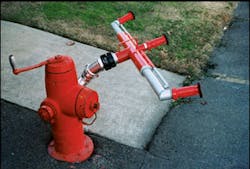
Emergency decontamination can be accomplished with equipment carried on apparatus for firefighting and rescue operations. Aerial master streams with adjustable nozzles can be put on wide-angle fog patterns and sprayed toward the ground, creating a decon shower. Nozzles can also be placed on the discharge ports of engines. Commercial devices also are available specifically for emergency decontamination. Such devices provide a wide spray pattern for mass decontamination. They can be attached to a ladder pipe on an aerial apparatus or a discharge port on an engine, or hooked directly into a hydrant to free apparatus for other functions.
Removing Clothing
The first step in technical or emergency decontamination of victims is to remove their outer clothing. Most of the contamination will likely be on the clothing of victims. Once removed, clothing and other personnel belongings should be bagged and marked for later disposal upon consultation with health and environmental officials.
Removing outer clothing of victims, while reducing the hazard, raises the question of privacy. Victims may be children and or adults. Provisions need to be made so that victims are segregated by age and gender. Children will be apprehensive of the decon process and the removal of outer clothing – the younger they are, the more apprehensive they may be. In some cases, children may be allowed to participate in some stages of decon, such as rinsing one another with a hose. Letting children participate in the decon process can greatly reduce the chaos and make the situation seem fun while accomplishing the task at hand.
Privacy for victims can be accomplished in a number of ways. Most fire department companies carry tarps of various sizes. With a little pre-preparation, procedures can be developed to use tarps in combination with ladders, fire apparatus or natural features at the site to provide privacy screens. For example, the Seattle Fire Department has developed a procedure for setting up a privacy corridor using an aerial ladder extended straight out. Tarps are hooked to the ladder with pre-fabricated hooks. The base of the tarp is held in place with a hoseline.
Commercially available tents and decon trailers can also be used to provide privacy. Once the decon process is complete, victims will need to be covered with some type of temporary clothing. Paper clothing is available, as are hospital gowns and scrubs. Plastic trash bags with holes cut for head and arms can also be useful.
Tarps and plastic sheeting can be used to help control runoff from emergency decontamination. However, the number-one priority is the decontamination of victims; if personnel and equipment are not available for controlling runoff, then it should not be a concern at that point. Victims should always take priority over property or the environment.
Weather can provide challenges for responders for both emergency and technical decontamination. Cold weather climates are a particular problem. Ice can form from runoff, creating a dangerous fall hazard for responders and victims. Cold climates also present an exposure problem for victims, particularly during emergency decontamination. If heated water is available, it should be used during cold weather, but responders may have to be creative. Decon tents and trailers are usually outfitted with water-heating capability. Pools and make-shift emergency decontamination lines usually do not have heated water available. Water-heating decon devices are available commercially independent of trailers or tents, but they can be expensive.
If you are in a cold climate, you need to make some provision for heating decontamination water. The Anchorage Fire Department in Alaska has developed a dry-decontamination process for cold weather to use on personnel who have been exposed to vapors or gases. This process makes use of positive-pressure evacuation fans that blow vapors and gases off of protective equipment. Personnel are then assisted with undressing and protective clothing is bagged for evaluation or disposed of if the PPE is disposable.
Decontamination can present many challenges, but they can all be overcome with the proper planning, training and equipment. Every fire department large and small should be able to conduct an effective emergency decontamination with equipment already available.
Robert Burke, a Firehouse® contributing editor, is the fire marshal for the University of Maryland. He is a Certified Fire Protection Specialist (CFSP), Fire Inspector II, Fire Inspector III, Fire Investigator and Hazardous Materials Specialist, and has served on state and county hazardous materials response teams. Burke is a veteran of 26 years in fire and emergency services, with experience in career and volunteer departments. He has attained the rank of lieutenant, assistant chief and deputy state fire marshal. Burke is an adjunct instructor at the National Fire Academy and the Community College of Baltimore, Catonsville Campus, and the author of the textbooks Hazardous Materials Chemistry for Emergency Responders and Counter-Terrorism for Emergency Responders. He can be reached at [email protected].