Apparatus Manufacturers Discuss Multi-Purpose Units
Editor's Note: Firehouse Staff Writer Ed Ballam covered this article in the November issue of Firehouse Magazine and for the November edition of the Firehouse Limited Edition Tablet app.
There was a time when parade apparatus was king in fire stations, but that’s not the case any longer. Today, function over form is far more trendy as the economy makes it hard to justify bells and whistles.
Multi-function do-it-all apparatus is trendsetting as is apparatus that is high quality that will last longer than a normal budget cycle as departments are now forced to consider keeping vehicles longer than normal.
A quick survey of several apparatus builders shows that departments today are looking for small apparatus that can handle more than one mission.
Representatives from Darley, E-ONE, KME, Pierce, Rosenbauer, Smeal and Spartan ERV were asked to see what fire departments want when they’re in the market for apparatus.
Darley
For W.S. Darley & Company, trends are often set by the company rather then followed.
In fact, Peter Darley, the executive vice president for apparatus for Darley, said his company is "a niche builder."
"The way I look at it, whatever we go out and promote is what we are successful in," Darley said.
For Darley, the company, that means copolymer bodies for the fire and emergency vehicle industry through its PolyBilt division and compressed air foam systems through its Odin Foam division.
The continuous mantra of doing-more-with-less so many departments seems to be chanting these days, Darley said he’s noticed increases in the number of units being sold with CAFS.
Along those same lines, Darley said there’s been an uptick in the number of mini pumpers being sold recently. He attributed that to the increased gross vehicle weights now being offered by Ford on its F-550 cabs and chassis, a popular platform for apparatus
"With the increased GVWRs, we can put a lot more on them," Darley said, noting it is possible to spec a smaller apparatus and still meeting the National Fire Protection Association’s (NFPA) requirements for firefighting.
"Departments are saying; ‘We have to economize on some things." Darley said, noting that a PolyBilt body on an F-550 makes for an inherently lighter vehicle upon which more firefighting equipment can be installed or carried. The small apparatus can still have sufficient pumps and tanks to provide firefighting capabilities, especially when CAF systems are added.
Mini-pumpers can also carry extrication equipment and SCBAs, Darley said, making them truly versatile apparatus, Darley said.
Darley said, like other builders, his company has seen requests for more pumper/tankers as well as quints, proving departments are looking to consolidate vehicles and reduce fleets.
He cautioned, however, trying to stuff too many functions into one vehicle might make it too big and cumbersome.
"Operating an apparatus as all three may not be the best answer," Darley said. "It could really make the apparatus too big.
E-ONE
Alan Hollister, E-ONE’s northeast regional sales director, see a trend of downsizing, particularly with rural and volunteer fire departments that are having challenges staffing apparatus, particularly during the day time.
To meet that challenge, Hollister said fire departments are looking to combine apparatus to do more than one thing, like rescue/pumpers, pumper/tankers and quints.
"They want to combine more activities into one apparatus," Hollister said, noting that it’s not unusual to have a pumper with an 1,800-gallon tank with "a fairly significant hose bed" giving the department more options.
When it comes to aerials Hollister said the vast majority are quints, whether they’re 75-foot, 100-foot ladders or 100-foot platforms, he said.
In Northeast cities, Hollister said he’s seeing a slightly different trend in that departments are not going the route of rescue pumpers. Rather, they’re not carrying rescue tools at all he said. Cities now want lower hose beds, a bit of water and some compartment space for hydrant kits, rapid intervention team equipment, hi-rise packs and that’s about it. "They’re strictly city trucks," Hollister said.
Another trend, particularly in rural communities is for mini-trucks based on Ford F-550 cabs and chassis, he said, adding the mini apparatus can be fitted with up to 300-gallon tanks, 1,250-gpm pumps and even compressed air foam systems (CAFS).
The small trucks have the advantage of being able to get into tight spaces with some serious fire power, Hollister said, noting that even the smaller capacity cab can be an advantage when departments are having difficulty staffing larger apparatus.
On the other end of the spectrum are custom E-ONE 80-inch extended cabs that are popular with some departments that have large volunteer staffs and large budgets to afford "no expense spared" apparatus. There are far fewer of those kinds of customers, but they do still exist.
Most departments are looking for short wheelbase apparatus of which E-ONE’s eMAX apparatus is particularly suited.
"Customers want apparatus that’s a short as you can get," Hollister said, noting that the eMAX apparatus has a smaller pump house and more compartments than traditional apparatus.
Even rescue apparatus has undergone a transformation to have the combination of walk-around access and walk-in capabilities for command centers, Hollister said, noting that some rescues even have pull-out sections like recreational vehicles to provide more space without increasing the wheel base.
Larry Daniels, Hollister’s colleague with E-ONE, is the company’s southeastern regional sales director. He too has seen trends in his region.
Departments need compartment space more than ever before and Daniels said E-ONE answered that request with the eMAX apparatus.
Ironically, in his region, Daniels said he’s seeing a bit of an uptick in the number of custom cabs and chassis being sold over the commercial cabs and chassis.
"It may be a bit of a strategy," Daniels said. "Many departments are running a longer replacement cycle, say from a 12-year cycle to a 20-year cycle." By getting a custom cab and chassis, they are getting closer to what they want and something that is better quality because they’ll have to live with it longer.
Fire departments are also shopping for financing options and ways to save money with purchasing options, Daniels said. Customers who do save money with tax exempt loans often put the saving back into the purchase price so they can "buy more features.
And most often lately, those extra don’t equate into bells and whistles, just more "no-nonsense" features, like LED 12-volt scene lighting and other essential equipment.
Safety never seems to go out of fade and lately, it’s been growing with departments moving to apparatus with airbags, lower hose beds and options to keep firefighters firmly on the ground, including technology that can control the deck gun remotely.
"Many departments are designing apparatus with a low concept so they don’t have to climb on them for anything."
Heading into the future, Daniels said he believes the apparatus market will be flat for the next couple of years, but there will be some continued growth for E-ONE because of aggressive marketing and good products.
"We’re looking at some nice growth into the future," Daniels said.
KME
When it comes to combining functionality of apparatus, Phil Gerace, KME’s director of sales and marketing, says KME has a number of products that offer unique versatility.
For example to meet a trend in the market, KME combined Type I and Type III apparatus to give customers true urban interface, as well as giving the departments ability to respond to wildland fires as well as some structure fires with the same apparatus.
"We have seen an increased demand for multi-function units," Gerace said. "Departments are trying to combine apparatus, particularly rescues and pumpers." To meet that demand, KME developed its PRO series apparatus, something the company is calling a better multi-purpose response vehicle.
Going hand in hand with the need for multi-purpose vehicles is the need to make better use of storage space on apparatus, Gerace said.
"There’s a trend toward using every available square inch of space for equipment," he said, noting that dunnage areas are now far more organized and utilized and even backboards are given space on apparatus where it’s available.
Gerace said there’s been a trend to make apparatus shorter overall with smaller pump panels and mitered corners to provide a little more clearance. To go along with shortened apparatus, KME has been working on cramp angles to make apparatus easier to maneuver – even aerials.
Safety never goes out of style and Gerace said truck committees are looking at all aspects of safety.
"When you look at it, people are getting hurt getting in and out of cabs," Gerace said. "So, we’re making lower steps to get in and out of the cab."
Hose beds are also lower than ever with firefighters wanting to make sure they avoid injuries, especially to the back.
Gerace said not only is KME making lower hose beds, they’re making a system called Lock and Load hose bed where the hose bed slides out on a tray then reloaded and placed back in the apparatus.
KME is also making apparatus with discharges and intakes only on the officer’s side of the rig, keeping all the hoses away from the pump operator completely, something NFPA has been trying to have happen for a long time.
As for the future, Gerace is certain safety and versatility will be trends for the long run.
Pierce
Pierce Manufacturing has tried to meet the market’s demands with versatile apparatus, said Tim Smit, Pierce’s national sales manager.
"The new big is little," Smit said of the trend to compact apparatus that can perform a number of tasks. "Customers are looking for more versatility with apparatus. They want one piece of apparatus that can do it all."
Pierce developed its PUC configuration to create a small apparatus overall with a pump that’s under the cab and a small pump control panel. The result, according to Smit is a very maneuverable apparatus with an increased amount of compartment space made available by the relocation of the pump.
Gone are the days of 10-person cabs, Smit said. "They just don’t need them," he said. Departments do, however, need comfortable room for those occupants who do ride in the rigs and departments need room for EMS equipment, he added.
Pierce’s Dash CF cab and chassis meets that need and provides plenty of room for the new norm of three to four firefighter crews, plus some EMS equipment as needed.
Smit said departments are more and more frequently asking for idle management technology, not only for green initiatives, but for maintenance reasons. Whenever the main apparatus engine can be shut off, emissions are reduced as is problem with soot build up in the apparatus’ expensive exhaust systems, he said.
Pierce has developed a system using lithium ion batteries that can power most all the critical functions of an apparatus, like lights and cab air handling. The batteries will last five to six hours with a 150 amp load – plenty to run warning lights and LED scene lights.
Like many other manufacturers, Pierce has seen a rise in popularity with rescue/pumper apparatus as well as quints which are the most popular aerial these days, Smit said.
"There are not as many niche apparatus as there once was," Smit said. "We see a lot more function in apparatus."
Choices in financing have become a shopping point for apparatus purchasers too, Smit said, noting that departments want to consider financing and leasing as they make apparatus purchasing decisions.
"People are looking for more function and less frills," Smith said.
Rosenbauer
Rosenbauer’s Vice President of Sales Scott Oyen said fire departments are looking at mid-range apparatus and are content getting slightly smaller engines, with a few less horsepower, to save money while still getting adequate performance.
The company also says customers continue to be interested in rear-mount pumpers. Customers are also asking for electronic controls and multiplex apparatus. Electronic over hydraulic controls and valves have gained popularity as well. The company has seen an evolution into more technologically advanced vehicles as the "Nintendo" generation firefighters come up through the ranks.
Mike Harstad, Rosenbauer’s aerial product manager, said "the joystick" generation has come to expect that mechanical devices must work with lots of technology and they have come to expect it.
"Technology is available in industry and agricultural equipment and it’s being adopted for the fire industry," Harstad said. He added that "envelope" technology that monitors all aerial functions and helps keep the operator within safe operation parameters.
"People now understand it more and expect it more than the old guys," Frederickson said.
Oyen said combination pumper tankers are very popular, particularly in rural communities.
"They find themselves having to do more with less," Oyen said, adding that virtually all departments everywhere find themselves in the same boat.
Fire departments are also asking for more green technology, according to Rosenbauer, which has met the challenge with Green Star, an idle reduction system that shuts down the engine and runs electrical systems with a backup generator system.
Ergonomics are also very important with customers these days and Harstad said there’s been a lot of interest in Rosenbauer’s aerial command seat. That provides a place for the aerial operator to sit adjacent to the aerial device and to swivel and pivot with the turntable and the aerial device for better comfort and visibility.
There’s also a lot more thought about steps and grab rails as fire department recognize the need to keep firefighters safe as they operate on apparatus, said Oyen.
Departments are paying more attention to compartments and equipment mounting as a way to save space and to be more efficient.
"It’s been big in Europe for years and it’s slowly moving this way," Oyen said of the effort to better utilize compartment space with swing out shelves and slide out trays. Heavy items are now finding homes in apparatus in low spaces to help prevent back injuries and falls.
Frederickson said departments find themselves weighing what they want with what they can afford which means the huge diesel engines are shrinking and becoming more realistic to the mission of the apparatus.
"We still do custom pumpers, but most of them are more realistic for the mission," Frederickson said, adding that departments still want their Federal Q2 sirens and aluminum wheels regardless what the economy might dictate.
Moving forward, Oyen said he believes there will be a lot more rescue pumpers in service in the future as the fire service shifts from fire suppression to emergency medical services.
"A traditional fire engine devotes 50 percent, or more, to fires when only five percent are really fires," Oyen said. I see a shift to more EMS/Rescue applications in the future."
Smeal
At Smeal Fire Apparatus, trends seem to have some regionalism, said Jeff Wegner, a regional sales director for the company.
In the Northeast, for instance, Smeal’s RPT, which stands for Rescue Pumper Tanker, has caught on.
"It’s a do-everything kind of truck," Wegner said, noting that one was recently sent to Waretown, N.J. that’s 45 feet long. "It has lots of compartments, dump valves, rescue tools and there are a number of those kinds of truck out there.
Wegner said that kind of truck is gaining popularity because departments want to "do a little more with less."
To make "do-it-all" apparatus, it can sometimes take a little creativity and Wegner said Smeal is willing to customize anything to make it work for the customer.
"If you have an idea and we can design and build it, safely, we’ll do it," he said.
Safety and quality are always in style and they continue to be trendy these days, Wegner said, noting that Smeal decided it wasn’t going to make cheaper apparatus just because the economy was soft.
And the customers seem to have responded, he said, noting that because departments might have to keep their apparatus 25 to 30 years, firefighters don’t want to compromise quality.
"They might not know when they are going to get funding again, so they want to get the best truck they can so it will last," he said.
By adding foam systems and CAFS, departments are also concerned about making tank water last as well. Wegner said as much as 80 percent of all apparatus built by Smeal had some form of foam system on board and far more than ever were CAFS.
As the technology has become more accepted, CAFS is also being more accepted and becoming almost commonplace.
And of those apparatus with foam systems, as many as 50 percent of those have some sort of automated refilling system designed to keep firefighters off the tops of apparatus, especially to hoist heavy foam pails.
Carrying on with the theme of keeping firefighters safe, Smeal has seen an uptick in interest in its EZLoad hose bed that simplifies hose loading and keeps firefighters with both feet on the ground.
Moving to the future, like other builders, Wegner anticipates a wider acceptance of electronic and technology to control apparatus. There was a time when the electronic pressure governor was a novelty, but it’s widely accepted now, Wegner said noting it’s virtually impossible to order mechanical throttles today from just about any builder.
Wegner said he believes technology will continue to gain influence in the fire apparatus market and predicts even more moving into the future.
SpartanERV
Departments want lower cost apparatus and that’s a fact driven by the economy, said Bill Doebler, vice president of sales for SpartanERV.
"They want more cross functionality," Doebler said. "They want to be able to do more for less."
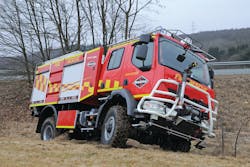
At trade shows this year SpartanERV was displaying a new wildland concept vehicle based on a Renault Gimaex 4x4 off-road vehicle. It was a very different vehicle and Doebler said it was interesting to take in the "wide range of reception" the vehicle got from firefighters.
"They were saying if you gave me a little more water, or a little more wheelbase or something, they said they would use it for a rapid intervention vehicle or for structural fires," Doebler said. From that he figured a trend in the market place is toward all-wheel drive vehicles that were small, yet could deliver a punch if necessary.
"A Gimaex apparatus with CAFS would be a big help, especially since there’s such a restriction on manpower we see today.
Doebler said he thinks fire departments are taking a hard look at what they have and what they need and then deciding what they can afford before they go to market.
In some cases, he said apparatus manufacturers that have units available for immediate delivery are often getting the order, Doebler said, noting that some departments are so far behind schedule on apparatus replacement, they are forced to move into the market because their engine collapsed and they need something now.
Fire departments are also looking seriously at green technology and SpartanERV is looking an idle reduction product to catch that trend. Doebler said it will be based on a Kubota diesel engine power plant that would shut down the apparatus’s engine after 90 seconds of idling to take over the electrical systems.
Doebler said safety is always in vogue and that’s a trend he sees continuing. Departments are now accepting electronic stability control devices for improved handling and safety.
Departments are also looking at the real costs of ownership and considering maintenance issues and quality, trends he predicts will continue into 2013.
"The way we’re going now, we’re going to see more safety and green initiatives," Doebler predicted.
About the Author

Ed Ballam
Ed Ballam served as associate editor for Firehouse. He is the assistant chief of the Haverhill Corner, N.H. Fire Department, and a National Registered EMT. He is also a Deputy Forest Fire Warden for the New Hampshire Division of Forests and Lands. Professionally, he's been a journalist for over 35 years working for a variety of publications, including employment as managing editor of a national fire service trade journal for more than a decade.