New York Chief Stresses Training After Plane Crash Response
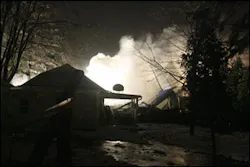
When Continental Flight 3470 tumbled out of the sky, it slammed into a modest home in Clarence Center, N.Y.
The plane came down in Fire Chief David Case's childhood neighborhood -- just over 700 feet from the town's volunteer fire department.
The impact of the crash killed all 49 people aboard, and one man inside the home. The plane and the house were a blaze of fire and debris. The combination of destruction, death and fire created a situation unlike any that Case or his crew could have ever imagined.
Case spoke about his department's response to the crash at FDIC in Indianapolis this week. On Wednesday, he told a full audience just how his department handled the huge task of fighting the fire, handling the mental and emotional strain and dealing with the onslaught of media and federal agencies. He spoke exclusively with Firehouse.Com about the crash, and about his class at FDIC.
Tackling the Flames
Although they had never prepared specifically for an incident of this magnitude, Case described a department that was cool, calm and organized.
"Was this something we trained for?" he asked, "No. Was this something we were prepared for? Yes."
Case said he was at home when the call came in at 10:20 p.m. on Feb. 12. Immediately, he began planning what needed to be done. As soon as he got on the scene, he set up incident command. He sent out a search and rescue crew to see if there were any survivors who could have been blown away from the crash site. Meanwhile, the crash's close proximity to the station meant firefighters were getting there in no time, ready to be put to work.
"The engine pulled up, training kicked in," he said.
Case said the scene was chaotic at first, with confused and upset neighbors screaming. However, his crew was composed and methodical. Teams were assigned tasks, those tasks were completed, and the teams reported back to him to let him know they were completed. Police arrived quickly and helped keep the area around the incident secure.
Despite the fact that flames from the crash scene were shooting 70 feet in the air, Case and his crew kept the fire isolated -- neither of the homes on either side of the home that was hit was burned.
"We followed incident command to the letter, there was a lot of teamwork," he said. "There were no individuals, only one fire company."
Crews were faced with several challenges fighting the huge fire. They were told to treat the area as a potential crime scene. That meant they had to handle things more delicately than they usually would. There were also added risks. He told of one particularly stubborn patch of fire that they couldn't get to completely go out. Even though they were told that gas in the home had been turned off, it wasn't, and there was a gas leak causing the flames. Additionally, when the crash first happened, firefighters didn't know how many people were on the plane, nor did they know how much fuel was in it.
The Mental Toll
Although training meant this crew was physically able to handle the fire, Case said he knew that the response was taking an emotional toll as well.
When crews arrived on the scene that dark and cold night, all they saw was the tail of the plane and the huge flames.
"When you see that big tail sticking out, it puts a whole new perspective on things," he said.
And in the following days, when the sun came out and the smoke cleared, there was more to see. It was hard seeing the aftermath of the crash, but Case said it was almost as if he and the other firefighters had some otherworldly help as they navigated the site scene.
"I never get the right words to describe the feeling. It almost felt as though we were being guided. You were kind of orchestrated by a conductor. You knew what it was, but you blocked it out."
Once the fire was completely out, the next task was the removal of the bodies. Case made the decision that his firefighters had had enough -- they would not be taking part in that.
"It would have ruined us," he said.
The town had rushed to support firefighters -- local clergy came to the station, restaurants offered food around the clock and a masseuse even offered her services -- but Case knew that his department had already seen enough. His firefighters range in age from 18 all the way up to some in their sixties. Case said after already working about 12 hours straight, removal of the bodies might be too much for some.
Even now, Case says that he has seen a difference in his department. "We are a lot closer family than we were," he says.
The department had a mandatory stress debriefing immediately after the incident so that they could talk and see how fellow department members were doing after the incident. They have had several optional debriefings since then.
Working with Others
Working on an accident of this magnitude meant that the department had a lot of people working alongside them. There was the NTSB, the FBI and local law enforcement agencies, just to name a few. However, Case said they were all able to do their jobs with little to no friction.
"They as agencies respected the job we did as firefighters," he said. "There were no turf wars, nobody came in thumping their chest saying 'this is mine, get out'"
On the scene, everything that was done, every agency that arrived, had to go through him first. He said a representative would approach him, he would send them back to the fire house, and then have another firefighter retrieve them when the time was right.
There was also the matter of mutual aid. Case said that because it had already been established, and because they often train together, things went smoothly.
"We knew what was coming, we knew what they had. Training with other departments is vital."
The Takeaway
Case said that what he hoped attendees at this classroom session took away from his talk was that -- volunteer or career -- a firefighter is a firefighter. He said his department is volunteer (his "day job" is as a welder), but they were called to act with professionalism, efficiency and organization the night of Feb. 12.
"There shouldn't be any difference between volunteer and career," he said. "Because we don't get paid doesn't mean we were not professionals."
He also stressed the importance of training. He said his crews operated so efficiently that night because they were prepared to act. They knew what they needed to do and did it. And that, Case said, is something every department can do to prepare for whatever unexpected challenge they face.
"You can't train for every possible scenario," he told conference attendees. "But you better be prepared."
Related Stories: