Eyewitness Report: Biloxi, MS - Emergency Response to Hurricane Katrina
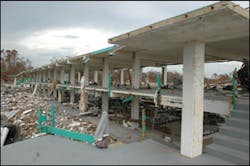
The events of the early-morning hours of Aug. 29, 2005, will long be remembered as the most destructive natural disaster that has ever struck the nation. Prior to the visit of Hurricane Katrina, the 1969 Hurricane Camille had been considered the worst-case scenario in the middle Gulf Coast region. All of the old watermark levels and stories of property destruction pale in comparison to this storm.
The death toll has exceeded 1,000 victims in a six-state area. The economic loss is equally staggering, with preliminary estimates exceeding $200 billion. Many of the communities that have been torn apart are projecting a reconstruction period of two to five years to reach pre-Katrina status.
As the storm passed through the City of Biloxi, MS, the wind had a sustained rate of 150 mph, with gusts reaching 178 mph. Reports indicate that the eye of the hurricane passed just west of Biloxi, placing it on the northeast quadrant of the weather front, perhaps the worst place in terms of destruction.
Once a quiet shrimping village, the City of Biloxi now covers an area of roughly 56 square miles and houses 10 Las Vegas-style casinos, which greatly increases the visitor population. An 11th casino, "Hard Rock," had been scheduled to open on Labor Day, a few days after Katrina hit. Needless to say, the grand opening has been delayed indefinitely with estimates ranging from 12 to 18 months.
David Roberts, fire chief and director of the Biloxi Fire Department, is a 30-year veteran of the fire service. His direct, no-nonsense leadership style has served him well during this career campaign incident. Operating nine fire stations (two of which were flooded from the storm surge), Roberts is charged with protecting about 55,000 residents and over 150,000 weekly guests. Under the leadership of Roberts, the Biloxi Fire Department has once again excelled as a community response agency in its handling of the destruction caused by Hurricane Katrina.
The city operates with a strong-mayor-and-council form of government. Mayor A. J. Holloway is the presiding elected official of the city and is facing his greatest challenge, which is dealing with the results of this catastrophic category five storm. To his credit, the mayor set the overall strategic plan and conveys these goals to departmental heads through planning meetings conducted daily at 8 A.M. Holloway also helped to provide the needed tools and resources for Roberts to complete the tactical mission of returning the community back to as close to "normal" as possible. It has been amazing and a privilege to work alongside Roberts as he restores order to this devastated community.
The Call for Help
When the news reports indicated that the City of Biloxi had been nearly destroyed, I made several attempts to contact Roberts, a close friend and colleague. I wanted to check on his well-being as well as find out whether Atlanta Fire-Rescue could be of assistance to his community. I sent several e-mail messages and left four or five voicemail messages on the first day of the storm. The next day, I tried to make contact using the same methods, but once again to no avail. In the mid-afternoon of Friday, Sept. 2, I finally received a phone call from Roberts. His initial report was quite bleak and shocking, but the good news was that David and his family had survived.
The chief asked for a staffed engine company to supplement his operation and requested that I also respond to help with the command and control of this disaster. In preparation of this and other requests for responses, we identified roles that would be crucial to the mission. The Atlanta Fire-Rescue deployment coordinator, Battalion Chief Chris Wessels, had already developed a roster of interested members who were willing and able to respond to the stricken Gulf Coast. In addition, a detailed plan of supplies and materials was drafted to include the deployment of eight members, as well as Engine 27, to depart for Biloxi on Saturday, Sept. 3, at 7 A.M. I was able to depart somewhat sooner, around 6 o'clock on the night of the request.
It took about eight hours to drive the nearly 300 miles southwest to Biloxi. Although I have traveled the interstate routes to Biloxi many times, this trip seemed eerie, as there were only a handful of cars on the road heading south or west. When I got to Mobile, AL, the first evidence of the wind damage started to appear. The closer that I got to Interstate 10, the greater the amount of trees that were down. In addition, I saw an increase in the number of roofs that had been torn off, as well as large amounts of ground debris throughout the area. Even though the media reported that Mobile had "dodged the bullet" of the westward-moving storm, damage seemed to be widespread through Mobile.
I made a stop at a Wal-Mart in Mobile to pick up needed supplies, fully understanding that Biloxi would not likely be able to provide sleeping quarters, food or water. To my surprise, the store was "locked-down" due to Mobile's dusk-to-dawn curfew. As I walked up to the door, the security guard realized that I was with the fire department and allowed me to enter. I quickly discovered that the store was only open for shelf stocking and for public safety personnel.
When I pulled into Biloxi, I was amazed at what I found. Having been there many times before, I guessed correctly that the Ocean Springs Bridge would not be standing, so I entered off of Interstate 110. The first warning that things would not be normal was that the large sign indicating the exit from I-10 to I-110 was missing. It had been blasted along with thousands of other road signs. Once I exited on to Highway 90 (the main east-west connector), the destruction was unbelievable. The first debris pile that I passed by was about 30 feet high and several hundred feet wide. The next morning, in the light of day, I realized that what I thought was a debris pile was actually a collapsed five- or six-story apartment house.
I will never forget the smell along the oceanfront that night and for the next several days. It was a result of unfortunate people who had lost their lives a few days earlier as well as rotting sea animals left behind from the storm surge. The odor had been greatly intensified due to the baking heat of the Deep South.
The night was very quiet, and the air was still, no breeze at all. The blazing lights of the casinos were missing (as the electricity was off for the entire city) and the ocean was like glass, not even a ripple as the moon shined across the sea. If the water were your only focus, the city would have seemed unaffected, perhaps even peaceful and serene.
I could not help but to explore the casino-row area. What an unbelievable sight! The barges where the casinos were once housed had moved blocks inland and were resting on top of buildings, cars and anything else that got in their way when the water returned to the ocean. These barges were 400 to 600 feet long and 200 to 300 feet wide. The Grand Casino, which was once able to boast of being the largest casino in the area, had been split into two separate barges and moved about a half-mile apart onto the shore.
The energy release and the destruction of Hurricane Katrina were nearly overwhelming. I started back to Central Station, but it was difficult because all of the street signs and familiar landmarks had vanished. As I entered the fire station, Roberts was there waiting for me, even though the hour was very late. He helped me find a spot in an office (as I recall, it belonged to the training chief) to roll out my newly purchased sleeping bag. I was surprised that there were so many firefighters at the station. I would estimate that at least 50 people were sleeping at the station that night and would be for the next few weeks.
Help had arrived from many different locations to help Biloxi get back on its feet: South Charleston, SC; Latimer, MS; Riverdale, GA; and of course Atlanta. Over the next few days, we deployed three engines into Biloxi fire stations to assist for 21 days. Eight members were assigned to each engine company, which allowed a staffing of four members 12 hours per day, seven days per week.
Interestingly, during their off time, our firefighters regularly opted to assist the local firefighters to repair their homes and help their families. This activity just happened and was not scheduled or requested; it was simply firefighters lending a helping hand to other firefighters in need. Seeing the work effort that everyone contributed made me proud to be a part of Atlanta Fire-Rescue and the fire service in general.
Trapped in the Fire Station
As we went about the work at hand, the topic would always surface as to how the various firefighters fared during the storm. It was heart-wrenching to hear of the stories of the total loss of homes and belongings that some firefighters told. One evening, a captain from Fire Station 2 (East End) was kind enough to ride with me to Fire Station 5 (West End) to guide me to the only station that had running water. It may not seem like a luxury, but a hot shower after four days of "garden hose" baths was something that I was greatly looking forward to.
Enroute to Station 5, Captain George Emile described what had happened to him and his crew on the day of the storm. What an experience that he had been through. The recount of those events kept me riveted and put the long-awaited shower into its proper perspective.
The story started at the change of shift that day with the fact that a second platoon was held over to provide additional fire rescue staffing for what would surely be the busiest day in Biloxi Fire Department history. As the double shift of eight members watched the storm slam into the coast, the water level began to rise in Fire Station 2. Everyone in the station was sure that the water would not enter into the building, based on the fact that this brand-new station was built about 10 feet above sea level and higher than the water level caused by Camille. However, at 8:30 A.M., the creeping tide found its way into the "pumper hall" (apparatus bays) and caused the crew to scramble.
Captain David Williams described the fact that all hands were moving quickly to place items out of the reach of the surging water. For a short while, the members believed that they would be able to prevent water damage to the goods in the station and there was very little attention on protecting themselves. The strong belief was that the water level would never be a serious problem to the safety of the members.
At 8:45, Williams called in over the department radio system to report that the water level in Station 2 had risen to their knees. By 9:20, the report was only getting worse in that the water had risen to chest level. Everyone donned a personal flotation device, which the captain described as a "Coast Guard" coat-style preserver. In just a few more minutes, the water had risen above their heads. All the firefighters retreated into a 28-foot Boston Whaler fireboat for a place of refuge from the rising tide. Before the water peaked, the fire apparatus were completely submerged and the boat was the only safe place within the station.
The crew only had a portable 800-megahertz radio to keep in touch with the outside world. The other stations and members held their breath until the words were transmitted that the water had stopped rising. Although the damage was done to the station and the apparatus, everyone trapped in Station 2 and 3 (Station 3 had a very similar experience) was OK.
A funny story did grow out of this nearly fatal event. As the water started to go down slightly, one of the firefighters saw a bright-green-colored dog standing on the roof of a member's pickup truck. As he announced that a "green dog" had made it and was on the roof of a truck, the other members were sure that the sighting was a firefighter gone mad due the stress or a weak attempt to provide comic relief. Either way, no one would believe the person that spotted the "green dog."
Lo and behold, the fact of the matter was that a dog had fallen into the green dye process that shrimp nets are dipped in and swam into the fire station parking lot. At first, everyone was happy that the pressure had not cracked a brother firefighter. The realization of what actually happened was quickly followed by loud and deep laughter, making the situation a bit less stressful.
As the reports continued to describe that the water level had receded to a manageable point, an engine company responded to check on and assist the trapped members. While enroute, Engine 1 was flagged down dozens of times to help citizens who had stayed behind to ride out the storm. The responding crews spoke of disturbing sights of toppled buildings and injured people crawling out of debris piles. "The scene looked surreal and something from a B-rated horror show," Roberts reported.
When the apparatus arrived at Stations 2 and 3 and the reports were that all hands were OK, everyone was able to focus on the tremendous task at hand. For the next six or seven days, all members of the department distinguished themselves as the heroes of the community as they handled the most difficult job of their careers.
There is a lot left to do to report that this incident is "under control." However, with the "can-do" attitude that the Biloxi firefighters and outside responders possess, no task will be too large. I am sure that many reports will be written and evaluations conducted, and that only positive comments will be made about the response that the American fire-rescue service provided. Without a second thought, I am glad that I was lucky enough to have had the opportunity to work alongside of true heroes.
The response to Hurricane Katrina is one of those career incidents that you don't want to miss. The closure to this event was a 14-minute documentary that Atlanta Fire-Rescue produced to honor our brothers and sisters to the south. In fact, another highlight occurred on Sept. 27, when the Atlanta Braves baseball team honored the Biloxi Fire Department by playing the documentary on the "Braves Vision" screen for all of our community to see. In addition, Roberts received a special honor by being introduced on the field just before game time. I am sure that he will long remember his visit to Atlanta.
Dennis L. Rubin, a Firehouse contributing editor, is chief of the Atlanta Fire Department. Previously, he was city manager and public safety director for the City of Dothan, AL. Rubin is a 33-year fire-rescue veteran, serving in many capacities and with several departments. He holds an associate's degree in fire science from Northern Virginia Community College and a bachelor's degree in fire science from the University of Maryland, and is enrolled in the Oklahoma State University Graduate School Fire Administration Program. Rubin is a 1993 graduate of the National Fire Academy's Executive Fire Officer Program and holds the national Certified Emergency Manager (CEM) certification and the Chief Fire Officer Designation (CFOD) from the International Association of Fire Chiefs (IAFC). He serves on several IAFC committees, including a two-year term as the Health and Safety Committee chair. Rubin can be reached at [email protected].