Well-Designed Rigs that Serve Their Community
Key Takeaways
- Building construction, heights, setbacks and points of access in a fire department's response district are crucial considerations during the specification of new firefighting apparatus.
- The purchase of combination fire apparatus, such as rescue-engines and quints, can help in circumstances in which a fire department must reduce the size of its fleet or its staffing level drops.
- Time spent by officers and firefighters early in the process of specifying a new apparatus helps to ensure the delivery of a vehicle that's suited to the needs of the community.
The planning process for new apparatus begins with determining the mission of the vehicle and which design features are needed to achieve that goal. One of the considerations should be the demographics of the response district, including building construction, heights, setbacks and points of access, which could affect apparatus placement and ground ladder requirements. Other considerations are available water supply and the department’s staffing models.
Over the past decade, combination apparatus, such as rescue-engines and quints, became increasingly common. The increasing cost of new apparatus and fleet replacement plans often necessitate a reduction in the size of the fleet or, worse, loss of staffing for separate engine and ladder companies in career departments. No matter what issues organizations face, combination apparatus can’t replace staffing, regardless of how much equipment is carried on the rig.
A move to quints
The Hauppauge, NY, Fire District (HFD) was formed in 1931. Over the years, it acquired a unique fleet of apparatus. That continues today, as the department protects an area that has a population of 21,000 and is experiencing large office and commercial development.
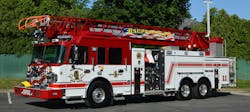
Traditionally, the HFD staffed five pumpers, one truck and one rescue apparatus from three stations, with the headquarters station housing the truck company, a 2010 Pierce 100-foot rear-mount tower.
While the HFD was planning to replace two of the older pumpers because of the building development in Station 2’s and Station 3’s response areas, the officers considered acquiring a single pumper and a quint to enhance their operations. Because quint apparatus would be a different concept, a used American Lafrance LTI 104-foot quint was acquired from Claymont, DE, and outfitted for use by the HFD. The apparatus was assigned to Engine Companies 1 and 3 and utilized alternately to determine the suitability of operating a quint from these stations, which traditionally operated pumpers.
An order for an engine and quint initially was placed with Spartan ER. After a short time, because of the increasing cost and production lead times, the HFD modified the order to have two new quint apparatus built. A preconstruction conference that spanned several days was held to review all pertinent details on the chassis, body and aerial device at the manufacturer’s facility.
Quint 3-8-11 and Quint 3-8-13 were built on a Spartan Gladiator chassis, with a 24,000-lb. Hendrickson Steertek front axle and a 54,000-lb. rear axle with air suspension. They are powered by a Cummins X15 engine and an Allison EVS 4500 transmission.
The chassis utilizes dual auxiliary braking systems with an engine brake and transmission retarder.
The structural steel front bumper protects the front intake components. Side and frontal air bags protect the crew seating for six personnel.
Chassis corrosion protection includes hot-dipped galvanized frame rails and stainless-steel battery boxes and fuel tank.
A 360-degree camera provides views on each side of the apparatus to assist the driver when positioning the vehicle and to enhance safety during operations.
The apparatus have a 238-inch wheelbase, an overall length of 41 feet, 9 inches and a travel height of 144 inches. The rigs carry a Waterous 2,000-gpm pump, a 500-gallon tank and a Smeal 107-foot rear-mount ladder. Tip load is 750 lbs.
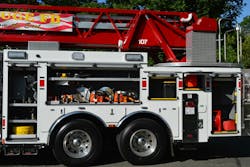
Each quint has three crosslay hosebeds, which include two 300-foot, 1¾-inch attack lines and a static bed of 400 feet of 2½-inch hose. Three hundred feet of 3-inch hose is carried in a rear-body slide-out tray. There’s 800 feet of 5-inch hose for supply line.
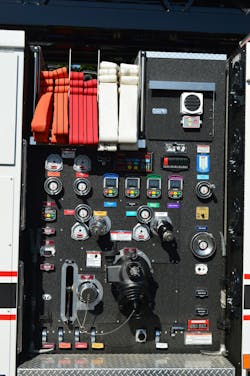
The pump supplies two 2½-inch left-side discharges and one 3-inch and one 4-inch right-side panel discharges. The aerial waterway is supplied by a 3-inch rear-body discharge and a 4-inch discharge. Several discharges are outfitted with flow meters.
When compared with NFPA 1900: Standard for Aircraft Rescue and Firefighting Vehicles, Automotive Fire Apparatus, Wildland Fire Apparatus, and Automotive Ambulances, which doesn’t require any specific ground ladder complement, the HFD quints are outfitted with a 35-foot extension ladder, two 24-foot extension ladders, and two 16-foot roof and two 10-foot folding ladders.
Cab and body scene lighting is provided on all four sides of the rig with 120-volt power that’s supplied by a Harrison 8 kWh hydraulic generator, which supplies two 200-foot 10/4 cable reels and body outlets.
The four-section, 107-foot aerial has a horizontal reach of 101 feet, 5 inches, with an outrigger spread of 16 feet, which enables the aerial device to support the 750-lb. tip load.
The HFD gained experience on quint operations by engaging personnel from large departments that operated quints as well as via training and operating with the used quint, having officers and members from the engine companies become familiar with apparatus placement and operations on the larger units.
Today, the quints operate initially as engine companies when responding in their respective first-due areas and can adapt as needed by the incident commander to provide truck company support at other incidents.
These well-designed rigs will serve the fire district for many years because of the time investment to specify components on the cab, chassis and body to support incidents in the response area.
Hydranted and rural district
Mission-built fire apparatus can be found in many large and small departments, often showing the time and dedication that’s required to develop the requirements for their new rigs. Such was found at the Oxford, MD, Fire Company (OFC).
The community dates back to 1666 as a seaport town and is home to the oldest privately owned ferry service. The fire company was founded in 1927, with the town donating a Ford Model T 500-gpm pumper and hose car. In 1950, the department placed into service a Dodge 500-gpm pumper that had fully enclosed cab seating for personnel and a wet water system, both of which were unique to the area fire service.
Today, the department operates with two pumpers, an engine tanker, a 105-foot rear-mount ladder, two ambulances, a brush truck, a boat and support units.
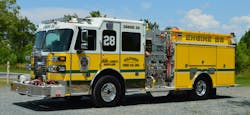
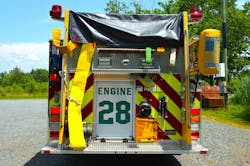
A Sutphen Monarch pumper was placed into service in September 2024 after years of planning and assigned as Engine 28. The rig was built on a 180-inch wheelbase. Overall length is 31 feet, 3 inches; overall height is 9 feet, 8 inches.
The pumper is powered by a Cummins L9 engine that’s rated at 450 hp and an Allison EVS 3000 automatic transmission. The rig includes a 20,000-lb. Hendrickson Steertek front axle and a 27,000-lb. rear axle with a Firemaxx air suspension.
The aluminum cab is 134 inches long and has seating for six personnel. A 24-inch front bumper extension provides room for a 5-inch front suction and 20-inch trash line with hose wells.
A Hale 1,500-gpm fire pump supplies two 2½-inch left-side panel discharges, two 4-inch right-side large-diameter discharges along with three 2½-inch hosebed discharges to support preconnected attack lines. Two 200-foot 1¾-inch crosslays with 2-inch discharges are mounted externally under each hosebed. A 3-inch discharge supplies a deck gun.
A booster reel that’s equipped with 150 feet of 1-inch hose is located on the left side of the apparatus and mounted on the upper portion of the L-shaped 1,000-gallon water tank.
The response area of the OFC includes several marinas and boat-storage structures that present flammable liquid hazards. An Akron Brass 125-gpm foam system that includes a 30-gallon tank was specified, with the front bumper discharge being foam-capable.
The pump panel was designed to make engineer training and operations safe via a combination of direct-acting valve controls for the left-side panel and remote discharges, with electric valve controllers for the large-diameter discharges along with a hand-wheel controller for the deck gun. The front and rear body intakes are equipped with master intake controllers at the left-side panel, with individual primer taps for each intake. The rear intake was mounted low at the right side of the body to permit easy access for drafting and connecting supply lines. Two 12-foot sections of hard sleeve are enclosed in the body and mounted low for safe access without having to climb on the body.
The hosebed accommodates 500 feet of 3-inch hose that supplies a Task Force Tips ground monitor, 1,000 feet of 5-inch supply line, and two preconnected 1¾-inch and one 2½-inch attack lines. A standpipe hose tray is mounted on the right side of the body with the ground ladders above, utilizing a Zico drop-down ladder rack.
Safety equipment that’s utilized on the cab and body includes knurled stainless-
steel handrails, a rear-body intermediate step and a beavertail rear-body extension. The cab and body are outfitted with Whelen scene lighting, including pole lights at the rear of the cab, with a 6.0-kWh hydraulic generator that provides power to a 150-foot reel that’s mounted on the left side, above the fire pump.
Engine 28’s capabilities to operate in both rural and hydranted areas complements the OFC’s other engines, which carry 1,000- and 3,000-gallon tanks and portable drop tanks and other large-diameter appliances.
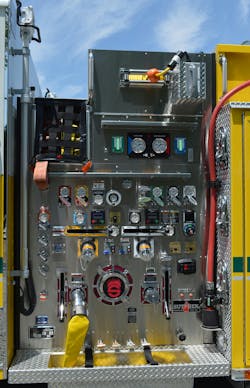
This pumper is a good example of how careful planning in the design process when specifications are developed can ensure that a rig will address the requirements of the department and will be mission-capable when serving in the first-due response district.
Time well spent
The commissioners and officers of the HFD and the officers and members of the OFC should be commended for their efforts to work with their respective apparatus manufacturer to initially design and refine the components and details, which are part of any apparatus build project. Given the high cost of acquisition for new rigs, time spent early in the process pays off at the preconstruction conference and final inspection.
Product Spotlight
Wireless Communications
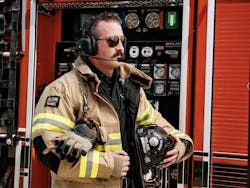
The Setcom LiberatorMAX wireless system is built for fire apparatus crews that demand rugged simplicity and clear communication. The system is designed for pump operators, engineers and in-cab crew comms. There’s no pairing, thus, no confusion. With a simple one-box install and U.S.-based design and assembly, the system delivers superb durability, intuitive operation, and integration with mobile and portable radios.
Bushings and Torque Rods
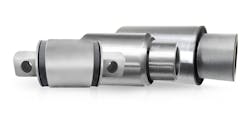
Severe-duty bushings and torque rods from Link Mfg. for Air Link suspension systems are rated between 46,000-52,000 lbs. The bushings feature a proprietary rubber compound and optimized geometry that was developed particularly to extend component life in demanding fire apparatus environment.
Front Steer Axle and Suspension System
The STEERTEK NXT high-capacity fabricated front steer axle and suspension system from Hendrickson now is avaiable on Pierce’s Saber and Enforcer chassis, HME’s 1871 chassis, and E-ONE’s Typhoon and Cyclone chassis. The system utilizes an innovative spring clamp group and a fabricated box-shaped axle that allows a reduction in weight, an increase in performance and added durability when compared with traditional I-beam axles and suspensions.

Product Spotlight
Front Steer Axle and Suspension System
The STEERTEK NXT high-capacity fabricated front steer axle and suspension system from Hendrickson now is avaiable on Pierce's Saber and Enforcer chassis, HME's 1871 chassis, and E-ONE's Typhoon and Cyclone chassis. The system utilizes an innovative spring clamp group and a fabricated box-shaped axle that allows a reduction in weight, an increase in performance and added durability when compared with traditional I-beam axles and suspensions.
HENDRICKSON-INTL.COM
Bushings and Torque Rods
Severe-duty bushings and torque rods from Link Mfg. for Air Link suspension systems are rated between 46,000-52,000 lbs. The bushings feature a proprietary rubber compound and optimized geometry that was developed particularly to extend component life in demanding fire apparatus environments.
LINKMFG.COM
Wireless Communications
The Setcom LiberatorMAX wireless system is built for fire apparatus crews that demand rugged simplicity and clear communication. The system is designed for pump operators, engineers and in-cab crew comms. There’s no pairing, thus, no confusion. With a simple one-box install and U.S.-based design and assembly, the system delivers superb durability, intuitive operation, and integration with mobile and portable radios.
SETCOMCORP.COM/PRODUCTS/SYSTEMS/900-MAX
About the Author
 Tom Shand
Tom Shand
TOM SHAND, who is a Firehouse contributing editor, is a 36-year veteran of the fire service. He works with Michael Wilbur at Emergency Vehicle Response, consulting on a variety of fire apparatus and fire department master-planning issues. Shand is a member of the Firehouse Hall of Fame.
 Michael Wilbur
Michael Wilbur
MICHAEL WILBUR, who is a Firehouse contributing editor, retired as a lieutenant in FDNY, where he was last assigned to Ladder Company 27 in the Bronx. He has served on FDNY's Apparatus Purchasing Committee and consults on a variety of apparatus-related issues around the country. Wilbur is a member of the Firehouse Hall of Fame. For further information, access his website at www.emergencyvehicleresponse.com.