Case Study: Department, Government & Stakeholder Cooperation for Developing a Fire Department Apparatus Fleet
Key Takeaways
- Three levels of priorities for the creation of a fire department that merged three fire companies into one agency included a program for the development of the new organization’s apparatus fleet.
- Reviewing apparatus needs in neighboring jurisdictions aids in a fire department’s consideration of its own fleet needs.
- Changes to a fire department vehicle fleet are better conceived when lessons learned from the maintenance of the exiting fleet are considered.
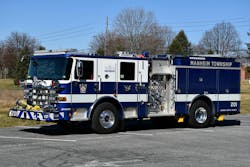
Manheim Township is located in Lancaster County, PA, and covers approximately 24 square miles. In 2020, its population was 43,977. It has a history that dates back to the early 1700s.
In November 2007, the township’s three independent volunteer fire companies that were located in Eden, Neffsville and Southern Manheim met to discuss the future direction of fire rescue services, following up on an earlier study that was conducted by Dr. John Bryan, who was the Program Chair for Fire Protection Engineering at the University of Maryland.
Historically, each of the three fire companies operated independently, with primary funding coming from direct-mail solicitations. Townshipwide, the apparatus fleet consisted of five pumpers, one truck, one pumper-tanker, five squads and numerous support vehicles. Although these resources were more than adequate, there was little standardization with respect to vehicle design, equipment locations and attack line deployment. With the township growth projected to increase, this would place additional burdens on the volunteer force.
Under the direction of Township Fire Chief Rick Kane, a 13-member group was formed, with representatives from each of the three fire companies along with members from the township government and at-large community members, to develop a 15-year strategic plan. The group worked over 18 months to develop numerous draft documents that would encompass the following areas: administration, organization and management, demand for services, fire rescue staffing, response patterns, station locations, apparatus fleet deployment, operational needs, emergency management and EMS.
Three levels of priorities with timetables for implementation were developed to establish the fire rescue system for the township commencing in January 2010. The result of these cooperative efforts was establishing Manheim Township Fire Rescue (MTFR).
Gaining experience
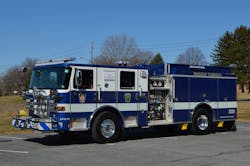
The apparatus portion of the MTFR strategic plan called for the acquisition of four pumpers, which would be outfitted identically, and providing a dedicated spare pumper for use to fill in for scheduled preventative maintenance and repairs. Two mini-squad vehicles would be acquired to provide EMS coverage, thus reducing wear and tear on the engine company units. Existing pumpers in the fleet that were acquired by the fire companies would be replaced with the planned new standardized rigs while retaining Station 204’s 2006 Pierce Dash 100-foot tractor-drawn aerial that was acquired by the Eden Fire Company.
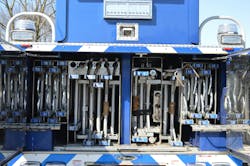
After reviewing pumper apparatus in different jurisdictions, in 2011, MTFR acquired four Pierce Arrow XT pumpers that had an overall length of 29 feet, 7 inches and a wheelbase of 176½ inches. The rigs were outfitted with a 2,000 gpm pump, a 500-gallon, low-profile water tank, a reinforced steel front bumper, a cab downview mirror, a chassis lubrication system and a cab headset intercom for each seating position. Each pumper is equipped with six preconnected attack lines in varying lengths with a 5-inch supply line and a static bed of 3-inch hose.
The MTFR pumpers were designed particularly for structural firefighting responses. This strategy would allow standardized equipment and hoseline locations, which would enhance training and fireground operations greatly.
The experience that was gained from operating these pumpers over the next decade provided the blueprint for newer replacement pumpers that were acquired during 2025.
New tractor-drawn aerial
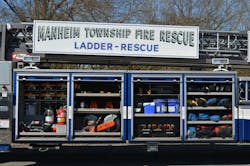
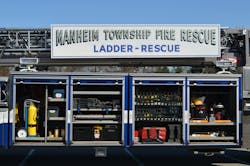
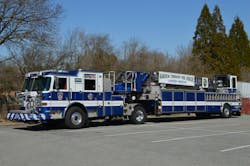
The success of operating a combined aerial/rescue apparatus with Truck 204 resulted in MTFR placing into service a 2017 Pierce Arrow XT 100-foot tractor-drawn aerial that has a trailer that carried a wide assortment of truck company and rescue equipment. The tractor has a 169-inch wheelbase, front bumper-mounted hydraulic rescue tools, a Stokes basket and an array of forcible entry tools within compartments.
The apparatus carries 446 feet of ground ladders, including multiple 16- and 20-foot roof ladders, three 35-foot extension ladders and one 45-foot Bangor ladder.
The aerial ladder was designed with a 500-pound tip load, with a prepiped waterway and outriggers that have a 17-foot jack spread.
The following year, the 2006 Pierce Dash aerial was sent to Pierce Manufacturing to be rebuilt with upgrades to the hydraulic system, compartment layouts, LED scene lighting and corrosion control measures. Like the other MTFR apparatus, the paint scheme matched the distinctive blue metallic and white that are the Manheim Township school colors.
Other apparatus
A portion of MTFR’s response district is beyond hydrant protection and relies on rural water supply for fire operations. Tanker 20 is a 2013 Peterbilt Pierce 3,000-gallon vehicle that’s equipped with a 1,000-gpm pump and rear-body and side-body dump valves.
Other support vehicles include Squad 209, which is a 2012 Peterbilt Pierce walk-in-body unit; Brush 20, which is a 2011 Ford F-550 4x4 Pierce wildland rig; and several utility and command vehicles.
Maintenance
The MTFR fleet of 21 vehicles is maintained by the department’s fleet mechanic, Lamar Sauder, who was the 2024 Spartan/Firehouse Emergency Vehicle Technician of the Year. (Having acquired four identical pumpers in 2011 enabled MTFR to standardize its fleet, and based on the experience that was gained from the design of these vehicles, newer pumper specifications were adjusted based on the lessons learned from these rigs.) Each apparatus is inspected and checked by career personnel daily, with preventative maintenance conducted every three months. Annual heavy preventative maintenance includes third-party testing for the pump, aerial and ground ladders on each apparatus.
Alternative to new
Today, under the leadership of Chief Scott Little, MTFR operates from four fire stations, with the latest, Station 202, opened in the Richmond Square area of the township in 2022. In 2024, MTFR responded to 3,458 incidents, including 181 responses to mutual-aid partners to provide pumper, truck and tanker responses as requested based on a countywide box alarm system.
The department’s career staff includes a deputy chief, and shift captains are supplemented by volunteer members.
Because of the high cost of replacement apparatus, in 2024, MTFR placed into service a Pierce Enforcer pumper that was part of the fleet replacement program and another Pierce Enforcer pumper that was a dealer stock vehicle that was modified to match the department’s standard pumper as much as possible. Engine 201 is a short-wheelbase, 2,000-gpm rig that carries a 500-gallon tank and a low rear hosebed. Its overall length is less than 30 feet. Engine 203 received the stock model rig, with its 184½-inch wheelbase, 1,500-gpm pump and 1,000-gallon tank, which is beneficial for the department’s response district with rural water supply.
Two of the 2011 pumpers were planned to be rebuilt to extend their service life. The first one was completed and assigned to Engine 202 at the Richmond Square Station. The second one currently is undergoing the work at the local Pierce dealership, Glick Fire Equipment, and will be assigned to Engine 204. Based on maintenance records, in-service hours, and cab and body condition, the rigs that had the best history were selected for the rebuilding project, with each apparatus having the work conducted at a fraction of the cost of a new pumper.
What’s ahead
Future plans for the department include standing up a municipal fire-based EMS program, including three in-service medic units with a dedicated spare and chase car to provide townshipwide coverage. This program is slated for early 2027, with staffing provided by a dedicated agency under contract with the township.
Also planned is the replacement for the 2006 Pierce Dash aerial, which will enable the current Truck 204 to go into reserve service.
Collaboration
Over the past years, the cooperation of township officials and stakeholders from each of the three volunteer fire companies accomplished much to advance the level of fire protection to the community. Well-planned and well-executed programs can be achieved—despite what might seem like insurmountable challenges—when fire service personnel work together to achieve a common goal. The MTFR apparatus fleet is just one example of work that can be accomplished when well-developed apparatus specifications and fleet-management practices are backed with financial support from the community for the benefit of everyone.
About the Author
 Tom Shand
Tom Shand
TOM SHAND, who is a Firehouse contributing editor, is a 36-year veteran of the fire service. He works with Michael Wilbur at Emergency Vehicle Response, consulting on a variety of fire apparatus and fire department master-planning issues. Shand is a member of the Firehouse Hall of Fame.
 Michael Wilbur
Michael Wilbur
MICHAEL WILBUR, who is a Firehouse contributing editor, retired as a lieutenant in FDNY, where he was last assigned to Ladder Company 27 in the Bronx. He has served on FDNY's Apparatus Purchasing Committee and consults on a variety of apparatus-related issues around the country. Wilbur is a member of the Firehouse Hall of Fame. For further information, access his website at www.emergencyvehicleresponse.com.