Budget- & Time-Friendly Fire Department Apparatus Purchasing
Key Takeaways
- By the providing the availability of base models, numerous makers of fire apparatus give fire departments a way to take delivery of rigs more quickly and to incur a lower price than is the case with more-custom vehicles
- Even when a fire department opts to specify a pre-engineered, base model vehicle, they can request relatively minor custom design aspects that suit their operational and response needs.
- Minor customization that recently was been provided on pumpers for two departments included additional hosebed dividers and pump panel labels to match other units in the fleet.
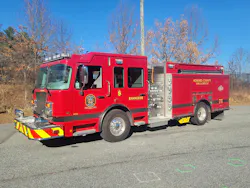
The phrase “necessity is the mother of invention” often is attributed to the Greek philosopher Plato from his work “The Republic,” where he espoused his thoughts on the vision of a society where decisions are based on using creative effort to solve a problem. Over the years, innovation often occurred when the existing practices or norms weren’t capable of meeting the needs of the community. From a manufacturing perspective, this occurred during World War II, when virtually all industrial production was organized to provide materials to support the war effort, including the conversion of automobile manufacturing to build military aircraft.
Today, fire apparatus manufacturers are innovating to solve two big problems: cost to customer and delivery time.
Program apparatus
The fire apparatus industry is working through an all-time production backlog for new vehicles.
This has resulted in double-digit increases in acquisition costs, partially because of material cost increases and the effect of the Environmental Protection Agency’s new engine emissions requirements for 2027.
The contract cost for a new apparatus is a combination of material costs, production hours to build the vehicle, engineering burden and overhead for the facility. Because of the extended build times, several manufacturers no longer offer a fixed-price contract. This leaves a fire department responsible for significant changes in material costs beyond those that are based on change orders.
In addition, when conducting preconstruction meetings for additional units, departments that developed particular designs for their apparatus based on response district and maintenance history have been advised that previously offered configurations or components no longer are available because of engineering effort or the effect on production schedules.
An example of how the apparatus industry has moved to meet individual customer needs was observed at a recent preconstruction conference. A change order was entered to provide a standpipe hose rack positioned above the right-side body compartments. The ensuing discussion resulted in at least 15 options for this one item, each with an associated design and cost.
Fully customized apparatus costs have risen above the point of being affordable in some instances. As a result, several apparatus builders of all sizes offer program apparatus that are designed and engineered at the factory level based on the most frequent configurations and built to meet a price point and to minimize production time. These base model vehicles have limited pre-engineered options. This allows departments to choose a configuration that most closely meets their needs while determining the final cost for the unit.
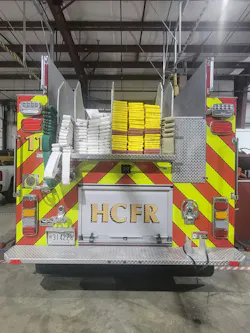
Further, base models, aka program apparatus, generally offer more rapid deliveries, because there is no preconstruction conference; the initial contract configuration is exactly what is built with no change orders.
Fraction of the cost
The Howard County, MD, Department of Fire and Rescue Services (HCDFRS) operates from 14 fire stations. In 2025, the agency responded to more than 44,000 calls for service. With plans to build an additional station, the department’s Bureau of Logistics has endeavored to provide a well-designed fleet of apparatus while working through the extended build times for vehicles that, in some cases, approach four years since initial contract. Several strategies have been utilized, including having frame rail replacements on pumpers on which the cab, body and drivetrain were in good condition as well as acquiring base model pumpers from Fouts Fire and Seagrave.
Two Seagrave TB50CA 1,500-gpm pumpers were placed into service by the department as Engine 91 and Engine 141. Each of the pumpers is outfitted with a stainless-steel body, a low rear hosebed, a front intake, a trash line and a front bumper that is steel reinforced.
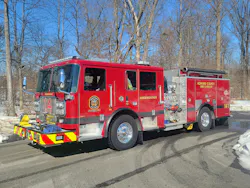
Three Fouts Fire pumpers are built on a Spartan FC-94 chassis and have a 181-inch wheelbase and an overall length of 32 feet, 3 inches. They currently are assigned to Engine 11, Engine 61 and Engine 71. (One of the rigs is expected to be reassigned to the training academy after three additional new pumpers are delivered in 2027.) The vehicles are equipped with a 1,500-gpm pump, a 1,000-gallon water tank, a 172-inch-long aluminum body, roll-up shutter doors and enclosed ground ladders.
Working with the local dealership, the HCDFRS had a number of local modifications made to the cab, chassis and body to make the units more compatible with other pumpers in the fleet. The modifications included transmission reprograming and adding front suction with swivel; a cab engine mounting plate; turn signals at the rear of the cab; a rear-body 2½-inch discharge; hosebed dividers; a cab brow light; floating hose trays; and poly rub rails. Pump panel labels were changed to match other units in the fleet; the same goes for Opticom emitter and radio equipment.
These pumpers enabled the department to provide new apparatus to enhance the fleet at a fraction of the cost of fully customized vehicles.
Base model with options
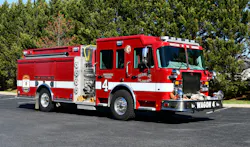
Another example of acquiring a program pumper occurred in Winchester, VA, where the Shawnee Volunteer Fire and Rescue Department (SVFRD) operates two pumpers and two medic units. It is one of four stations that are staffed by the Winchester Fire Rescue Department. Replacing a 29-year-old pumper, which previously was rebuilt, was problematic because of the extended lead time and associated costs. After reviewing several options, including a newer used apparatus, a Fouts Fire program pumper was ordered with several options to meet local needs. Assigned as Wagon 4, the vehicle includes cab and body-mounted equipment. The pumper also has crosslay and rear-body hose configurations that are laid out to match other units in the fleet.
Immediate delivery possible
Available program pumper apparatus design varies from manufacturer to manufacturer. Some of these are available for immediate delivery and might be the answer to address your fleet replacement issues.
Product Spotlight
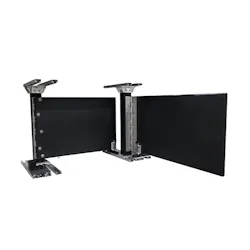
Swing-Out Tool Board
Innovation Solutions’ Swing Out Tool Board maximizes storage and accessibility on emergency vehicles via durable polymer construction that’s built for demanding environments. Easy-to-mount boards securely hold tools in place using a rugged, hinge-and-latch system—available on the board or as a standalone kit. Designed through the company’s Build and Ship program, each board can be customized to the customer’s specifications and delivered ready to install.
Generators
Harrison Hydra-Gen PTO generators provide fire apparatus with dependable onboard power without the need for separate portable units. Utilizing the vehicle’s transmission PTO, the generators deliver stable electricity for lighting, ventilation, rescue tools and other essential equipment. With flexible, weatherproof, remote-mounted electrical boxes and capacities as much as 50 kW, the systems enable faster deployment, extended runtime and reliable performance when power is needed immediately.

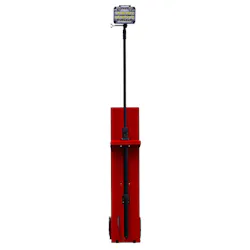
Roof-Recessed Pole Lights
Command Light’s new roof-mounted, 43- or 63-inch telescoping pole lights stow below the roofline, while nesting the LED low on the apparatus during transit. When fully extended, the pole lights reach 63 inches or 100 inches, respectively, to provide elevated, directional lighting. A variety of high-lumen LED fixtures, for as much as 40,884 lumens of light (depending on LED), are available.
Product Spotlight
Swing-Out Tool Board
Innovation Solutions’ Swing Out Tool Board maximizes storage and accessibility on emergency vehicles via durable polymer construction that’s built for demanding environments. Easy-to-mount boards securely hold tools in place using a rugged, hinge-and-latch system—available on the board or as a standalone kit. Designed through the company’s Build and Ship program, each board can be customized to the customer’s specifications and delivered ready to install.
FMICO.COM/PRODUCTS/TOOL-BOARD-SWING-OUT
Generators
Harrison Hydra-Gen PTO generators provide fire apparatus with dependable onboard power without the need for separate portable units. Utilizing the vehicle’s transmission PTO, the generators deliver stable electricity for lighting, ventilation, rescue tools and other essential equipment. With flexible, weatherproof, remote-mounted electrical boxes and capacities as much as 50 kW, the systems enable faster deployment, extended runtime and reliable performance when power is needed immediately.
HARRISONHYDRAGEN.COM/PTO-SHAFT-DRIVEN-GENERATORS
Roof-Recessed Pole Lights
Command Light’s new roof-mounted, 43- or 63-inch telescoping pole lights stow below the roofline, while nesting the LED low on the apparatus during transit. When fully extended, the pole lights reach 63 inches or 100 inches respectively, to provided elevated, directional lighting. A variety of high-lumen LED fixtures, for as much as 40,884 lumens of light (depending on LED), are available.
COMMANDLIGHT.COM/TELESCOPING-WORK-LIGHT
About the Author
 Tom Shand
Tom Shand
TOM SHAND, who is a Firehouse contributing editor, is a 36-year veteran of the fire service. He works with Michael Wilbur at Emergency Vehicle Response, consulting on a variety of fire apparatus and fire department master-planning issues. Shand is a member of the Firehouse Hall of Fame.
 Michael Wilbur
Michael Wilbur
MICHAEL WILBUR, who is a Firehouse contributing editor, retired as a lieutenant in FDNY, where he was last assigned to Ladder Company 27 in the Bronx. He has served on FDNY's Apparatus Purchasing Committee and consults on a variety of apparatus-related issues around the country. Wilbur is a member of the Firehouse Hall of Fame. For further information, access his website at www.emergencyvehicleresponse.com.