The Evolution of Two-Piece Engine Companies & Combination Apparatus in the Fire Service
Key Takeaways
- The Syracuse, NY, Fire Department’s (SFD) revised strategy for its engine companies in the mid-1970s proved to be very effective, and departments from across the United States traveled to Syracuse to review operations and apparatus designs that were associated with the SFD’s two-piece engine company concept.
- In the late-1970s, staffing issues prompted the Rochester, NY, Fire Department to deploy nine quint-midi companies. The rigs were staffed with four members on the ladder and two on the midi-pumper and handled minor incidents, to save wear and tear on larger quint apparatus.
- Following American LaFrance’s introduction in 1979 of 75-foot quint, other apparatus makers, including Ladder Tower, Pierce Manufacturing and Seagrave, added such rigs to their product line.
Note: Full coverage of Firehouse's 50th Anniversary
Dating back to the era of horse-drawn steamers and hose wagons, it was common for engine companies to operate with two units to supply fire streams at structural fires. As motorized apparatus replaced the horses, some departments continued to operate two-piece companies. These consisted of a wagon and a pumper, using primarily 750–1,000-gpm rigs and five- or six person staffing. Following World War II, two-piece engine companies were prevalent in departments, including the departments of the District of Columbia, the city of Los Angeles and New York City, with each adapting operations to meet its needs.
In the period of the War Years during the 1970s, when civil unrest resulted in heavy fire activity, the two-piece companies frequently split, with additional staffing to increase the number of units that were available for responses. Over time, the budgetary effect of operating and staffing two-piece companies in large departments caused changes in apparatus deployment and alarm assignments.
The District of Columbia Fire Department operated two-piece engine companies until early 1992, but in the heyday, all 33 engine companies operated with a wagon and pumper using rigs that were built by Hahn, Peter Pirsch and Ward LaFrance.
Historically, the National Board of Fire Underwriters recognized the importance of hose wagons and two-piece companies when it reviewed municipal fire defenses. A 1922 report for the city of Syracuse, NY, included recommendations for an additional hose wagon to be paired with existing engine companies along with establishing a new ladder company.
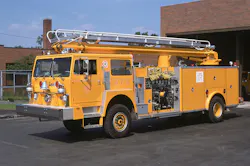
The Boston Fire Department operated five double-pumper companies. These units were assigned two fully staffed engine companies as well as 11 companies that were assigned a pumper and hose wagon. Several 1947 Mack Type 85 hose wagons were outfitted with a booster pump, a 150-gallon tank and two Eastman deck guns. Several of these rigs served into the early 1970s and weren’t replaced until 1979 with Ford C-8000 Sutphen units that were equipped with a 1,250-gpm pump and a fixed heavy stream appliance. These wagons were paired with 1970 Hahn 1,250-gpm pumpers for two-piece engine companies that served into the early 1980s.
During the 1970s, several departments, including those of Syracuse and Rochester, NY, introduced two-piece companies, although each department used widely different operational procedures to address increasing fire activity.
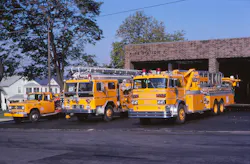
In February 1973, Syracuse Fire Department (SFD) Chief Thomas Hanlon III unveiled a reorganization of the department that entailed building seven new stations to address aging firehouses that dated back to the horse-drawn era.
Over a few years, each engine company was assigned a mini-pumper that was built on an International chassis and was equipped with a 300-gpm pump, a 200-gallon tank, two crosslay hosebeds, a pump manifold, a remote control 500-gpm monitor and 3½-inch supply line.
The minis operated with maxi-pumpers that were outfitted with a 2,000-gpm pump, a 500-gallon tank, four crosslay hosebeds, a 50-foot Telesqurt, a Rapid Water system, and fixed and portable heavy stream appliances. The rigs were outfitted with automated pump controls from Fire Research Corp. in conjunction with the SFD’s training division.
The department's fleet at that time consisted of 11 pumpers, 6 trucks, and squad and rescue companies, with a first-alarm assignment that provided a response of 26 personnel plus the district chief.
The use of two-piece engine companies proved to be most effective. Departments from across the United States traveled to Syracuse to review the SFD’s operations and innovative apparatus designs.
During Hanlon’s tenure, the SFD acquired at least 58 new apparatus along with innovations, including remote control hydrant valves, automatic nozzles and Rapid Water-equipped pumpers.
A little farther west, during the late 1970s, the Rochester Fire Department (RFD), which was under the leadership of Chief Leonard Huether, reorganized to address staffing issues. This resulted in the deployment of nine quint-midi companies that were supplemented by eight engine companies.
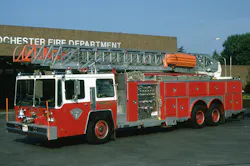
Unique among department apparatus fleets, the Rochester Maintenance Shops produced 30 apparatus for the RFD, including several GMC 630 model open-cab pumpers and seven Mack B model 1,000-gpm pumpers, all of which were designed and built by Deputy Chief Louis Vogt. These rigs were complemented by tractor-drawn and midship aerial ladders that were built by Peter Pirsch.
The first two quints to enter service in Rochester were built by Ward LaFrance and included 100-foot Maxim rear-mount ladders. These prototype rigs were followed by what would become the standard configuration: an E-ONE Hurricane tandem-axle chassis that was equipped with a 110-foot aluminum ladder, a 1,500-gpm pump and a 300-gallon tank. The quint midi companies were staffed with four personnel on the ladder and two on the midi-pumper. They handled minor incidents, to save wear and tear on the larger quint apparatus.
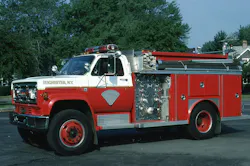
The RFD’s engine company apparatus during this time consisted of a mixture of American LaFrance 900 series rigs, which were built with an aluminum treadplate roof to accommodate a Stang gun, and Ward LaFrance units.
The midi-pumpers were larger in size than the SFD’s minis, having a two-door cab commercial chassis and equipped with a 1,000-gpm pump, a 500-gallon tank, two crosslay hosebeds and full height body compartments. The RFD quint-midi deployment system remained until around 2008, when the department transitioned back to a traditional engine truck operation, which took several years to fully implement.
As a result of magazine articles that covered the changes at the RFD and the SFD and the effect on their operational procedures and fireground tactics, a number of departments took notice, with a resulting increase in the number of mini-pumpers and quints that were placed into service. The fire apparatus industry took notice and began to offer different models of these vehicles.
Along the way, combination apparatus, including quints, rescue-pumpers and other variants, entered the marketplace.
Fleet adjustments based on calls
In 1976, FDNY recorded more than 400,000 incidents, responding to more than 153,000 fires, including a substantial number of arson-related fires. Fire duty in busy companies was near an all-time high. Engine Company 45 handled about 7,800 runs; Ladder Company 124 handled more than 4,000 incidents.
Although these numbers are staggering, for a six year period, Engine Company 82 in the Bronx was the busiest FDNY engine company, answering more than 9,000 runs in 1968.
This level of fire activity was similar in other larger cities and created deployment problems to handle the increasing number of calls and working fires.
Although many departments retained a traditional approach, using heavily staffed engine and ladder companies, the effect of reduced funding in financially strapped municipalities increased the need to adapt vehicle fleets to meet these needs. Larger departments continued to utilize both tractor drawn and rear-mount aerial ladders, in addition to a variety of mid-mount tower ladders that were being produced by the apparatus industry.
One of the first manufacturers to address the quint concept was American LaFrance, with the introduction in 1979 of a single-axle, 75-foot vehicle that was built on a pumper chassis and typically equipped with a 1,500-gpm pump, a 500-gallon water tank and a small complement of ground ladders. Other builders, including Ladder Tower, Pierce and Seagrave, added these short wheelbase, 75-foot aerial quints to their product line.
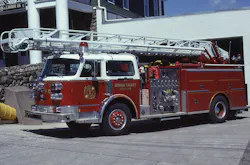
In some cases, these 75-foot quints were placed into service as engine companies that provided aerial capability. Others embraced the quint concept for use as a ladder company, providing enhanced fireground functions.
Apparatus life cycles
The chassis component technology of the time limited the gross vehicle weight ratings for the front and rear axles, with some units experiencing overweight conditions and poor braking and handling. This was similar to the initial acquisitions of mini-pumpers in Syracuse: Because of the availability of commercial chassis weight ratings, the first two units, with their steel body construction and fixed components, proved to be overweight.
Few departments have the opportunity to acquire prototype apparatus to discern the capabilities of vehicles. However, in Syracuse, after two years of front-line service of the busiest engine companies, future vehicle specifications were modified to provide for aluminum body material, changes in the front bumper layout and removal of one of the two booster reels.
Over the years, the anticipated life cycle for fire apparatus was 20 years, which probably was rooted in some of the National Board of Fire Underwriters recommendations. Fortunately, where vehicle fleet replacement programs were developed with adequate financial support, some departments are capable of replacing front-line apparatus at 10 or 15 years. One thing that hasn’t changed over the past 50 years is that apparatus life cycle benchmarks require a combination of well-developed specifications, enhanced preventative maintenance and testing programs as well as station crews that take care of their units, providing regular daily and weekly inspection practices. As is the case in many areas of fire service history, “what is old is new again.”
About the Author
 Tom Shand
Tom Shand
TOM SHAND, who is a Firehouse contributing editor, is a 36-year veteran of the fire service. He works with Michael Wilbur at Emergency Vehicle Response, consulting on a variety of fire apparatus and fire department master-planning issues. Shand is a member of the Firehouse Hall of Fame.