Wildland Fire Apparatus: A Different Kind of Response Vehicle
Key Takeaways
- The large investment in a wildland rig that’s configured, for example, to respond over rough dirt roads is misguided when the department isn’t likely to encounter much of that type of terrain in its jurisdiction or to travel to rugged areas to join other agencies in an attack on a wildfire.
- Changes to pickups from the Big Three automakers in the creation of a wildland rig must be considered in terms of whether the changes will void the warranty on the vehicle.
- Space for firefighters’ personal gear, inclusion of communications tools so members can speak with their family, and data systems to read email, use mapping software and upload/download incident action plans go a long way in making an assignment that takes those people away from home for days or weeks more tolerable.
Note: This article is part of the Firehouse 2026 Fire Apparatus Supplement. To read the entire supplement, click here.
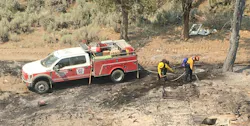
The vehicles that we use to respond to and suppress wildland fires have changed significantly. The complexity of who responds contributes to those changes. Previously, state and federal land management agencies in many states handled a vast majority of the wildfire response. However, now more than ever, local fire agencies handle the initial—and even the extended—attack on wildland fires.
Furthermore, you can’t look on any social media platform and not find an example of a local fire service organization that sent apparatus and personnel to other states for long-term assignments.
The response itself
Sending people, equipment and supplies generates a whole host of positives. There also are some potential negatives.
Experience is a huge plus for the personnel and the community who those people serve when back at the home front. Incident command system experience that those members might not get ordinarily within their response district prepares the personnel and the agency for when that moment strikes.
The negatives? The rigs that are configured for wildland response became more costly to build and to maintain.
When we look at the apparatus that are used to suppress wildland fires in the past, in many places, wildland engines were labeled with a land management emblem on the side door.
Then, in the 1980s and 90s, fire service organizations began to gain equipment and apparatus either from direct purchase or the Federal Excess Personal Property (FEPP) program and other such programs. However, in the past 25–30 years, agencies began to direct-build their own style of wildland engines. Some meet a standard; some don’t.
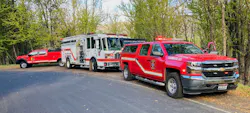
In general, we ask these rigs to be multifaceted. One minute, the vehicles are used to respond to a medical call, the next to a structure fire and the next to a vegetation fire. They must be large enough to transport personnel and all of the equipment that can be stuffed into every compartment, but they must be more comfortable than the models that were used in the past. Yes, they can include every flashing light and noise makers of every kind, but budgetary constraints can’t be overlooked.
Meet the need
Will the rig be used on the home front, or will it be sent to assist others in conjunction with reimbursement from the requesting agencies? Is an initial-attack, long-duration fire support vehicle desired or something simple that’s relatively inexpensive but, perhaps, costly to maintain? Is the desire to park lots of water on the side of the road or to pump and roll (think: tactical, shoot and move)? Must the apparatus be packed like the circus clown car or must it be designed to be comfortable for the crew?
For example, it makes no sense to buy a $400,000, beefed-up Type 6 wildland engine to run it on medical calls over the pavement of a city. With tires that are designed to be used on the rough dirt roads in the wildland fire environment, eating through an almost $3,000 tire in six months is ineffective and inefficient. However, departments across the country do just that.
How about the capability to have fire-camp repairs? Often, when you roll into a fire camp of an extended attack situation, the on-site mechanics have access to many of the common break-down items for quick repair and turnaround. However, when you roll into camp with a crazy, out-of-the-norm build, you might need to wait a while on a repair, because the mechanics must secure premium parts. In addition, some mechanics have clear directions not to won’t work on certain build-ups because of the potential litigation of out-of-the norm designs. Not being qualified to make certain repairs puts them in a precarious position, and they don’t want liability.
When the intent is to send the unit out of district to support others, look at what other organizations do. There’s a reason why most state and federal land management wildland fire programs are very selective on who builds, what they build and how they build it. They typically want wildland engines to last 7–10 years and around 70,000 miles before they put them to surplus and provide them to a local fire department through the Rural Fire Readiness Program and other such programs.
Whether an apparatus will be built for home or away, those who are involved in its specification should strive to meet the NFPA standard. The simple rationale: It’s a standard for a reason. Numerous departments across the United States have been sued after a rig was involved in a crash. One key question that’s been asked: To what standard was the apparatus built? The next question often is, “Was the vehicle being used for what it was intended?” The next two standard statements by the plaintiff’s attorney typically are, “Show me the maintenance records” and “Show me the personnel training records.”
Build your own
Many fire service organizations have carried out a remount of a vehicle apparatus only to suffer litigation because of poor execution of the project.
Some insurance companies aren’t aware that remounting a vehicle that served a different purpose to now be a pumper is a thing. They simply want to know the name of the chassis manufacturer and how much you paid for it.
So, is there a vendor that can help you to do the remount? If so, how much are you able to spend?
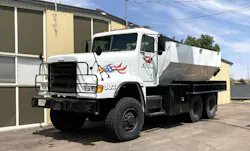
Numerous fire service organizations successfully secured used military vehicles for all sorts of unique fire apparatus designs. That said, one design for the military is much different than a converted use to a water tender. How and who is building/welding that attached water tank? Exercise caution in this manner. Many agencies have had catastrophic incidents that involved tender rollovers, burnovers and motor-vehicle crashes.
If you explore the remount idea, will the chassis meet the box configuration from a previous apparatus? How much tooling must be done to make it work?
Make sure that you secure extra parts that aren’t of the norm, so when there’s an issue, you don’t have to scramble to find replacement parts that might not be original equipment.
Trying to find some obscure driveline yoke can cost a lot more in the long run than anticipated, particularly when you ask for a rush on shipping.
Common pitfalls
When you specify a wildland apparatus, some common sense and themes must be considered in advance and not be an afterthought.
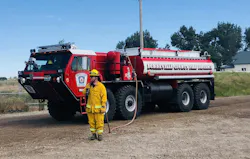
The welds on pump-piping from excessive vibration as four $3,000-a-piece tires rattle your kidneys while driving to another state are going to crack and break. As for those 42-inch tires: Keep in mind that there probably won’t be room for a spare and you could be stuck in the middle of nowhere and must wait 3–5 days for a tire. Yes, being towed off of a mountain is an option, but because it’s an oversize vehicle, you’ll be charged an “oversize fee” on the tow bill.
The capability to drive faster than 55 mph absolutely will be hindered by those tires, too.
How about those electrical gremlins that your builder swore wouldn’t be a problem? When they start to pop up like there’s no tomorrow, will you have to park your fancy, look-like-a-bad-ass rig for six months in the shop, with no capability to respond to calls?
How about that cool, $30,000 suspension that was an after-market buildup? Can it cause you a bunch of problems, including because it voided any warranty that you thought you had from Chevrolet, Ford or Ram?
These are real problems that must be considered before you use the vehicle for responses other than those that were intended. The Big Three automakers have very clear warranty rules about what they’ll repair when major changes to a vehicle’s design are made. Further, in the current market of fire apparatus builders, asking them to repair items in the design flaw brings its own problems after having waited 1–4 years for the apparatus to be built. (Many of the long-timers who are in the fire service have watched costs for apparatus skyrocket to unbelievable prices and unrealistic wait times. Did you request and sign for a new rig in 2022, and now it’s 2026 and you still haven’t seen it? “Houston, we have a problem.”)
Little things
As you begin the process of looking around to see what others are doing or driving down the road for on- or off-district wildland fires, ask them the difficult questions. Many will tell you what’s working and what isn’t.
When you begin to look for a builder, search the internet to see who’s taking care of their customers and who got suckered into a bad buy. Strive to make the vehicle meet a standard.
If the rig is going to make long trips, put in some creature comforts for the men and women who are stuck in the cab during those assignments. Ensure that there’s enough compartment space for personal gear, so you don’t look like the Beverly Hillbillies’ ol’ jalopy, with bags held on by bungee straps. Add communication tools, so members can call home to speak with their family and friends. Give the vehicle the data systems to read emails, use mapping software, upload or download the incident action plan, and complete crew time reports and equipment shift tickets. Those little things go a long way for the men and women who are on that rig for 14–21 days while away from the home front.
Be smart
At the end of the day, all that firefighters want is a great apparatus to work on,
to care for and to have pride in. However, if the rig is spending half of its startup in the shop before even catching a vast majority of its calls, then the vehicle’s development and production isn’t the right thing to do on behalf of the firefighters who will respond on it or the citizens for whom it was designed to serve. When it comes down to it, all of us are taxpayers. Be sure to be smart and to be financially responsible.
About the Author
 Bill Arsenault
Bill Arsenault
Bill Arsenault is a 34-year veteran of emergency services. He has been a part of municipal fire services and EMS organizations. After 25 years of service in Idaho, Arsenault was offered the chance to become a part of CAL FIRE and currently works in the Fresno-Kings Unit. He is a graduate of the National Fire Academy (NFA) Managing Officer Program and an NFA instructor, holds numerous International Fire Service Accreditation Congress and National Wildfire Coordinating Group certifications, and has degrees in fire service leadership, wildland fire management and structural fire science. Arsenault is a decorated combat veteran from the U.S. Army.