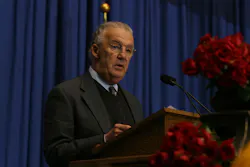
NFFF Pays Tribute to Sarbanes
Former U.S. Senator Paul Sarbanes died on Dec. 6, 2020. Sarbanes paved the way for Congress to create the National Fallen Firefighters Foundation (NFFF) in 1992. Previously, he helped secure the location for the National Fallen Firefighters Memorial in Emmitsburg, MD.
An NFFF statement read, “Paul Sarbanes was a leader and a friend to firefighters in Maryland and across the nation…. NFFF has long honored Senator Sarbanes for his work and commitment to the fire service. The Sarbanes Scholarship Program assists the children, spouses and life partners of fallen firefighters. In addition, the Senator Paul S. Sarbanes Fire Service Safety Leadership Award is given annually by NFFF and the Congressional Fire Services Institute to fire service organizations that promote the health and safety of firefighters.”
NFFF Board of Directors Chairman Troy Markel said, “We will long honor and never forget the unflinching commitment of Senator Sarbanes in making sure our nation’s fallen heroes are remembered and their families are cared for. Firefighters lost an important friend and key ally who had an enormous impact on the fire service.”
For more information on the scholarship program and the Safety Leadership Award, visit firehero.org.
CSU Awards 2020 NVFC Scholarships
The National Volunteer Fire Council (NVFC) and Columbia Southern University (CSU) named NVFC members Maggie Zimmerman of Breckenridge, MI, and Randy Cannon, Jr., of St. Stephen, SC, as the recipients of CSU’s 2020 NVFC Scholarship. Each scholarship covers as many as 60 credit hours toward one of CSU’s online degree programs.
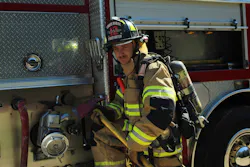

Cannon also hopes to help to train others after using the scholarship to achieve his bachelor’s degree in fire administration. He is interested in starting an Explorers program to guide others into firefighting.
For more information on CSU scholarships, visit ColumbiaSouthern.edu/Fire.
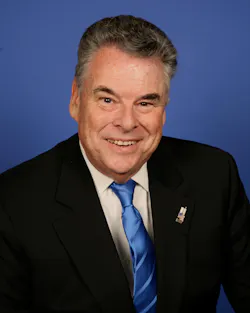
The Congressional Fire Services Institute (CFSI) selected retiring Congressman Peter King (R-NY) as its 2020 Legislator of the Year.
Elected to the U.S. House of Representatives in 1992, King distinguished himself throughout his career on Capitol Hill for his support of public safety, including the fire and emergency services. In 2007, he was named a co-chair of the Congressional Fire Services Caucus. Together with his fellow co-chairs, he has been on the front lines of many legislative efforts in support of U.S. firefighters and emergency services personnel.
King has been a tireless advocate for the Assistance to Firefighters Grant (AFG) and Staffing for Adequate Fire and Emergency Response (SAFER) grant programs and worked closely with fellow members of the New York congressional delegation on passage of the James Zadroga 9/11 Health and Compensation Act of 2010 and the subsequent reauthorization of the program in 2019. He also co-sponsored different measures during his time on Capitol Hill in support of both the career and volunteer services.
“On fire service issues, Congressman King has always been willing to work in the spirit of bipartisanship with his colleagues,” Bill Jenaway, who is the president of CFSI’s Board of Directors. “His efforts have benefited every member of the fire service, from the volunteer and career firefighter,” said.
For more information, visit cfsi.org.
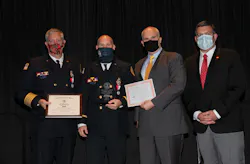
Representatives from STIHL presented the Firefighter of the Year award to Capt. Edward “Woody” Landgrover at the Virginia Beach, VA, Fire Department annual award ceremony. Landgrover, who is a 22-year veteran of the department and has served as a captain for more than 10 years, received a $500 STIHL product certificate in recognition of his service and dedication. STIHL also presented the department training center with two rescue chain saws.
The IAFF and the Firefighter Cancer Support Network (FCSN) designated January Fire Fighter Cancer Awareness Month to “provide firefighters with the tools and guidance to develop life-saving protocols for cancer prevention and to support those who had a cancer diagnosis.”
The month-long campaign will include Safety Stand Downs, training briefs meant to highlight the effects of occupational cancer, and focus on topics of prevention and mitigation. The topics of these briefs include: the scope of the cancer problem, best practices on prevention, leadership tactics to help prevention and skills to help survivors of occupational cancer.
For more information, visit firefightercancersupport.org.
CPSE Offering Technical Writing Program for the Fire Service

New research from the American Heart Association shows that not only are firefighters at increased risk of developing atrial fibrillation (AFib), but the more fires that they fight the higher the risk that they will be diagnosed with AFib, which is an irregular heartbeat that can lead to blood clots, stroke, heart failure and other problems.
According to an article that was written by Laura Williamson and was published in American Heart Association News, Lead Researcher Dr. Catherine Vanchiere, who is an internal medicine resident at Temple University Hospital in Philadelphia, indicates that her team surveyed nearly 12,000 U.S firefighters and found that nearly 5 percent of those who fought 11 or more fires per year reported being diagnosed with AFib, compared with fewer than 3 percent of those who fought no more than 10 fires per year.
Researchers say several factors likely contribute to this statistic: Exposure to toxic materials in smoke, strenuous job duties and emotional or mental stress all tax the body. Symptoms of AFib can include fatigue, shortness of breath and heart palpitations.
The U.S. Fire Administration recommends that all firefighters, regardless of age or health history, talk to their doctor about the risk factors that are mentioned in this research and see whether further screening is recommended.
This Month in Fire History
Jan. 1, 1853, Cincinnati—The first fire engine is tested
Jan. 5, 1985, Erath, LA—Texaco gas plant fire causes $51 million in damages
Jan. 5, 1995, Seattle—Warehouse fire kills four firefighters
Jan. 6, 1961, San Francisco—Thomas Hotel fire kills 20
Jan. 10, 1976, Fremont, NE—Pathfinder Hotel fire kills 20
Jan. 11, 1820, Savannah, GA—Fire damages 463 houses
Jan. 12, 1908: Boyertown, PA—Rhodes Opera House fire kills 170
Jan. 14, 1969, Pearl Harbor, HI—USS Enterprise carrier fire kills 24
Jan. 19, 2017, Tehran, Iran—High-rise fire and collapse kills 30 firefighters
Jan. 23, 2005, New York—FDNY Black Sunday fires kill three firefighters
Jan. 27, 1967, Cape Kennedy, FL—Apollo 1 launch pad fire kills all three crewmembers
Courtesy: NFPA
About the Author
Firehouse Staff
Content written and created by Firehouse Magazine editors.