Combination Departments: A Firefighter’s Point of View
Key Takeaways
- The informality of a combination fire department and the more frequent interaction with leadership that results from that might appeal more to some firefighters who considering a move than to others.
- Firefighters who are contemplating a move to a combination fire department from a career department must consider whether they would be OK with the dynamics that result from volunteers' irregular presence at the station.
- Firefighters who move to a combination department from a career agency must be comfortable with the possibility that standards will be different from that to which they are accustomed.
A lot has been written from a managerial perspective on the unique challenges that are faced in combination departments, but little has been written from a firefighter’s perspective on how these challenges affect the career line personnel who work there.
Combination departments are getting more and more common as overwhelmed volunteer departments look to lighten the burden by adding career staff to their roster.
Maybe you’re looking to start your fire service career, or maybe you’re looking at lateral move to a combination department. Combination departments can have unique benefits over larger career departments, but it’s good to know the ins and outs before you apply to a combination department.
Although no two combination departments are the same, here are some characteristics that I’ve found to be frequently true in the 12-plus years that I’ve been affiliated with these types of organizations.
Informality brings opportunities
Combination departments usually are relatively small in staffing yet still cover a large response area. They usually don’t have the luxury of multiple divisions or dedicated specialty teams that handle unique calls, such as water rescue, rope/technical rescue or wildland firefighting. Often, there are one or two career personnel on duty who lead and/or coordinate the response, with volunteers supplementing the response crew.
Many of you heard the phrase “jack of all trades, master of none.” There’s a lot of truth in this in regard to a combination department. You truly get to experience a wide array of call types.
With combination departments typically being smaller, you’re a person and not just a badge or employee ID number. Frequently, there are opportunities to assist leadership with projects, which can be valuable mentoring opportunities to help to build your experience.
Combination departments tend to be more informal, with officers (even chief officers) sometimes being on a first-name basis, compared with the typically more formal environment of career departments, where people might be addressed strictly by rank. I find that this informality, as well as the more frequent interaction with leadership, has been invaluable to me for preparing for leadership roles, by providing opportunities to “pick their brain” and to see the use of different leadership perspectives and techniques.
Apparatus assignment variety
At a career department, you might find yourself assigned to the same apparatus each shift; at a combination department, you might get to use a variety of apparatus. In my department, a member might respond in an ambulance, a pumper, a brush truck, a water tender or a rescue boat, all in one 48-hour shift. Many people enjoy getting to train on such a variety of apparatus.
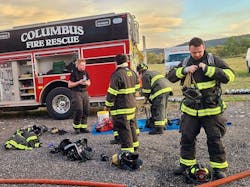
Often, career personnel who work at a combination department are on a fast-track for training as driver/operators, because, often, there’s no guarantee that a driver/operator-qualified volunteer will be able to respond to each call. Career members in combination departments need continual training and refreshing to stay proficient with a variety of apparatus and equipment.
Dynamic staffing
Staffing can be highly dynamic. Many combination departments don’t know exactly how many volunteers they might get to respond from call to call. This is particularly dependent on time of day or weekend versus weekday. This can be a stressor for some career personnel in combination departments.
Sometimes, career staff roll the initial responding apparatus, and volunteer members come in and get other apparatus or backfill the station. Responding to a structure fire with three people, knowing that additional personnel are likely 5–10 minutes out, can be stressful. Others find the challenge a positive thing. I personally like the challenge of it.
Career members in combination systems must know that there might be times that they must “John Wayne” it and safely do what they can until more personnel arrive and more aggressive fire suppression can be performed.
Although you might work with the same crew on each shift at a career department, at a combination department, your coworkers often fluctuate. Sometimes, volunteers come in and spend the day in the station, so you often have no idea who you are working with until you come on shift. This can change even in the middle of a shift, as other volunteers might pop in as they get free time and decide to log some duty time.
Although it’s a good thing anytime that you have volunteers wanting to engage, it can make it challenging for career staff if they are the ones who coordinate that day’s duty crew. Maybe you already planned training that was better for a small group, and you suddenly have three additional volunteers. Maybe you mapped out apparatus assignments perfectly. Maybe you already ran to the store and planned dinner for five people, but now you find yourself with eight.
Again, it’s a good problem to have, but it means that whoever oversees the shift must do some shifting on the fly to adapt to changing personnel levels.
There always is the chance that it throws off shift dynamics, too, whether it’s a personality difference, etc. Career members in a combination department must be flexible thinkers and be able to roll with these sometimes-frequent daily roster changes.
Input matters
One thing that I noticed is that it feels like career personnel are invested more significantly in the department when it’s a combination department. Being smaller, it’s easier to have those one-on-one conversations with leadership, as noted above. There are a lot more opportunities to have both formal and informal discussions when department matters can be discussed. In my experience, I’ve felt significantly more “heard” and that my input matters at combination departments than I have at a career department.
Spotlight on volunteers
One of the trickier aspects for some people is that at combination departments, there often is a tremendous spotlight on the volunteer personnel, while the career personnel tend to operate in the shadows and behind the scenes.
In my opinion, volunteers should be front and center. They are the ones who risk their life and their health to serve their community for no pay or small stipends. For this reason, I have tremendous respect for them.
Career personnel tend to look at this from two angles. Some are OK with this, because they see it as their job to support the volunteers and feel that they’re being paid to be there and don’t really need the “atta-boys” and recognition for simply doing their job. Others find that it grates on them after a while. They see the work that they do behind the scenes to keep the department running smoothly and sometimes feel overlooked or taken for granted, particularly if they believe that the department wouldn’t be capable of functioning if staffed only by volunteers. People who are looking to apply to a combination department should be aware of this dynamic.
Different standards
I don’t really want to say that the standards are lower in combination departments, but let’s be honest, necessity almost dictates that they are. Thus, the personality of the firefighter plays a tremendous role at combination departments. I’ve seen people come from a larger career organization to a combination system and really struggle. One can’t expect the same level of competency at a mostly volunteer department as at a career department. Many aspects are different by nature.
Most volunteers can’t do a full-time, multimonth training academy. Call volume plays a role. A career firehouse that runs 10–15 calls per day is going to be at a different performance level than a combination firehouse that runs 1–2 per day.
Firefighters who go into a combination department and expect the same level of performance that they were used to at their former career department might find it difficult to adjust. Combination departments tend to have fewer policies and procedures, and the policies and procedures that do exist tend to cover essential safety topics.
Rigid thinkers who are used to more “step-by-step” rather than more “goal-focused” standard operating guidelines are more likely to struggle at a combination department.
Training
Firefighters who like to teach tend to integrate well into a combination department. These organizations aren’t places where you come on shift, check out your apparatus and then plop down in a recliner when not running calls.
In addition to maintaining proficiency in a wider variety of apparatus and equipment, many times, the career staff have a very active role in helping to train volunteer members. This connects back to how an ideal combination department firefighter is flexible: That firefighter might have a plan for the day, but then a volunteer or two comes in and wants to do some training. The day’s plan might need to be reconfigured a bit.
Steppingstone?
Sometimes, turnover is higher in combination departments. Many firefighters use a combination agency as a steppingstone to get their foot in the door in the fire service and then move on to a busier career department.
For people who don’t mind the things that are noted above; it doesn’t have to be a steppingstone, it can be a great place to spend your career.
About the Author
 Kyle Starr
Kyle Starr
Kyle Starr is a captain/paramedic with Columbus. MT, Fire Rescue who serves as fire/EMS training officer. He previously served as assistant chief of Red Lodge, MT, Fire Rescue. Starr has been in fire/EMS for 28 years.