MN Firefighter Answers Call to Help During Israeli-Palestinian Conflict
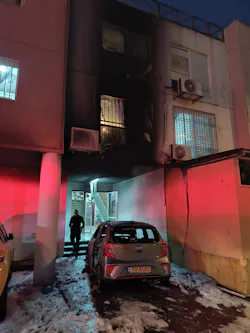
There are times when the fight turns personal. This was the case for part-time Plymouth, MN, firefighter Mike Walstien when he made the decision to travel to Israel to aid the local fire service.
“You know those people are dying because of an act of war. I saw what I saw on Oct. 7, my people being massacred. It was the single greatest loss of life of Jewish people since the Holocaust,” Walstien told Firehouse.com. “I’m Jewish. My wife is Jewish. My children are Jewish. I felt like I had to go help Israel.”
On Oct. 7, thousands of Hamas terrorists burst into southern Israel, slaughtering some 1,400 people in their homes, on their streets and at an outdoor music festival in the deadliest terror attack in Israel’s history. That was the night that Walstien started to search for ways to travel to Israel.
The Emergency Volunteer Program (EVP) was his answer - they sent firefighters, medical professionals, and mass-feeding teams to aid the in-crisis country.
EVP was looking for firefighters who had active experience in firefighting with some years of the job underneath them. Prior to this, Walstien, 48, had been to Israel just two times, once as a kid and once as a part of a military volunteer program.
The call for help came in
The process isn’t as simple as putting people on a plane and getting them to the fire fight. It’s short-notice, off-the-cuff and mainly put on the volunteer to accrue the necessities. On Oct. 17, Walstien received a phone call around 8:30 p.m. letting him know that EVP was sending their second wave of firefighters.
From there, they had a quick conversation with Walstien and let him know they were planning to send him and others out on Oct. 23. Then, they had moved up the already quick turnaround to Oct. 21 due to the expected ground invasion in Gaza. At that point, Walstien had just a few days to get approved time-off from both of his jobs, obtain gear that included seven uniforms, clothes, turnout gear and level three or better body armor, plus the time needed to speak with family.
Walstien and his wife have two kids, and his wife had been on the same page with him before any conversation took place.
“My wife asked me what I was going to do, and I told her I needed to go to Israel. She said that she knew, and asked if I what else I needed,” said Walstien. “I said I know the first thing that needs to be done is that I need to go to Israel, and she said I know, what else?”
On Oct. 21, Walstien and 19 other uninformed volunteers had taken a flight around midnight. Everyone was on the same wavelength of not knowing what they were going to be doing, but that they were there and ready to help by any means necessary. The Israeli government had given all of them letters of approval to bypass any customs agent they may have encountered. The entire process went very smoothly, according to Walstien.
On the ground in Israel
Upon arrival late at night, they were brought to the National Fire Academy and were immediately told where the bomb shelter was located, along with a very brief tour of the facility. From there, it was getting started in just a few hours and they got thrown into the thick of it for 13 and a half days straight.
Walstien roomed with three others in the fire academy dorms, a volunteer firefighter for New York, a captain from Florida and mid-20’s male from Kansas. There was next to no sleep the first night for any of them, as they got up at 6 a.m. to get intel and a breakdown of operations comparative between Israeli firefighting and American firefighting.
After a half-day of training and equipment familiarization at the National Fire Academy, they were sent to their stations. Walstien was a part of a two-person team that went to Hadera, a fire department that covered multiple districts. Other firefighters from his group were sent to Haifa, Jerusalem, Ashkelon, and Ashdod.
Different equipment used
“What I learned is they go to fires with one-inch hoses, small pumps, tiny fire trucks and less than half of the people that we have, and it works just fine....They're about getting the job done,” said Walstien. “We’re looking at these one-inch lines that are essentially a quarter-inch wider than a garden hose and we're like well, what fire are we going to put out with it? The answer: all of them. All of them. It worked.”
Israeli fire trucks have a very simple pump, there’s not a lot of pressure and not a lot of water, however in turn, this allows the fire to be fought for a long time without the need of a connection to a hydrant. Along with that, the turnout expectation for Israel fire departments is 60 seconds. They slept in their uniforms and were never far away from a truck.
In addition, the content of the fires was a bit different from American fires. Most of the construction of buildings in Israel are concrete, steel or cement rooms. Making the fires more containable, and the threat of extension is next to none. Other fires that were dealt with were car crashes, field fires, huge garbage fires and hazmat calls.
However, the biggest fire that Walstien encountered was caused by an LNG explosion at an agricultural facility that created a fireball, something that Walstien had never seen before. Midway through the incident a woman in a pickup truck arrived on scene with bags of shawara sandwiches, cucumber salad and Coca-Cola Zeros for everyone.
While that may have been the biggest fire, one of the most notable events for Walstien during his time in Hadera was when his crew was fighting a fire in the mountains beginning in the early afternoon. The fire had gone on for hours as his truck had run out of water, and a tanker needed to be brought in for more. The scene that followed was movie-like, Walstein recalled.
“We've been fighting this fire for hours. Then the sun was setting. It was beautiful in the mountains and we're fighting this fire. We're determined to turn it over, then I heard the evening Muslim prayers from the city below. Wow,” said Walstien. “It was just one of these moments, I'm looking at Israel, this is multicultural Israel. I'm fighting fire for Israel. The light from the city, the evening prayers over the loudspeaker from the mosque, and fighting fire on a mountain. It was incredible.”
An eyewitness to unity
The atmosphere in such a trying and difficult time was preparedness. According to Walstien, there wasn’t any fear in the Israeli people. They were prepared. With that came hospitality, kindness, and inclusiveness, even with the language barrier.
“The Israeli people are the most warm and welcoming people I have ever met. Everyone you meet is instantly your best friend. The greatest threat to my life in Israel was diabetes, as they wanted to feed me delicious food before, during and after every call,” said Walstien. “I distinctly remember our nation in the weeks following 9/11 - a feeling of unity and resolve. The Israeli people are united. They are dedicated to ensure the safety of their population, and determined to ensure that 'Never Again' is an accurate statement.”
Coming back to the U.S., Walstien had some adjustments to make. Being home with family again was great, his sleep schedule was thrown to the wayside, and the driving speed was significantly lower in America. Out of all it, Walstien doesn’t see what he did as heroic. He was going there to be a firefighter, his job.
“I count these past two weeks as one of the most uplifting experiences of my life. My fellow volunteers from the U.S. feel the same. I will do this again,” said Walstien.
About the Author
 Ryan Baker
Ryan Baker
Associate Editor
Ryan Baker is a writer and associate editor with prior experiences in online and print production. Ryan is an associate editor for Firehouse with a master's degree in sciences of communication from the University of Wisconsin-Whitewater. He recently completed a year of teaching Intro to Public Speaking at UW-Whitewater, as part of his graduate program. Ryan acquired his bachelor's degree in journalism in 2023 from UW-Whitewater, and operates currently out of Minneapolis, MN. Baker, also writes freelances for the Ultimate Frisbee Association (UFA) in his free time, while also umpiring baseball for various ages across the Twin Cities Metro Area.