San Diego Lauds Deputy Fire Chief, 100, who Broke Color Barrier
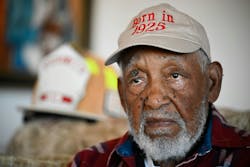
When Ben Holman became a San Diego firefighter in 1951, he wasn’t looking to make history. He was just looking for a good, steady job with an opportunity to advance.
But the fire chief at the time saw Holman as the perfect hire to help racially integrate the fire department, which until that time assigned all its Black firefighters to a single station in Mountain View, a predominantly Black neighborhood. Every other station was manned exclusively by White firefighters.
Chief George Courser told Holman he was going to be his Jackie Robinson in the fire department. He would be the one to break the color barrier, just as Robinson had done in professional baseball in 1947.
He assigned Holman to Station 14 in North Park, where he became the first African American firefighter to bunk down in a firehouse and fight fires next to White colleagues. Soon after, Courser transferred other Black firefighters to stations around the city.
Holman’s long-acknowledged role in integrating the fire service was celebrated anew last month when he turned 100. The mayor and City Council proclaimed Dec. 26, his birthday, as Alwin Benjamin Holman Day. About 100 friends and family members later gathered at a church for his birthday party.
The city proclamation recognized that Holman “made history as the first Black firefighter in the city to be assigned to a station other than Station 19, breaking the color barrier that had long segregated Black firefighters to a single post and paving the way for future generations of firefighters of color.”
Holman “exemplified professionalism and integrity,” the proclamation said, and “served all people equally, without regarding race or background, and demonstrated through his actions that compassion, service, and courage transcend division.”
Focused on the work
When he joined the department, Holman didn’t think much about his color-barrier-breaking role and focused more on doing his job — putting out fires and rescuing people in need. He got involved in the firefighters’ union and steadily advanced in the department. By the time he retired in 1983, he had reached the rank of deputy chief.
As time has gone by, Holman has come to accept his place in history.
“There were other cities around the country that had tried to integrate their departments, and there was all kinds of resistance … not from the citizens necessarily, but from the firefighters themselves,” Holman said. “Some were very, very prejudiced.”
Some deputy chiefs and battalion chiefs protested the move, but Courser stood firm. Holman, at times, had to endure racist jokes and slurs, and got the silent treatment from some.
But, he said, the firefighters he was stationed with treated him as they would any probationary firefighter. “I was accepted by most firefighters, Black, White, green or whatever,” he said.
He said the fire chief told him that if he had any problems, he should come and see him. Holman never did.
He knew it was important he succeed.
“Well, I knew then that if I did not survive, then it would be a long time before the Black firefighters would be accepted,” he said.
Before he was hired, Holman met with the chief several times, answering questions about his life and family, and about growing up in Alton, Ill. In a 2013 interview with the Union-Tribune, he shared how his mother had tried to shield him from experiencing segregation as a child, keeping him from knowing the local drugstore wouldn’t serve Black people by telling him they didn’t need to stop there for a soda since they had cold drinks at home.
Holman’s daughter, Kyra Randall, said her father’s even temper and soft-spoken manner, even when angered, likely appealed to the chief. “My dad is not distracted by external pressure and can easily focus on the task at hand,” she said.
Before coming to San Diego, Holman had enrolled as a pre-med student at Lincoln University in Jefferson City, Mo., but World War II intervened after just one semester. He asked to defer his service but was told the draft board needed him sooner.
After enlisting in the Navy, he was stationed in San Diego in January 1945. He left the military and worked several jobs, including with the post office, before applying to the fire department, which had been hiring Black firefighters since 1919.
Holman liked being a firefighter, liked being the person called upon to help others. On his days off, he looked forward to going back to work.
Looking back on his 32-year career, he wishes he’d stayed a battalion chief, working directly with the rank-and-file, instead of moving higher in the department, where he was tasked with personnel decisions and other administrative tasks.
Money was the primary reason he sought promotions. “I looked at the end of the game. I figured out, you know, when I retire, I want the most money I can get. And so that’s what kind of motivated me to keep moving up,” he said.
Daughter grasped legacy years later
Holman and his wife, Ruby, were married for 71 years before she died in 2020. When asked about his secret for living such a long life, he credits his wife, saying she cared so well for home and family, he never worried about those things when he went off to work.
Randall said her mom frequently visited her dad at his fire stations. She and her brother would go there to hang out after school, playing ping pong and climbing fire poles. The family went on camping trips with other firefighters’ families, enjoying water skiing and outings with the close-knit group.
She doesn’t recall her father ever talking about breaking the color barrier when she was little. It wasn’t until she was an adult, helping plan a workplace luncheon to celebrate Black History Month, that she fully grasped the role he played.
A coworker wanted to invite the local firefighters who had integrated the San Diego fire department, a development chronicled in a video shown on KPBS called “The Men of Station 19.” Randall had heard of the film and knew her father was one of the four firefighters featured, but had never watched it until then.
That’s when she appreciat her father’s legacy. She said she was in her late 30s or early 40s.
Over the years, Holman encouraged other African Americans to sign on as firefighters, and he supported city diversity efforts. He also encouraged his own family members to consider the career. Holman’s late son, Darryl, worked as a firefighter for a while, and a grandson applied at one point. He said he thought his daughter would have done well and advanced in the fire service, but she disagrees — noting she doesn’t like getting up in the middle of the night.
In August 2024, Holman pinned the fire chief badge on Chief Robert Logan’s chest during his swearing-in ceremony. Logan is the department’s 19th fire chief and the third African American to hold the post.
Writing in a LinkedIn post in December about Holman, Logan said he was “constantly reminded that I stand on the shoulders of courageous people.”
The chief said the city proclamation honoring Holman was long overdue. “This means a lot to me because without him, there would be no me.”
©2026 The San Diego Union-Tribune. Visit sandiegouniontribune.com. Distributed by Tribune Content Agency, LLC.