Military Veteran, 41, Finds Second Calling as Bristol, CT, Firefighter
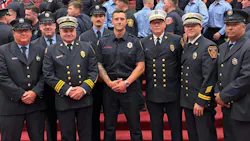
Justin Tomlin has a lifetime of experience in service. The Barkhamsted native served in infantry in the U.S. Army in both Iraq and Afghanistan. He was a Texas State Police trooper who worked on the U.S./Mexico border. And he also served as an officer for the Torrington Police Department.
Tomlin will bring all of that experience to his role as the newest member of the Bristol Fire Department following his graduation from the Windsor Locks-based Connecticut Fire Academy on Wednesday. He was one of 34 other recruits to graduate to firehouses around the state.
“I might as well be an 18-year-old with no experience in life, right? Which is a beautiful thing at the age of 41,” Tomlin said with a chuckle. “And to be able to start in something brand new and continue to learn, I understand emergency services. I understand emergency response, but fire is its own culture. It’s all a job and it’s a whole new thing.”
Tomlin was born and raised in Connecticut. His first job was as an EMT out of high school before joining the military at 23 and lived in Texas for 10 years when he was an infantryman stationed in Fort Hood.
He said he became a Texas state trooper before there was any national awareness of “a border crisis.” He said many of his assignments were in the area of Waco, Texas.
“State police were tasked with providing mutual aid to the border to try to help with the crisis, and a lot of it was rescue and recovery,” Tomlin said. “We would rotate every six weeks to the border.”
Tomlin married his wife Kate, a West Hartford native, when he was still in the Army.
“Once we started having kids we decided to relocate back to Connecticut, and I worked for a few years with the Torrington Police Department. I ended up going to school and earned a degree in homeland security, operational management and emergency management. Around the time of the COVID-19 pandemic, I was offered a position with a health care system in Connecticut managing an emergency management program,” Tomlin said.
He was in that position for a few years, but he said he wanted to get back into the public sector and firefighting really piqued his interest.
“Providing aid to people, there’s nothing like it. There’s no other calling,” said Tomlin, who is excited to be a new member of the Bristol Fire Department. “We only have one shot at life on this beautiful planet, so if you have a calling to help people in a time of need, you better take it. When I turned 40, I wasn’t in that kind of work anymore and it felt like an empty void in my life. You’re capable of doing it and not everyone has that ability to be capable of responding to a crisis. I had to get back to it.”
Tomlin was appointed to a position in January and spent a week at the department similar to an onboarding process before living at the Connecticut Fire Academy for 70 days.
Tomlin said his past experiences in the military, as an EMT and as a law enforcement officer will be helpful to him as a firefighter.
As a state trooper in Texas, Tomlin said he “was on his own island” for many shifts. During his time in Texas, backup troopers are consistently responding but “you have to make you have to be your own boss and make your own decisions.”
“One of the things that I missed after I got out (of the Army) and moved into law enforcement was the camaraderie, the teamwork and the brotherhood,” Tomlin said. “As an infantry manager, you’re never doing something by yourself. You always have a minimum of three or four other guys in a squad or a platoon, and everyone has a specific role within that element. And if anyone doesn’t hold up their end, the whole team becomes weak. Fire is very much like that. You have a truck company, and everyone’s assigned a specific role, and everyone needs to carry their weight and do their role. If you don’t, there’s dire consequences.”
Tomlin said it was that type of teamwork and camaraderie that he “missed tremendously.”
Tomlin said the first month to five weeks of the 15-week fire school was basic types of training. For example, putting a ladder on the side of a building and doing it safely with proper body mechanics without hurting yourself, and learning how to decide how many rungs to extend and placement of the ladders. He said they also learned about using personal protection equipment and using it appropriately in a fast but safe manner. He also learned how to pull a hose off of a truck into a crossway.
“It can almost seem mundane,” Tomlin said. “All of these individual skills need to be done as if it’s muscle memory because your adrenaline is pumping and people are depending on you. While you do that, you have to remain situationally aware of what’s going on around you.”
The second phase of training was applying skills and putting them together in a controlled, clean environment. Tomlin said the third phase “they are putting you in blacked out situations where you are in a building with zero visibility and you have to effectively, safely find someone, without getting yourself lost.
“They’re introducing heat, smoke and some controlled chaos and you are forced to apply those skills and work together as a team and do your job as effectively as possible,” Tomlin said.
Tomlin said they also learn motor vehicle extraction and there is also an extensive physical fitness program throughout the 15 weeks. He said one instructor told him that legs, lungs and grip are critical in doing the job effectively.
“It’s challenging in the right ways, but it’s doable when you follow the instructions,” Tomlin said.
P.J. Norwood, director of training for the Connecticut Fire Academy, said to gain entry into the academy, students first must pass a written test through a series of oral exams and pass the national standardized testing that’s governed by the International Association of Firefighters, and the International Association of Chiefs.
Once those hurdles are cleared, they are hired by a specific department. Then there are background checks and medical evaluations and then they enter the 70-day period living at the academy, which is either 14 or 15 weeks based on the cycle. They check in on a Sunday evening and are dismissed on a Friday evening and live at the academy during that time frame.
Days at the academy start at 7 a.m. in formation and march over the training ground. They do daily maintenance including inventory of equipment and cleaning of the facility. Physical fitness starts at 8 a.m. Depending on the day, they will stay on the training ground and have a full turnout of firefighting equipment until lunchtime.
After lunch, the recruits will be doing hands-on training until 4 or 4:30 p.m. They may also be broken up into smaller stations.
“We build the foundation for them to have a safe career,” Norwood said. “Obviously, within 15 weeks, we can’t give them everything. Some of the days will differ if it’s a classroom day or a physical fitness training. Some days they will have an administrative day in the classroom for eight hours.”
Norwood noted that this class of 35 is smaller than the typical average graduation class of 54 over the last 10 classes. During that time frame, the peak number of graduates was 70.
“It’s cyclical. It really depends on the municipalities, and their hiring cycles and retirement cycles. We had a two- or three-year period of extremely high numbers in the 60s and 70s, and then the last three classes, it’s been down into the 40s and now low 30s. I don’t know what this next fall class is going to be like, that class starts August 30. But traditionally, the August classes are larger numbers because many of the departments work on the fiscal year, so they hire new recruits to start July 1.
Tomlin served as a platoon leader for his class at the Connecticut Fire Academy. He said it was challenging and “quite a bit of extra work” bridging the gap between the instructors and the rest of the class.
“The entire class was phenomenal,” Tomlin said. “I walked across that stage with that group that was so easy to manage and made me look good. They are brothers for life.”
Tomlin said his wife Kate and daughters Ellie and Charlotte were at the graduation on Wednesday in Bloomfield. His parents, his sister and her husband and his in-laws were all in attendance for the ceremony.
Norwood said Tomlin made his mark as a platoon leader and his duties to take care of the day-to-day communications with amongst all of the recruits.
“He was noticed very early within the first few days of the program,” Norwood said. “He was already organizing the group and very quickly rose to the top and he became one of the best platoon leaders that I’ve seen in the past 10 classes I’ve seen at the academy.”
Norwood praised Tomlin’s communication skills and ability to lead by example. Norwood added that he worked “every day to gain respect based on his example.”
“From an administrator standpoint, how well the recruit program ran was because of his service and his role,” Norwood said. “But what I didn’t know until this week is how much his recruits actually cared and respected him,” Norwood said. “In the 10 classes that I’ve been here, we’ve had great platoon leaders. But this is the first time ever since I’d been at the academy as director that every recruit purchased and signed a present to the platoon leader.”
Tomlin was gifted a memorial picket axe that the entire class signed and presented to him at Wednesday’s graduation.
“When you’re in leadership roles, there’s always going to be some people that don’t agree with your decisions and that may not like you for the role that you have, but not with Justin,” Norwood said. “Every single recruit, every instructor that I’ve spoken with, every recruit coordinator, had nothing but respect for him and liked him as a person and for his leadership style. It was pretty remarkable to lead that many people and have every single one of them like him and truly care about him to gift him that memorial axe at graduation.”
Norwood emphasized that Tomlin will be a great addition to the firefighter ranks in Bristol.
“He’s led a life that’s been filled with service leadership,” Norwood said. “We were very proud to have him. We’re very proud of his military service, his law enforcement service and we’re excited to see what he does in Bristol. And I think he’s going to have a wonderful career there. He continues to lead by example. Even as a recruit firefighter, he’s definitely still going to be in a leading role.”
©2026 Hartford Courant. Visit courant.com. Distributed by Tribune Content Agency, LLC.