New Bill Aims to Improve, Expedite Public Safety Officers Benefits Process
When public safety officers have a fatal or catastrophic injury in the line of duty, they and their families are entitled to certain benefits under the Public Safety Officers’ Benefits Program.
The PSOB program is run by the U.S. Department of Justice’s Bureau of Justice Assistance. In 2026, the PSOB benefit per person totals $461,656, in addition to monthly educational assistance of $1,574 for up to 45 months.
But in order to receive compensation, injured officers and their families must prove that the injury or death was a direct result of action undertaken in the line of duty. Lifestyle choices and medical conditions can cause certain cases to be dismissed, leaving surviving families with no compensation.
The rules also stipulate that fatal heart attacks and strokes must occur within 24 hours of nonroutine physical activity to be eligible for benefits, even if they were a result of job-related activity.
For Annette Wilson, these requirements prohibited her from receiving benefits for 10 years after her husband, a fire apparatus engineer for the Madera-Mariposa-Merced Unit, died of a heart attack in 2014.
During an overtime shift, Stephen Wilson responded to a structural fire while complaining of a headache and other discomfort. Wilson’s condition grew worse over the next three days until he passed away due to a cardiac arrhythmia.
But instead of receiving benefits for her husband’s death, Annette Wilson, a Madera resident, was thrown into a legal battle with the PSOB program to prove that the cardiac event began during his shift. After 10 years, she was approved to receive the benefits.
“My husband spent his career running toward danger to keep our community safe,” Wilson said. “He died because of that work, and yet his own claim was denied because of a technicality.”
A newly introduced bill in Congress aims to help injured officers or their families receive the benefits they should be entitled to when they are severely injured or die in the line of duty.
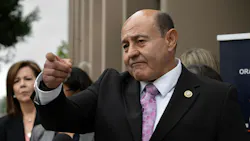
“If those workers put themselves out on the line, then it is only fair that we take care of those workers as well,” bill sponsor Rep. Lou Correa, D-Santa Ana, said. “Where that injury happened is where we need to lay the responsibility.”
The bill would shift the burden of proof away from surviving families. Qualifying events will automatically be covered unless medical evidence suggests the injury was unrelated to service.
“It’s rebuttable,” Correa said about the approval process laid out in his bill. “But nonetheless, it gives the opportunity of the surviving family to have a shot at some reasonable compensation for the death of the working spouse”
In addition to streamlining approval of qualifying events, the bill would extend the 24-hour cutoff for heart attacks and strokes to be covered to 72 hours.
“We’re following precedent that is well established in this country, which is taking care of our workers with just compensation for their families,” Correa said.
The bill — titled the Public Safety Officers’ Benefits Enhancement Act — is a bipartisan effort led by Correa and Rep. Jefferson Van Drew, a Republican from New Jersey.
“When our first responders answer the call, they are willing to put everything on the line for complete strangers,” Van Drew said in a statement. “If the stress of that job costs them their life, their loved ones should not have to battle the government for the support they deserve.”
Ten lawmakers have signed on as cosponsors, including Reps. Mike Thompson, D-Napa, and Adam Gray, D-San Joaquin Valley.
The bill is already endorsed by the National Association of Police Organizations, Federal Law Enforcement Officers Association and the National Fallen Firefighters Foundation, to name a few.
“Almost everybody we talk to has been very much supportive of our measure,” Correa said. “This is consistent with our American values of fair play and honest dealing with our workers. We take care of our workers, we take care of our families, and this is consistent with that value.”
While strong opposition to the bill is not expected by Correa, the fiscal impacts of the bill might lead to some opposing legislators and organizations.
Correa’s office has identified nearly 40 pending PSOB cases in which survivors are trying to prove a heart attack or stroke occurred within 24 hours of nonroutine activity. It is likely these cases, and others, would directly benefit from the bill, Correa’s office said.
The expected payout for families waiting for benefit approval, which could be granted with the passing of this bill, would be $16-25 million, Correa’s office said.
Correa just introduced the bill on Wednesday, July 22, so it is early in the legislative process.
“This is a fairness issue,” Correa said. “This is an individual who died, made the ultimate sacrifice on the job, and this is about taking care of their family.”
©2026 MediaNews Group, Inc. Visit ocregister.com. Distributed by Tribune Content Agency, LLC.