Progress Report
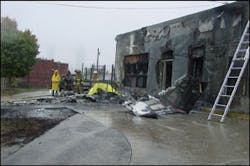
Atlanta, GA, Oct. 19, 2004 – “Fire was flowing down the street for a good 100 to 200 feet,” Captain Tim Norton of Atlanta Fire Rescue Engine 6 said in recounting a fatal crash involving a twin-engine plane. Shortly before 11 A.M., the members of Engine 6 were returning from a fire education demonstration when they saw the plane plummeting toward the ground. As they watched through their rain-spattered windshield, the 1979 Beechcraft Baron plunged nose first into the parking lot of a collision shop located near the Martin Luther King Jr. historical site. “As soon as the plane disappeared below the horizon, a black column of smoke immediately arose,” Norton recalled.
Having just departed a neighboring airport enroute to Florida, the four-passenger plane was loaded with 100-octane fuel. According to the Federal Aviation Administration (FAA), the Beechcraft Baron can carry upwards of 100 gallons of aviation gasoline. Upon impact, burning fuel was strewn across the parking lot as well as the front of the body shop. Ignited fuel flowed into the street, creating a river of fire as it traveled down the gutter. Approaching the scene of the crash, the responding crews were forced to stay on the far-right-hand side of the street in order to bypass the flames. Due to the massive fuel load, a master stream deck gun was immediately deployed to combat the inferno. Foam from AFR Engine 12 was used to hit the hot spots after the bulk of the fire was knocked down.
There are no reports of injuries from the occupants of the building that was hit or from pedestrians on the street. Unfortunately, the two passengers aboard the plane did not survive the crash. Although the members of Engine 6 were on the scene in just under a minute, rescue attempts were unsuccessful due to the extreme fire conditions.
—Bill May
"Hot Spots on the Web"
Send your suggested “Hot Spots” website to [email protected]
This month’s focus: Incident response/management
CDC Emergency Response & Preparedness
CDC resources for health-related emergencies.
DHS National Response Plan
Download the just-released NRP.
EMI Interactive NRP
Responder information, training and more.
FEMA National Incident Management System
References to NIMS.
National Fire Service Incident Management System Consortium
Incident management resources for every type of emergency.
National Incident Management System Integration Center
On-line resources to assist in implementation of NIMS.
National Fire Academy
ICS self-study course in emergencies.
National Incident Fire Center
Wildland fire information and resources.
National Interagency Incident Management System
NIIMS – Earlier version, similar to NIMS.
U.S. National Response Team
Preparedness, response and recovery.
Submitted by
Deputy Chief Charles Werner
Charlottesville, VA, Fire Department
Firehouse® Magazine contributing editor
Firehouse.com TechZone Editor