FHWorld17: The Fire Service Instructor— Leading Change Through Training
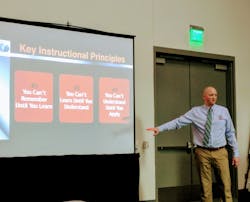
Training is clearly integral to the fire service, but with multiple generations and different learning styles to contend with, how do training instructors and company officers know the best ways to educate their crews? In his Thursday Firehouse World session "The Fire Service Instructor: Leading Change Through Training," Devon Wells—first vice president of the International Society of Fire Service Instructors (ISFSI)—offered ideas for how to reach firefighters in the classroom as well as on the drill ground.
Wells noted that the size of the organization doesn’t matter; there are training challenges for departments big and small. The key is to affect the training officer’s mindset so they can bridge the gap between the different generations and the different training styles.
Step 1, he said, is to identify the challenges at your department. What are the real problems you face? Key to this is being honest about the challenges and where your training may be lacking. Then you must prioritize the identified challenges so you know where to start.
Another early step in the process is to determine what training resources are currently being used. There’s so much available content available via blogs, webinars, podcasts, magazines and conferences. Wells encouraged looking into what your crews are currently using so you can offer some guidance as to whether those sources are providing valuable content that aligns with your department’s priorities.
When determining the best way to approach training for your department, Wells reminded that there will often be issues of scale, regardless of department size. A large metro department may have six training officers—which could sound like a lot for a small department—but if those six people have create consistent, quality training for 3,000 people, there are bound to be some challenges.
Wells then walked through the various types of training: traditional approaches, such as weekly drills and instructor-led classroom training; e-learning opportunities, such as PowerPoints, webcasts and podcasts; and the blended learning approach, which combines the first two. Clearly, there are pros and cons to different types of training. Video game technology adds realism, but it’s not real; e-learning reduces class time, but it also reduces firefighter contact time. So how do you find the balance among the types of training, Wells asked.
Consider how millennials want to consume information: They don’t want to watch a PowerPoint of 500 slides, and if your trainers are stuck to that one mode of training, “you need to kick them loose or make them change,” Wells said. Some types of training, like cognitive-focused training, will work well for an e-learning format like watching a video on an iPad. The firefighters can do it on their own time, and training is consistent. The key, he said, is to “use the technology to your benefit,” because otherwise, you’re going to lose them.
Wells underscored that you must get crews on the drill ground as well. There is no replacement for the real-life, hands-on training, so it’s imperative to find a way to work this into any training program.
Additionally, it’s important that instructors bridge the gap between what they see in training burns and what they see in real life, he said. Consider the current challenges on the modern fireground—larger homes, open floor plans, evolving fuel loads, more void spaces, changing building materials, smaller lot sizes and more. “We’re got to train how we’re going to fight fires today,” he said. And there are many tools to choose from—offensive, defensive, interior, transitional, direct, indirect, VEIS, etc. It’s all about making the right choice and giving your crews the tools to make these decisions, he said.
Wells encouraged instructors to be the change agent in a department. Further, it’s not just training officers who can play this role. In fact, company officers will often be the ones who can impart the most change, as they have the direct, regular contact with crews, he said. With this in mind, give the company officers the high-level training that gets them fired up so they can take that same enthusiasm back to their crews.
Wells then offered some tips for the training itself. First, get the audience engaged. Ask them questions. It’s one thing for a couple people to be “checked out,” but it’s another if half the group is clearly unengaged. If that happens, stop and do something different; change it up. Find a way to reengage them. If you don’t, then your message simply won’t be received. Also, use props and visual aids. If your department doesn’t have the resources to burn an actual house, you can build a small dollhouse to simulate the same fire activity. Videos of research burns are also a great way to engage participants, as you can critique the crews’ actions and talk about fire dynamics.
One of the mindset shifts that trainers need to consider is the concept of being a progressive thinker, Wells said. He listed a host of changes the fire service has made over the years, particularly to equipment—changes that were quickly accepted. “But when it comes to our tactics, we can’t change,” he said, questioning why some are so resistant to accept new ideas backed by science. This is where understanding the “why” behind training is so valuable. “If you teach them the ‘why,’ the tactics part will be easy,” Wells said.
Of course, there’s never going to be a good time to do the next great thing, Wells said. But it’s vital to get the ideas out there and start working toward an improved training program. “Take the challenges you’ve seen in your departments and focus on them,” he said. “There’s nothing more important than that.”
About the Author

Janelle Foskett
Janelle Foskett served as editorial director of Firehouse Magazine and Firehouse.com, overseeing the editorial operations for the print edition along with working closely with the Web team.