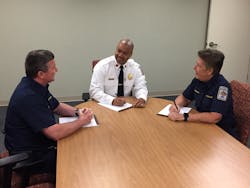
Leadership is a word often used among fire chiefs. There is no shortage of theory, books, articles, discussion and philosophies on leadership. While many organizations across the country have excellent leaders, it is likely that many are natural leaders or seek out specific leadership training independently. Fire chiefs across the country must place an emphasis on leadership training, as some say the fire service is suffering from a “leadership pandemic.”
From firefighter to company officer
Many say the most difficult and challenging transition in a firefighter’s career is promoting from firefighter to company officer. People become firefighters for a variety of reasons, and the same is true for firefighters becoming company officers. Firefighters seek to become company officers for a host of reasons, such as taking on a new challenge, increased pay, operational effectiveness, ability to influence change on the shift/department, etc.
Without question, a company officer must be prepared and trained to be operationally efficient and effective. Most departments have some form of operational training program in place to train aspiring or newly promoted company officers. That said, being operationally competent and effective does not necessarily make you an effective leader or prepare you for the personnel and/or administrative issues the new company officer will face on day one.
What happens when the newly promoted officer shows up to work for their first shift with a group of firefighters whom they may or may not know, and is faced with a significant personnel matter? Has their department prepared them for the day an employee comes into the office and says, “I feel …,” “I can’t …,” “Why …,” “I’m not motivated to …” or “I’m gonna ….”? These are very real scenarios that many officers, both newly promoted and experienced, face more often than house fires with victims trapped.
Developing front-line supervisors
The challenges company officers face today and into the future continue to change due to generational variances, technology, fire service and community expectations. Most departments put an emphasis on preparing new company officers operationally, as we believe they should. However, many departments across the country fail to train their new and aspiring company/command officers on the intangible, “soft” skills of leadership.
Building an effective leadership development program is the key to developing front-line supervisors. Many departments have training programs to teach the practical application of leadership skills for the incident scene. However, those same departments face challenges when preparing their supervisors for the non-operational leadership challenges. There are a variety of reasons for this and many include lack of funding, personnel to carry out an officer development program, resources, and experience in providing training on the critical tasks of leadership and management.
As a result of these collective reasons, the fire chiefs of the Fire & Rescue Departments of Northern Virginia took the initiative to develop a regional officer development program. The Fire & Rescue Departments of Northern Virginia constitutes a coalition of 14 member departments with a mission to provide the Northern Virginia region with the best possible emergency services through shared use of resources and coordinated emergency response.
The fire chiefs tasked a committee of officers, representing all departments, with developing a week-long residency program designed to develop the intangible leadership and management skills of company and command officers. Those tasked with program development attended a variety of officer training programs at the regional, state and national level, with the intent of developing a program to improve front-line and command officers. The direction provided by the fire chiefs led to the creation of the Northern Virginia Fire & Rescue Leadership Development Institute (LDI).
Program elements and steps
The following includes an overview of the non-operational elements that are critical to developing a successful officer development program, many of which were defined and refined by the staff of the LDI. Time, money and resources will dictate what aspects of a program can be incorporated to meet departmental needs. The key concepts for a non-operational program should take into consideration that 90 percent of any officer’s time is spent interacting with the members and citizens while not on the incident scene.
The first step of program development requires defining the program and purpose. Key development criteria should include:
- Staff roles and responsibilities
- Budget
- Venue location
- Curriculum and schedule development
- Speaker selection
- Student qualifications, experience and requirements
These criteria should be the core of the program and each should be evaluated during the after-action review and through the planning process for the upcoming session. Further, the concept of revolving staff annually should be considered to prevent stagnancy and maintain evolution of the program.
An educational model should be designed to build confidence in leadership skills by teaching principles through the process of each training session. Graduates will use the skills learned to increase their abilities and effectiveness as department leaders at varying levels.
The model could include the following steps:
- Officers learn individual leadership principles during each class session.
- Officers put the principles together and recognize how they are intertwined.
- Officers model the principles throughout the program.
- Officers model the principles of leadership after graduation when they return to their departments and continue with their role as leaders in their organization (changing their own behavior).
- Officers mentor their crews and teach them the principles they have learned (working to change the behavior of others).
Students need to come with an open mind to learn new concepts and improve upon their effectiveness as fire service leaders. The students targeted for a company officer leadership program are newly promoted front-line unit officers where the challenging buddy-to-boss transition occurs. The command officer leadership and management program provides a foundation for newer organizational leaders and helps further the skills of more experienced leaders. Students of both programs should complete pre-course work that requires reading and writing assignments with the focus on leadership and management. Students and staff should develop core values, a mission and a vision statement to reinforce the oath officers take to be an effective organizational leader.
Setting the tone of the program is critical at the onset and must include teambuilding. This principle cannot be overlooked and should be reinforced as students work with other officers whom they may not know, thus taking them out of their comfort zone. Teambuilding sessions requiring physical and academic challenges can set the tone for the program and firehouse environment.
Another important element of physical and mental preparation includes participating in daily physical fitness training each morning. A fitness and nutrition class can provide officers with ideas for improving fitness and nutrition at the firehouse.
Building a curriculum
The effectiveness of the program relies upon building a robust curriculum of nationally renowned fire service and non-fire service speakers presenting on a variety of leadership topics.
Curriculum considerations could include:
- The theories and concepts of leadership as taught in the military, as there is high value in comparing the military to the fire department as a paramilitary organization
- The science of leadership that reviews personality and leadership styles, generational differences and communication skills
- Interviewing techniques where officers are provided different approaches to the formal and informal subordinate discussions
- Leadership during critical events that encompasses the mental, physical and psychological characteristics that impact officers
- Mental health focusing on the well-being of our own taught by a fire-service experienced mental health provider
- A session dedicated to cancer prevention, health and fitness
- Fire chief’s leadership panel discussion where the officers get to hear the expectations, thoughts and theories from their chiefs
Scenarios are the cornerstone of an effective program. Students must participate in realistic non-operational, issue-based scenarios that will impact an officer. Students should be encouraged to draw from their personal experiences and what they have learned throughout the program to successfully manage these scenarios. Role players and facilitators are the key to scenario success and this is often when the “lightbulb” moment occurs for students. A well-planned program brings itself to fruition when the students participate and watch each other using the skills they have learned throughout the week.
In sum
Leadership, management and communication skills are both an art and a science that each officer must use daily to be an effective leader. The fire service is dynamic and we continue to see changes in the way we provide services to the public and work with each other. Properly educating officers on how to be better leaders in the operational and non-operational environment is critical to the success of any department and one that will pay dividends for years to come.
About the Author
Bill Betz
Bill Betz is a battalion chief for the Fairfax County, VA, Fire and Rescue Department. He is a 25-year veteran of the fire service, having held several operational and staff positions in various ranks. Betz has a bachelor’s degree in business management and serves on NFPA’s 1961: Standard on Fire Hose committee.
Shawn Dunstan
Shawn Dunstan is a captain with the City of Fairfax, VA, Fire Department. He is a 24-year veteran of the fire service, having held both operational and staff positions in various ranks. Dunstan is an EFOP graduate and has associate of applied science degrees in emergency health sciences and fire science technology, a bachelor’s degree in management and an master’s of public administration from George Mason University.