Minnesota Fire Departments Consolidate for the Future
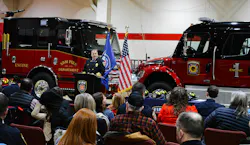
Minnesota fire departments have been struggling to recruit and retain firefighters to the point that departments are not able to service their communities properly. A solution has been found for long-term sustainability, consolidating city departments into fire districts, allowing the them to combine staffing, resources and funding.
Recently, four fire districts have expanded their coverage areas by having departments merge.
The West Suburban Fire District (WSFD) already covered Medina, Independence, Loretto, Hamel and portions of Greenfield and Corcoran, which serves around 18,000 residents. On Jan. 1, 2026, the Maple Plain Fire Department joined the WSFD.
On the same day, the Bethel Fire Department joined the St. Francis Fire Department to create the Rum River Fire District (RRFD).
Other consolidations include the Centennial Fire Department joining the Spring Lake Park-Blaine-Mounds View Fire Department (SBM Fire) that serves roughly 105,000 residents, while the Orono and Long Lake Fire Departments coming together to create the Shoreline Fire Department (SLFD).
As mergers become commonplace in Minnesota, there are clear benefits for the departments themselves, the communities they serve and long-term operations. But, these mergers didn’t happen overnight, the process required long hours and hard work.
West Suburban Fire District
The WSFD formed in July 2023 when the Loretto and Hamel fire departments merged, then Maple Plain and Independence consolidated, sparking conversations of having Maple Plain join WSFD due to its crisis of getting volunteer firefighters.
Hamel and Loretto were nonprofit 501(c)(3) corporations and continued with that into the WSFD. When that merger happened, it required the Relief Associations to get together to figure out how pensions were going to be handled.
The decision was made to join the Public Employees Retirement Association (PERA). Hamel firefighters were receiving $6,300 per month for their pension, while Loretto firefighters were at $6,000 a month, and when they got together, the number increased to $6,900.
They needed to simplify board positions and determine the overall leadership structure. While no one lost jobs, an agreement was made that reductions would be made in the future.
Ahead of the process, WSFD Chief Jeff Leuer wanted to collect as much information as possible, and he went to other merged departments in northern Minnesota, and elsewhere, to departments to understand what works and what doesn’t.
"This is an opportunity for us to be able to consolidate, join resources, join forces and become one entity," Leuer told Firehouse.com.

"We were able to make sure that none of the members or officers were lost through the process," said Leuer. "Keep the firefighters involved in the process and let them help decide. If they feel that they're part of the process and have input, it will create buy-in throughout the membership."
When Maple Plain joined WSFD, a challenge was transitioning the city-owned department into the private WSFD. That brought the pensions back into question, because WSFD’s pension was double the amount of Maple Plain’s.
The solution agreed upon was that members of Maple Plain would get their current pension paid out. Then, they would carry over the years of service with WSFD but begin a new pension. and start over with the WSFD. For instance, if a member has five years of service, they are 50 percent vested with the WSFD, and if the member has 10 years of service, they are fully vested.
"Some people say money doesn't really matter, but in this case, it does," said Leuer. "Members really took interest in what their pensions would look like."
Through hours of negotiation between leadership at Maple Plain and WSFD, Maple Plain turned over its apparatus to WSFD as their buy-in and brought all its members and equipment. Citizens did not want to lose their department’s identity, because it is one of the features that gave their city an identity. They opted to keep station names on the buildings.
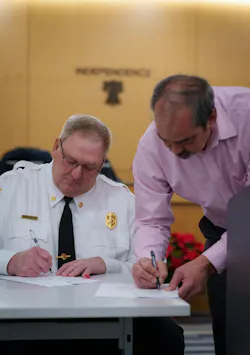
Cost savings for the WSFD have been notable. With duty crews in place, they don’t have to budget for more firefighters responding to a call than necessary, and it has given the district more opportunity for grant money because they are seen as more of a regional department, than a single city.
The 70 firefighters in WSFD operate under the same Standard Operating Procedures and Standard Operating Guidelines.
"We are getting more people looking at it and wanting to be part of this bigger organization," said Leuer.
The WSFD has created a family environment, but that didn’t happen right away. Leuer recalls that at the beginning you could tell who came from Hamel and who came from Loretto because they would sit on opposite sides of the rooms, but now you can’t tell who came from where.
"It's going to happen with Maple Plain after a while," said Leuer. "They're going to feel like one."
It was all about long-term sustainability for Leuer, as he emphasized that on multiple occasions.

Rum River Fire District
The RRFD’s process was a easier in terms of implementation but still took a lot of work behind the scenes.
Bethel began working with St. Francis in 2023 due to their staffing shortage and created an auto-aid agreement. Eventually, the shortage became too much for Bethel to operate on its own and Fire Chief Dave Schmidt brought in the State Fire Marshal’s Office to help moderate conversations centered around the joint-powers agreement, stay focused on the goals of long-term sustainability and growth and to fix immediate issues into a joint-powers agreement.
"We wanted to create something that had long-term foundational sustainability," said Schmidt.
Budgets were examined because Bethel had a different budget available than St. Francis. Schmidt wanted to make sure the funding formula was sustainable and scalable. With rising costs for equipment and pension payments and the conversation for contracted service organically developed into the joint-powers agreement.
"The funding dollars are getting harder and harder to acquire," said Schmidt. "The staffing model has been failing for 20 years, and it's at an accelerated rate in the last couple of years."
The funding formula resulted in a 94-6 cost split for St. Francis to Bethel on every dollar spent on the fire department. St. Francis got a six percent reduction for fire protection services to its community, and Bethel is paying six percent of its total budget to get a robust second station, more staffing, consistency and reliability.
"It makes a lot of sense from a financial standpoint, for cities to start collaborating at a higher level," said Schmidt. “Even the larger career fire departments in the metro are struggling to recruit and retain people. We can't continue to do business as we have done. It's not sustainable, and it's continuing to prove that it's not stable."
St. Francis hired all Bethel firefighters who wanted to come over and since they were already working together, and it was logistical work that needed most of the focus. Practically, the Bethel Fire Station serves the eastern-third of St. Francis more efficiently and effectively.
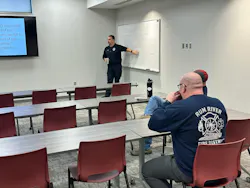
"This isn't a takeover," said Schmidt. "This process needs to be a collaboration, which means we take out all of our preconceived notions of what we want it to be, or what we think it's going to be."
Schmidt was in constant communication with the staff, which made the transition more seamless and put a lot of value on answering the question for everyone involved, “why are we doing this?”
He believes it is a win-win for both cities and mentioned that the process went a lot smoother than he expected. Schmidt gives credit to everyone involved in the process, from the elected officials and firefighters to the State Fire Marshal’s Office and expects more cities to inquire about joining in the next 5-10 years.
"What we really wanted to focus on with this process is that eye towards growth," said Schmidt. "We wanted to create a joint-powers agreement that is truly scalable and expandable. If somebody else was interested in joining the district, this is what it looks like. This is what we're using for a funding formula. These are the expectations of becoming a member of the district. I think we've accomplished that."
Schmidt wanted to get things right with the implementation and details to minimize mistakes. He recommended bringing in a third party because they can help you assess at pointing out blind spots.
"This process that we went through is a journey, and it's going to continue to be a journey," said Schmidt. "Our success is reflective of those that chose to be a part of the process. A ton of credit goes to everybody, because it's not an individual effort. I couldn't be prouder of everybody that was involved."
SBM Fire
Similarly to the RRFD, Centennial and SBM Fire had been working together over the past four years. The chief of SBM Fire, Dan Retka, was essentially Centennial’s fire chief because of an administrative contract. The next step was to officially bring them over.
"Having one regional fire department for this area made way more sense, because we're all fighting for that the number one commodity, and that's people," said Retka. "We're all fighting for the same people."
The two parties were already training together, and Centennial was following SBM Fire’s guidelines and policies.
"We can be much more effective, more efficient under one roof," said Retka. "Having strategically placed stations equals better service for our community."
The biggest hurdle in this process was that the Centennial Fire Department was firmly ingrained into its community. With the department being dissolved, it was a tough pill for the community to swallow.
"No matter how good a plan that we had, there's going to be hiccups," said Retka. "You have to expect hiccups and be agile and overcome them. Making sure that that transparency is there. I have daily conversations with all of our cities. There's zero surprises."
A lot of education took place at state-level meetings, council meetings and town halls. The focal point was that the name was going to be different but the fire service provided is going to be better.
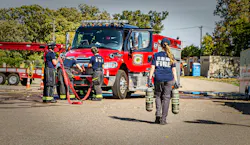
Since the merger went into effect, SBM Fire has hosted community events and had significant emergencies that resulted in good outcomes that have helped with community buy-in.
"I wish cities would be more open to doing things like this," said Retka. "What's going on in the fire service and primarily volunteer services, it's a revolving door. If you can put egos, pride and ownership aside and start looking at what makes the most sense, we can do some pretty special stuff that enhances the service level."
All but five firefighters transitioned over from Centennial, and the fiscal positive byproducts gave SBM Fire the lowest per capita fire department in the state. It has also lowered the cost of service by closing two stations in Blaine that were located close together and covering holes in Blaine to where three stations are covered 24/7, every day of the year.
"The fire service is going to continue to provide that service, in fact, it's going to be better now, because we've got a bigger pot to go from," said Retka.
On top of that, $3 million has been knocked out of its capital fund from the staffing changes, apparatus and station consolidations and budget tweaks, making service equipment strong and secure. They have no hard capital, they pay cash for equipment and the plan is fully funded.
"This is the model for the future for long-term sustainability," said Retka. "We're buying for the same people, buying the same crap, buying the same trucks. Working together, buying a ladder truck, opposed to three separate ladder trucks for the community, that's smart business. That's a sustainable business."
SBM Fire has been able to transition to more of a career-style for its members. Now, the department has 20 full-time firefighters, six full-time captains, full-time battalion chiefs and a full-time fire apparatus operator to oversee the apparatus fleet. Looking at the numbers, Retka mentioned that due to the closing of stations and reworking the budget, they were able to hire three full-time captains at a 4-5 percent increase to the cost for the city, whereas in most instances that is a 9-10 percent increase.
"As a fire chief with the changes we made, I can sleep good at night knowing I've got qualified full-time officers on every single call that happens in our district," said Retka.
The common theme of long-term sustainability holds strong with Retka. He recommends that chiefs look at their strategic plan, be honest with themselves and ask if it's sustainable. He adds the strong suggestion of being honest with the challenges you are facing to your councils, mayors and administrators.
"We've been our own worst enemies, saying we'll figure it out," said Retka. "We can only say that for so long. You're seeing where we're at now as an industry, and we need to make major changes."
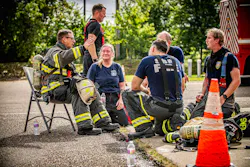
Shoreline Fire Department
This merger is different than the others. Originally, the Orono and Long Lake fire departments worked together, but Orono separated and operated on its own for about a year and a half. Now, they are back together after evaluating long-term service delivery and establishing to a joint-powers agreement.
The challenges they faced weren’t about pensions, but rather about tactics and operations. Chief Mike Heiland and Deputy Chief John Paszkiewicz talked to other merged departments monthly to see how they could be the most effective this time around.
"These departments have been going for over 100 years, and it is a big change to take that step," said Paszkiewicz. "That's the hardest part, behind the scenes."
The organization operates on a joint-powers agreement, and its biggest hurdle has been going from a paid-on-call model to duty crews Monday-Saturday. The daytime staffing has been difficult to manage as there are more responsibilities for the department.
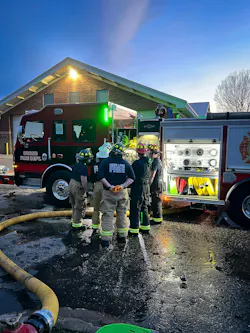
"The JPA was what a lot of people wanted to see," said Paszkiewicz. "They didn't want to see another department that was a standalone, individual city department."
Also, there was mental wear and tear on the members and the community with the back and forth. Now, the department and cities can look forward and focus on the future with the mental anguish behind them.
"The training and recruiting are going well," said Heiland. "We are well-equipped, well-funded and it was a three-year process to get here."
Conclusion
As staffing and recruiting gets harder, equipment and services get more expensive and leadership starts to focus on long-term sustainability and growth, these mergers are a great example of counterbalancing those effects. These chiefs and organizations are phenomenal examples of how to go about starting and implementing the process of becoming leaders in the fire service.
About the Author
 Ryan Baker
Ryan Baker
Associate Editor
Ryan Baker is a writer and associate editor with prior experiences in online and print production. Ryan is an associate editor for Firehouse with a master's degree in sciences of communication from the University of Wisconsin-Whitewater. He recently completed a year of teaching Intro to Public Speaking at UW-Whitewater, as part of his graduate program. Ryan acquired his bachelor's degree in journalism in 2023 from UW-Whitewater, and operates currently out of Minneapolis, MN. Baker, also writes freelances for the Ultimate Frisbee Association (UFA) in his free time, while also umpiring baseball for various ages across the Twin Cities Metro Area.