Fire Department Culture: Integrity, Commitment, Aggressive Tactics, and an Elite Mindset
Key Takeaways
- Integrity is the foundation on which every other fire department cultural value rests, so firefighters are able to trust each other without hesitation on the fireground, in the firehouse and in the community.
- Firefighters must remain steadfast in the fact that their oath and the expectations of the citizens who they serve aren’t shift based, but career-based.
- Aggressive tactics, when paired with discipline and training, become the difference between mediocrity and being elite.

Culture is the heartbeat of every fire department. It defines how firefighters interact, how they approach the job, how they handle adversity and, ultimately, how they serve their community. Equipment, facilities and training matter, but without an elite culture, those things never are utilized to their full potential. A culture that’s rooted in integrity, commitment, aggressive tactics and an elite mindset creates an environment in which firefighters don’t just survive through their career, they thrive throughout it.
What does it take to build such a culture? What leadership behaviors sustain it? What daily discipline is necessary to ensure that it lasts for generations? (A hint: Motivation isn’t culture. Discipline is. Motivation dies, and discipline wins.) Below are the four pillars of firehouse culture.
Integrity: Basis of trust
Integrity is nonnegotiable. It’s the foundation on which every other cultural value rests.
Firefighters must be able to trust each other without hesitation on the fireground and other emergency incidents, in the firehouse and in the community that they serve.
Integrity means doing the right thing when no one is watching, refusing to take shortcuts and holding yourself accountable to the same standards that you expect from others.
Integrity is a word that’s discussed in every leadership article that’s worth its salt. Why?
Because, often, we struggle to get it correct, and without integrity, a member has no true moral compass and no true self-worth and such an individual brings no true value to your department.
When department members lose integrity, cracks form in morale, accountability disappears and trust erodes. Conversely, when integrity is unwavering, all members know that their word matters and that others will stand by them. They won’t take opportunities to ambush others in their department, whether they are civilian staff at headquarters, brothers or sisters from another shift, or members of another division. They all support each other and push each other to be the best version of themselves.
Commitment: The glue
Commitment is the willingness to give more than what’s asked. It’s the willingness to sacrifice time, energy and comfort for the greater mission.
The very beginning of the American fire service was built on the commitment and sacrifice of Benjamin Franklin’s volunteers of the Union Fire Company. If we can’t hold that close to our heart, then we lose what truly is a priority on this job.
Firefighters are bound by a sacred commitment—to protect life and property—but commitment also means investing in your team, showing up to training fully engaged (both on and off duty), mentoring the next generation and standing firm when the work gets difficult. We must get back to the fact that our job isn’t based on a 24/48, 48/96, 24/72, 13-23, blah, blah, blah. It’s based on the pure fact that we are firefighters 24/7/365—to our community that we serve and to each other. We must remain steadfast in the fact that our oath and the expectations of our citizens aren’t shift-based; they are career-based. We must perform at all times and be ready to sacrifice everything at a moment’s notice.
A culture of commitment doesn’t tolerate laziness or half-assed effort. It takes the elite of the elite, the best, the ones who prepare more, train more, show up more and know that every morning when they sit on the bumper and look across their city, there’s a mom who’s in a robe, toddlers who are watching Mickey Mouse Clubhouse, kids who are getting on the school bus, a husband who’s going to work. That mom has the expectation that she will see her family at dinner that night. The children have the expectation that they will come home to their family, house, toys and siblings. That dad has full expectation of coming home to a happy family that he can provide for. Those are the expectations that they have for us.
Those come straight from our oath. Those are the facts of our job and the commitment that it takes. You can’t let down your citizens.
Aggressive tactics
Aggressiveness in the fire service often gets misunderstood. Aggressive doesn’t mean reckless. Aggressive means decisive, confident, and being smart and willing to act quickly when seconds matter.
An aggressive department is trained to move forward, with purpose, whether that’s stretching lines deep into a structure, forcing doors with speed or performing rescues under difficult conditions.
Throwing around “aggressive” as a buzz word to make you look cool on social media is a death trap.
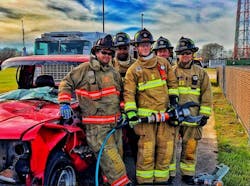
Being aggressively smart, built on repetitions at the training ground, years on the back step listening without talking much, and attending every training opportunity that you can to make yourself better, is what aggressive looks like.
Aggressive tactics, when paired with discipline and training, become the difference between mediocrity and being elite. You can’t allow mediocrity to start in your department.
It’s the fastest-spreading cancer, more deadly than a plague, and it will control the young minds of your department before you ever have a chance to build them the right way.
Citizens expect firefighters to act with urgency and effectiveness. They expect us to perform miracles in moments when there’s no light at the end of the tunnel. They expect us to die for them. A culture that values aggressive, smart tactics ensures that when the alarms sound hesitation doesn’t exist, because if it does, it costs lives.
Elite mindset: Mental edge
An elite mindset separates a good department from a great one. This mindset is about discipline, resilience and the refusal to settle for average. Elite firefighters don’t clock in and clock out. They live the job, constantly sharpening skills, improving fitness, studying fire behavior and embracing the grind. They are the ones who have the most haters and who get bashed on the most. (If you’re into the job and want to be elite, you must have the shoulders to help to shield the heat.) These are the people who probationary members want to follow.
The elite mindset also includes humility. True professionals never think that they’ve “arrived.” They know complacency kills. They study failures, learn from mistakes and stay hungry to improve. They understand that carrying the ideal of an elite mindset comes with a heavy sword should they not perform. That’s why you find them doing all of what’s noted above. They must stay on their game, mentor the young members and continually push the positive behavior that’s needed to be elite.
Leadership starts the fire
Culture starts at the top but is lived at every level. Chiefs, captains and lieutenants set the tone by modeling the values daily. If leaders cut corners, tolerate laziness or bend integrity, the culture erodes instantly. Always remember, you are what you allow. Your words mean nothing if you allow differently.
I have been in those situations many times in my leadership career, when I must choose mentally whether to allow or not allow a certain behavior or attitude. I have seen both sides. Allowing bad behavior, mediocre mindsets, lack of integrity or laziness isn’t the answer, and leaders are the problem. You must protect the culture and the other members of your department; you can’t allow one bad apple to ruin the bunch. If you have 180 people in your department and you decide in favor of the one bad apple, you lose 179 members. Your culture will fail.
If leaders demonstrate consistency, fairness and toughness, firefighters rise to that level.
Leaders must:
- Be the most disciplined person in the room.
- Show up early, prepared and mentally locked in.
- Hold themselves to the same or higher standards as their crew.
- Demonstrate that no task is beneath them.
- Show their expectations, not just talk about them.
Clear expectations
A great culture can’t thrive on vague standards. Expectations must be clear, repeated and enforced. Firefighters must know what “right” looks like. This includes:
- Training requirements.
- Fitness benchmarks.
- Conduct inside and outside of the station.
- Allowing members to operate within the confines of your expectations.
- Elite performance expectations on the fireground.
- Elite performance expectations in the firehouse that’s built on professionalism, respect, trust and honesty.
Once those expectations are communicated to members, leaders must enforce them fairly and consistently. Nothing kills culture faster than selective enforcement. We have the best job in the world. You must show up on time, pass down with the off-going shift, check a rig, clean the firehouse, train, eat three times per day, work out and save lives. Show up, be happy, perform at an elite level and do your damn job.
Recruiting and onboarding
Culture starts before Day 1. Hiring should focus not just on technical ability but on character and alignment with values. Your process isn’t about scores; it’s about finding good human beings who possess the behavior, character and attitude that you want in your department—not based on what you’re told that you need.
A candidate who has skill but lacks integrity or humility will be the snake bite to the culture. It will start to rot your department deep within the lowest levels and work its way up. By the time that it gets to the higher levels, it’s too late. It will rot the outside skin and spread until you amputate. This is why company officers and chiefs must invest in their members, get to know them and have a true pulse of the department, so that when that first drop of venom hits, you can inject the antivenom.
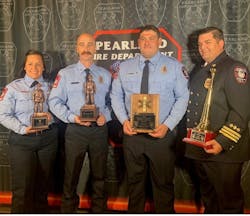
Onboarding must reinforce culture from the beginning. New firefighters immediately should feel the weight of tradition, the pride of commitment and the expectation of elite performance. For example, in the Pearland, TX, Fire Department, on the last day of probie school, the probies sit with senior members of the department and talk about the culture, history and tradition of the department for several hours. At the completion of that session, the probies walk into their graduation and then hit the streets. That discussion with senior members is our last chance to prepare new members for the hard-charging, fun, exhausting but elite atmosphere that they’re about to enter.
Retaining the culture
Training is the single most effective way to keep culture sharp. When training is realistic, challenging and relentless, it builds trust and confidence. A culture that trains hard leaves no room for complacency. The process isn’t difficult. What is difficult is going to the training ground and showing exactly what you don’t know. Trust me, it’s OK. Just go and get better. Stop complaining. Think of it like this: Olympians train 10-plus hours per day, for four years, for one competition, for one shot at a gold medal. Why do you complain about an hour?
Key principles:
- Train every day, even if only for 20 minutes.
- Push scenarios that test decision-making and aggressiveness.
- Demand excellence in basic skills: hoselines, ladders, search, etc.
- Encourage officers to lead from the front during training.
- Show trainees your expectations.
Fitness: Not a suggestion
A department can’t have an elite mindset if firefighters are out of shape. Physical fitness isn’t just personal; it’s a duty to your crew and citizens.
Have I always been the pillar of health? No. Did I understand that I wasn’t meeting the expectations of how I should be able to perform? Yes. Because of that integrity, I was able to make changes and meet the standards.
We all have our ups and downs, but we must realize that being elite starts with being physically fit. Firefighters must be able to perform under extreme conditions without hesitation and for long periods of time. Physical fitness is the one part of the job, outside of our attitude, behavior, integrity and other moral values, that we can control. We must control it and in the right way.
Embedding fitness into culture means:
- Structured physical training as part of shifts.
- Encouraging personal accountability outside of shift.
- Leadership participation in workouts.
- Treating fitness as an operational requirement, not as an option.
Rituals and traditions
Culture is reinforced by rituals. Whether it’s the way that roll call is conducted, how promotions are celebrated or how retirements are honored, these traditions remind firefighters that they belong to something that’s bigger than themselves. Traditions are what keep us grounded and keep us setting the tone for our culture. Tradition is a culture within itself, and we can’t look at it as a memory.
Simple acts, such as eating together, cleaning rigs as a crew and ringing a bell during a memorial service, carry weight. They communicate pride, unity and respect for the profession.
Hang up and hang out: No phones at the kitchen table. Yes, I am bad about this one, but my brothers around me keep me solid and hold me accountable.
Courageous conversations
Maintaining culture requires accountability. Leaders must confront poor performance quickly, firmly and fairly. Cowardice in addressing problems spreads toxicity, but accountability must be balanced with compassion, to correct behavior while keeping the firefighter’s dignity intact.
Further, there’s a time and place for corrective action. Sometimes—and, honestly, most of the time—it should be in the office and in private. However, there are times when it’s needed as a group discussion to make the point clear and to show those who are around you that you aren’t afraid to make difficult decisions. That’s your job. You’re the leader, and you can’t be afraid to lead.
Courageous conversations and difficult decisions are the hallmark of elite leadership.
Leaders must be willing to say the difficult thing, even when it’s uncomfortable, because culture depends on it, and so do the people you work with.
Generational differences
Each generation brings different expectations, learning styles and attitudes. Strong culture bridges these differences by focusing on universal values: integrity, effort and accountability. Get to know your people, their hobbies, what makes them motivated and what makes them disciplined. If they like Pokémon, then for God’s sake, go learn Pokémon, so you can have good, in-depth talks about a subject that intrigues them. Show them that you’re willing to make the investment in them. Most importantly, ask them, “How did you learn?” You must know how to teach them to make them successful. There are no two ways about it.
Culture for the long term
Building a great culture is difficult. Retaining it is even more difficult. It requires:
Mentorship programs. Senior firefighters must mentor rookies intentionally, passing down lessons and traditions.
Leadership development. Invest in officer development programs that teach not just tactics but people skills, conflict management and ethical decision-making.
Recognition systems. Celebrate excellence publicly. Recognize not only big rescues but also daily demonstrations of commitment, fitness and integrity.
Continuous improvement. Conduct after-action reviews, solicit feedback and adapt. The best cultures evolve while holding onto their core values.
Playbooks. These include engine company operations, truck company operations, rescue operations and what the expectations are. Write out your play and have audibles for members to call.
A department’s culture is its greatest strength or its greatest liability. Building one that’s based on integrity, commitment, aggressive tactics and an elite mindset requires intentional leadership, daily habits and unwavering accountability. It can’t be faked, rushed or forced. It must be lived, every shift, every call, every interaction.
When done correctly, this culture produces firefighters who are physically sharp, mentally tough, ethically grounded and relentlessly aggressive in the pursuit of saving lives. It produces leaders who inspire trust, crews who act with unity and a department that citizens can count on in their darkest hour.
The fire service doesn’t need average. Communities deserve elite, and elite culture starts with integrity, is fueled by commitment, is demonstrated through aggressive tactics and is anchored by an elite mindset.
About the Author
 Jacob Johnson
Jacob Johnson
Jacob Johnson started at the Katy, TX, Volunteer Fire Department as a Junior Explorer Post Firefighter at 15 years old. Throughout the years, he moved up in the ranks until he changed departments in 2007. Johnson was one of the original full-time members who was hired by the Pearland, TX, Fire Department, where he currently sits today as a member of administration, serving as an assistant chief. Johnson has taught at numerous schools in Texas and has traveled over the past year to teach his mentoring and leadership class.