Succession Planning for the Next Chief of the Fire Department
Key Takeaways
- To “leave the department in a better place than when I arrived,” fire chiefs must begin the process of succession planning the day that they are promoted, assigned or voted into office.
- Fire service members who want to be considered for a fire chief position must apply several strategies early in their career (e.g., obtaining a graduate-school level degree, attaining national and state certifications, attending training seminars and conferences and acquiring credible fireground command experience.
- To ensure an effortless evolution of department operations, outgoing fire chiefs must apply a robust amount of time coaching, mentoring and training the heir apparent.
Succession planning and proactively preparing members for the next step in their career are integral to the sustained success of a fire department. Although these activities should occur at every organizational level, the critical importance of choosing a successor to the position of fire chief can’t be minimized. Reports of departments that made poor decisions that resulted in negative consequences are daily news.
Preventing these damaging situations from occurring rests squarely on the shoulders of the chief of department. A goal of every fire chief is to “leave the department in a better place than when I arrived.” To achieve this, chiefs must begin succession planning the day that they are promoted, assigned or voted into office.
Choices
The type of department and the organizational structure under which it operates might provide several methods to move into the fire chief role, including testing, appointment, interim service or a formal written succession plan. Regardless of approach, current fire chiefs should have a clear outlook on subordinates who might be able to fill their position.
The fair, demonstrable and quantitative work to develop and mentor potential successors should start several years prior to current chiefs’ end date.
A main objective of a well-designed succession plan is to find and develop internal candidates who are aware of and support the mission, vision and goals.
Benefits of choosing an internal candidate might include improved morale, minimal service disruptions, added promotional opportunities, and operational consistency and stability. However, this might not be best for the future of the department or the community.
If flexibility or the rule of three allows, one should take a deep look at all potential internal candidates to see whether they have what it takes. If a qualified candidate can’t be found, hiring from outside might be in the department’s best interest.
Contenders
Achieving fire chief status is extremely competitive and challenging. To place themselves in contention, candidates for these positions must apply several strategies early in their career. These actions should include obtaining a graduate school-level degree, attaining national and state certifications, attending training seminars and conferences, participating in promotional processes or annual officer-voting events, and acquiring credible fireground command experience. Putting in the work to realize these goals exhibits motivation, commitment, purpose and a desire to lead. These are prominent personal qualities that a fire chief looks for when choosing a successor.
In addition to these attributes, every leader should possess exceptional interpersonal skills, aka people skills, such as sound communication, emotional intelligence, collaboration, active listening, empathy, conflict resolution and assertiveness.
Another key element of the endeavor to consider lies in the department’s opinion of the candidates.
Internal contenders will be judged by the respect, trust and integrity that they built during their time in the organization.
External candidates will be judged by the actions and leadership style that they exhibited at their former department.
Support of the choice from these boots-on-the-ground firefighters makes the transition more collaborative and less complicated.
Fire chief’s responsibility
Once the process of evaluating successor candidates is complete and leadership made its choice,the meticulous work to ensure that the individual will be ready begins. As stated above, this crucial responsibility rests directly with the departing boss. This isn’t the time to sit back and count the remaining days.
To ensure an effortless evolution of department operations, outgoing chiefs must apply a robust amount of time coaching, mentoring and training the heir to their position.
It’s common for exiting fire chiefs to keep their end date confidential, which might limit the time that’s available to deliver a successful transfer. This scenario creates rushed changeovers and a diminished transfer of critical information. Unless the departure is outside of their control, departing fire chiefs are duty-bound to ensure that the appropriate amount of time is given to the transition.
Transition
Several formal and informal approaches and best practices ensure that an incoming fire chief is provided with the information and resources that will be needed for that person to make decisions and find success in the new role. This is where the exiting chief can discuss command level expectations and standards, such as work schedule, community engagement, meeting attendance, on-call status, reporting obligations and other intelligence that’s exclusive to the daily tasks of the office.
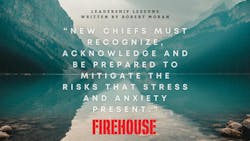
The job of a fire chief comes with built in stressors. Therefore, it’s essential for outgoing chiefs to dispense an honest assessment of the personal stress and anxiety that the best of fire chiefs encounter in this critical leadership position. New chiefs must recognize, acknowledge and be prepared to mitigate the risks that stress and anxiety present.
Direct talks concerning confidential information should be held to ensure complete understanding and acknowledgement of department operations, ongoing personnel issues, current and future challenges, local political environment, community issues and any other privileged information. This is an excellent opportunity to build a strong personal relationship between the parties, fostered by honesty, trust and respect. After leaving the organization, outgoing chiefs take a wealth of organizational knowledge with them.
Therefore, building a robust bond that supports future discussions and the smooth transfer of institutional intellect can be beneficial to the incoming chief.
Notable value can be found in bringing the new chief to all scheduled meetings and events. These might include meetings of department heads, mutual-aid associations and stakeholder groups and those that pertain to planning and projects, the union and community events. Introductions can be made, information acquired and constructive relationships established. Developing recognized connections is a key component of the job of the incoming fire chief. This individual will be the new face of the organization, so building this foundation is critical to the future of the organization.
Management of the department’s annual operating and capital budget is an essential component of the work of a fire chief. Allowing the incoming chief the opportunity to be involved in developing, presenting and managing these budgets gives the incoming chief the insight and foundational information to continue this exercise in the future. Letting the incoming chief make purchases, communicate with municipal finance officers, develop specifications and engage with suppliers under the guidance of the office is an effective course of action. The new chief should be connected to all budgetary and operational elements of any outstanding projects, grants and programs. Empowering an incoming chief to oversee these agendas and be involved in the decision-making process provides exceptional knowledge of the programs and supports a successful transition.
Plan of succession
Choosing and preparing a successor for the position of fire chief is a challenging yet rewarding process. Outgoing fire chiefs must develop and execute a resilient plan of succession early in their tenure. This will be vital to the future success of the organization. Remember, failing to plan is planning to fail. Don’t be among the fire chiefs who betray their vow to leave the department in a better place than when they arrived.
About the Author
 Robert Moran
Robert Moran
Robert Moran served as fire chief of the Brewster, MA, Fire Rescue Department from 2010–2024. Prior to that, he served 26 years with the Englewood, NJ, Fire Department, retiring in 2010 after 12 years as chief of department. Moran holds a master’s degree from Fairleigh Dickinson University, is a certified public manager, and has a Chief Fire Officer (CFO) designation from the Center for Public Safety Excellence. He serves as an adjunct instructor for Kean University and the New Jersey Division of Fire Safety and lectures at numerous regional and national fire service conferences. Along with his training partner, John Lewis, Moran writes the back page of the New York State Association of Fire Chiefs' Size-Up magazine and operates Jersey Guys Fire Service Training.