
NFFF Offers “Attributes of Leading” Train-the-Trainer Program
The National Fallen Firefighters Foundation (NFFF) has developed a Train-the-Trainer pilot program that uses videos to highlight the qualities of leadership. Titled “Attributes of Leading,” the program is designed to give firefighters an interactive and practical method for facilitating conversations about “leading actions,” taking the concept of leadership to a more actionable approach.

1. Developing Competence
2. Building Grit
3. Being Well
4. Exercising Self-Regulation
5. Demonstrating Humility
6. Developing Trust
The Competence, Grit and Well videos feature firefighters from departments in Montana and California, and the Trust, Humility and Self-Regulation videos feature firefighters from departments in Ohio, Missouri and Minnesota. They represent a broad cross section of the American fire service, including structural and wildland firefighters as well as career and volunteer personnel. The videos use a storytelling format, with firefighters sharing positive examples of leading actions.
Firefighters are encouraged to watch the videos and then complete a plan-of-action worksheet to discuss the attributes of leading.
The videos and worksheet are all available online at fdtrainingsolutions.com/leadership-videos.
NFPA 3000 to Address Active Shooter/Hostile Event Response
On Oct. 1, 2017, 58 people were murdered and more than 800 others wounded when a gunmen opened fire at the Route 91 Harvest Festival in Las Vegas. Just 5 weeks later, 27 people were killed and 20 were wounded at a church in Sutherland Springs, TX.
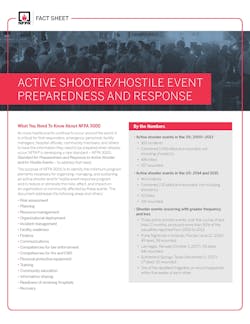
The purpose of NFPA 3000 is to identify the minimum program elements necessary for organizing, managing and sustaining an active shooter and/or hostile event response program and to reduce or eliminate the risks, effect and impact on an organization or community affected by these events.
The goal of NFPA 3000 is to prepare a single set of requirements to be used by a whole community addressing unified command, integrated response and recovery as follows:
- Unified Command: Explain how and why the unified command structure at an operations level needs to be in place and practiced.
- Integrated Response: Preparation and response must take into account the operations of numerous different agencies. These organizations must have operational plans that incorporate the objectives of other responding agencies and they must function as a cohesive, integrated unit.
- Recovery: Effective recovery planning must start now, and there are several aspects of recovery that need to be planned for.
For more information on NFPA 300, visit nfpa.org.
IAFF Marks 100 Years of Service
On Feb. 28, at 2 p.m., fire alarms in community fire stations across the United States and Canada rang out to mark the 100-year anniversary of the creation of the International Association of Fire Fighters (IAFF).
The IAFF was established to give firefighters a greater voice and to make sure firefighters and their communities stay safe. Over the past 100 years, the IAFF has lead dramatic improvements in fire safety including better sprinklers, improved smoke alarms and public education.
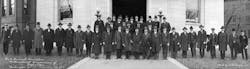
For more information on the IAFF and some of the 100 year celebrations, visit iaff.org.
IAFC Works with Esri to Create a New National Mutual Aid System
The International Association of Fire Chiefs (IAFC), Esri and the Intermedix Preparedness Division (soon to be Juvare) announced that beta testing of the new National Mutual Aid System (NMAS) will begin in four states.
In these emergency situations, it is critical that response personnel have access to a simple, yet comprehensive mutual-aid system for managing resources. WebEOC helps responders communicate more effectively, share important information, generate event reports and manage a range of tasks in one, centralized, Web-based environment. These benefits allow the IAFC to connect partner agencies and disparate organizations during response efforts.
The four states involved in beta testing are California, Florida, Tennessee and Utah.
“It is an exciting accomplishment to get to this point in such a short period of time,” said Chief Thomas Jenkins, the IAFC president and chairman of the board. “Ensuring that emergency managers and responders have real-time information and resources at their fingertips is an essential element in protecting their communities. I commend the fire and emergency service leaders in these four pilot states for seeing us through this important phase of the plan.”
The current NMAS is used throughout the United States to identify, request and deploy resources for mutual-aid support. The new version of NMAS will use the latest technology to accomplish these tasks faster, easier and more accurately.
Line-of-Duty Deaths
5 U.S. firefighters recently died in the line of duty. Four deaths were health-related and one was the result of injuries sustained in a collapse during fireground operations. This edition of Firehouse is dedicated to these firefighters.
ENGINEER JASON DICKEY, 38, of the Lawrenceburg, TN, Fire Department, died on Feb. 12. Dickey was battling a fire in a two-story residence when he and two other firefighters were trapped by a collapse. Dickey was killed in the collapse. The two other firefighters were injured and taken to the hospital. The cause of the fire remains under investigation by authorities.
LT. RICHARD JENKS, 72, of the Pascoag, RI, Fire Department, died on Feb. 14. Jenks collapsed while fighting a residential chimney fire. Other responders performed CPR and transported Links to Landmark Medical Center in Woonsocket, RI, where he was pronounced deceased. The nature and cause of fatal injury are still to be determined.
CAPT. EARNEST MCDUFFIE, 51, of the Hinesville, GA, Fire Department, died on Feb. 20. While performing fire department mandated physical fitness training, McDuffie was running at a local park and fell unconscious. CPR was rendered immediately, and McDuffie was transported to Liberty Regional Medical Center where he passed away from a nature and cause of fatal injury still to be determined.
AISSISTANT FIRE CHIEF CHRISTOPHER PRYOR, 46, of the LaVale, MD, Fire Department, died on Feb. 25. After returning home from an early morning response for a motor vehicle crash, Pryor complained to his wife that he was not feeling well. Pryor's wife then took him to the emergency room where, upon arrival, he collapsed. Pryor passed away from a nature and cause of fatal injury still to be reported.
LT. CASEY STEPHEN KUHNS, 30, of the Morrisville, VT, Fire Department, died on Feb. 28. Kuhns responded to a motor vehicle crash and, later that night, participated in fire department training before returning home. Early the next morning, he was found deceased at home from a nature and cause of fatal injury still to be reported.
About the Author
Firehouse Staff
Content written and created by Firehouse Magazine editors.