Close Calls: Explosion Blows Manhole Covers into the Air
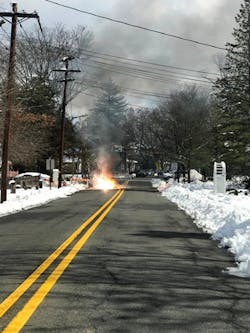
We all know those calls that elicit a “hand wave.” You know, when the tones go off and you give the hand wave, expressing your less-than-thrilled dispatch of THAT kind of call. Some of the worst types of calls to wave off include those that involve wires sparking, arcing or burning trees. Of course, when a call like this does come in, our no-nonsense and treat-it-seriously response should be one of extreme caution so that members of the public—or first responders—don't become part of the problem. Furthermore, with electricity and other utilities, predictability can be challenging, especially when electricity combines with other factors to create unique emergencies. Bottom line: Any time we go out the door, think about the worst-case scenario and do a “what’s the worst that can happen?” size-up—and then plan for it.
In this case, the fire department responded to a report of a tree in contact with an electrical line, creating a fire, followed by part of the tree falling, sending powerlines to the ground. Then a natural gas buildup underground caused an explosion that sent manhole covers flying like Frisbees. Manhole covers are usually made of cast iron and weigh in excess of 100 lbs.—nothing to mess with, especially when airborne!
About the department
Organized in 1911, the Ho-Ho-Kus, NJ, Volunteer Fire Department has been proudly serving the borough of Ho-Ho-Kus and its surrounding towns for over 100 years. The department is 100 percent volunteer with 70 active members who protect a predominantly residential population of approximately 4,000 residents in an area just under 2 square miles.
The borough, located in Bergen County, just outside of New York City, is also home to a small industrial park that includes light manufacturing and warehousing, as well as a commercial business district with professional office buildings. Bisecting the town is the active New Jersey State Highway Route 17 and the New Jersey Transit Railroad Main Line.
The incident
On March 8, 2018, at 9:55 a.m., the Ho-Ho-Kus Fire Department received a call from the Ho-Ho-Kus Police Department reporting a tree on fire in the area of 1 Gilbert Road at its intersection with Hollywood Avenue. Companies arrived on scene, and the company officer established command and reported a primary service line in contact with a tree, creating a small fire. Public Service Electric and Gas (PSE&G) was requested to respond to the scene.
A Command Post was established on Hollywood Avenue, a safe distance away from the active fire. While awaiting the arrival of PSE&G, a portion of the tree fell and with it tore down multiple powerlines onto the roadway and on top of a nearby vehicle. The high-tension lines began arcing in the roadway and on top of the vehicle, which was close to a nearby structure.
Command requested Dispatch to have all remaining Ho-Ho-Kus fire apparatus (in quarters) respond to the scene.
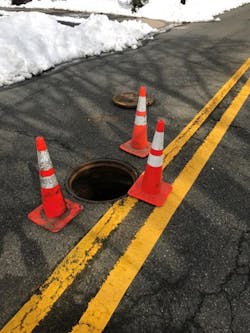
The manhole covers were in close proximity to apparatus and first responders. An immediate evacuation was conducted for all residences along Hollywood Avenue and Hollywood Place. Once evacuations were complete, all apparatus and members retreated to a farther distance.
Upon the arrival of PSE&G, readings were taken on the roadway, underground and inside accessible structures to look for any potentially dangerous gas levels. Subsequently, the arcing wires subsided, and the incident was gradually downgraded as gas levels were determined to be safe. PSE&G de-energized power to the area to ensure the safety of area residents and pedestrians.
The fire department then extinguished the remaining fire and ensured the area was safe. The fire department operated for approximately 7½ hours. The cause of the explosion was a natural gas buildup in the sanitary sewer from a location remote from the site. The resulting explosion escaped at the weakest point, the manhole covers.
This incident is another stern reminder to the public as well as members of the public safety community that electrical and gas emergencies can quickly advance into potentially deadly situations. Fortunately, all area residents, firefighters and other first responders involved in this incident went home safely.
Discussion with Chief Goldfeder, Ho-Ho-Kus department leadership and others
There are several good actions to note about this run by the Ho-Ho-Kus Fire Department and its leaders. Members sized up the incident, established command, notified utilities and evacuated the immediate area, protecting the public and themselves. No one was injured. Although firefighters were in harm’s way when the manhole covers took off, no member of the public was ever at risk due to the department’s cautionary actions. Following are a few thoughts relayed to this type of response.
Utility companies: Utility companies are the experts—get them there quickly. Drill with your local utilities regularly so that your members are prepared on what to do—and what not to do—prior to the arrival of utility representatives. Have them look at your tools and equipment, specifically what you will be using prior and upon their arrival. Training should also include the utility services’ understanding of your department’s command-related policy.
Training: Initial and ongoing annual training should be mandatory for anyone responding to these emergencies. This includes fire, law enforcement, EMS, fire-police, and any other agency that may respond.
Laws: Determine local or state laws in relation to your department operating at gas or electrical emergencies. For example, in the case of wires down, when can you leave that scene? After you tape it off? After the utility company arrives? When you get bored? When you get another run? What if you tape it off, leave the scene, and then a civilian gets hurt, or worse, prior to you essentially “passing command” to the utility responder? Be smart and research these things now and then make sure they are a part of your policies/procedures and training—and be sure to also include your local utility emergency response leaders as a part of that.
Prior to the utility company’s arrival on scene, there is much you can do but that should only be based upon your level of training, education and qualifications. Sometimes doing nothing other than evacuating and protecting an area, like what the Ho-Ho-Kus Fire Department did in the case, is the right thing.
Hot zone: When establishing a hot zone for safety and barrier purposes, be cognizant of where the wires are in relation to exposures, such as walk/bike paths, roads, people, vehicles, metal fences and structures. Assume that electricity will reach those areas if additional wires come down.
Evacuation: If you are going to evacuate an area, how will you do that? How will you communicate with the evacuees initially and then throughout the situation? What’s the risk when they walk out? What about disabled folks? Where are the evacuees headed? What if it is 3 a.m.? What if it is 2 degrees outside? Do they need to evacuate or are they better off staying in their home or building? What is your department’s policy related to area evacuation? Evacuation is no simple task without policy and training.
When appropriate, firefighters can check nearby buildings for gas and overheating electric panels and evacuate if needed.
Underground hazards: What’s underground? Firefighters all know that underground means gas—sometimes manmade and sometime natural—but the gas is down there. We have all read about workers (and firefighters) losing their lives underground when attempting to perform a rescue. With the gas comes the predictable potential of an explosion. Plan for that in training but also size-up the manholes situation related sewer drains and openings.
Water application: In his book and related writing on “Responding to Routine Emergencies,” Chief Frank Montagna (FDNY, ret.), one of my closest mentors and friends, urges caution when applying water to these kinds of fires. There have been several incidents that resulted in injuries to firefighters who sprayed water directly into burning electric manholes. It is better to apply water after the power has been removed from the hole, but it is possible to safely apply water into a live manhole ONLY if you are properly trained to do so—and there is a need. Again, the need for training is clear.
As Chief Montagna wrote: “How can you safely respond to utility incidents without the appropriate level of training? You can't! Since you must respond regardless, make every effort to obtain training and to foster an ongoing relationship with your utility.” Nothing shocking about that advice.
My sincere thanks to the chiefs, officers and members of the Ho-Ho-Kus Fire Department for their willingness and cooperation in sharing this event with each of you.
About the Author
Billy Goldfeder
BILLY GOLDFEDER, EFO, who is a Firehouse contributing editor, has been a firefighter since 1973 and a chief officer since 1982. He is deputy fire chief of the Loveland-Symmes Fire Department in Ohio, which is an ISO Class 1, CPSE and CAAS-accredited department. Goldfeder has served on numerous NFPA and International Association of Fire Chiefs (IAFC) committees. He is on the board of directors of the IAFC Safety, Health and Survival Section and the National Fallen Firefighters Foundation.