Close Calls: We Never Know
I have no experience in high-rise fires, ship fires or subway fires—and I know that, and I act that way. Fortunately, the areas that I respond to don’t provide that challenge. I respond to industrial fires occasionally and to commercial fires plenty. Mostly, I respond to single-family and multifamily dwelling fires, with the majority of responses throughout my career having been to single-family houses. Because of that—and because that applies to most firefighters who operate in suburban areas—I focus strongly on learning as much as I can regarding these common areas.
I never have stopped learning, and I never will. Although every fire might seem the same, they all are a little—or a lot—different. I take my responsibility as a deputy chief (almost always assigned as a division command officer at fires) extremely seriously and never rest on my laurels. Every day is a training day and is an opportunity for me to be the best that I can for those who count on me—the members and the public.
I share the above thoughts as a reminder to each and every one of you—from probie to senior member to company and chief officers—that you must never stop learning on this job and, again, that every day must be a training day. If not, it’s time to go. The former very much was reflected by the companies that turned out on the fire that’s profiled here.
First alarm
This August 2021 fire was a reported dwelling fire in Montgomery, OH, which is a suburb of Cincinnati.
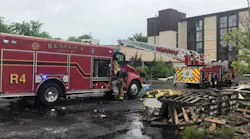
At 10:45 a.m., the Montgomery, OH, Fire Department (MFD) was turned out, along with the Blue Ash Fire Department, the Deerfield Township Fire & EMS Department, the Loveland-Symmes Fire Department, Madeira-Indian Hill Joint Fire District and Sycamore Township Fire & EMS, for the single-family-dwelling alarm that was dispatched by the Hamilton County Communications Center. The MFD companies arrived first along with Fire Chief Paul Wright and reported smoke showing on the Alpha side of the residence. Interior crews confirmed a working fire in the basement walls between the first and second floors, Charlie division.
It’s important that firefighters understand and appreciate what the crews found when operating—and that’s the “you never know” part of this. After all, we are taught to expect the unexpected, and that’s exactly what happened here.
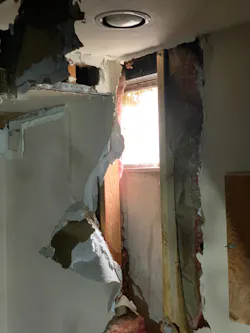
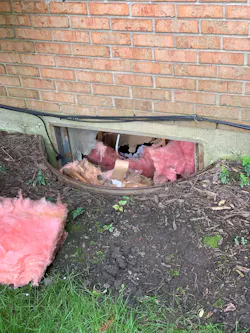
When a 360-degree size-up was done, “look-out” basement windows were identified. There was no “walk-out” basement access. However, what firefighters saw on the exterior didn’t match what was reality inside of the basement. Many of the windows were covered by drywall in the partially finished basement.
Expect vs. find
One interesting element of this fire emerged when exterior firefighters took out some basement windows on the Charlie side. They pulled insulation when they did so. That drew their attention. Excellent.
Normally when a window is vented, or “opened up,” insulation isn’t part of the equation. Knowing what should be expected (as well as what shouldn’t be found) comes from training along with experience—not one, not the other, but a combination of both. You wouldn’t want a surgeon who stopped training after medical school digging into you. You wouldn’t want a pilot who stopped training after pilot school flying your plane. We are no different: Our training never can end.
The members of the department and I originally were dispatched to an electrical fire, which was upgraded to a structure fire.
When dispatch starts a response in a “lesser” condition and then it’s upgraded to a structure fire, it always seems to heighten the emotional response from crews. Mostly, this seems to get them in a position where they apply a more serious consideration, that there truly is a changing environment that they are headed toward.
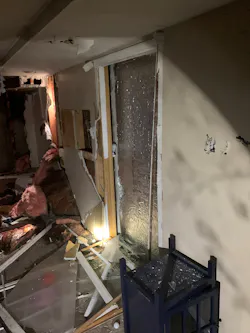
Even with the upgrade in regard to the status of this fire, the first-arriving members didn’t expect to find a basement that was configured with “false windows” nor that the residence’s “true” windows would be covered with drywall.
The smoke conditions on arrival were light smoke on the Alpha side at the basement foundation level. It was white smoke, with no pressure behind it.
I made the initial 360 and considered whether it was possible that this was a mulch fire that worked its way into the structure. The other three sides had no indication of a fire. It was a look-out basement that had no smoke or fire showing from the basement windows. (Note: At this time, we didn’t realize that the basement windows were covered with construction materials.)
I can remember thinking to myself about the dangers of basement fires and that the current thought process was to possibly not make entry (all occupants confirmed out) and to either flow water into the basement via the windows or to cut a hole in the first floor and drop in a cellar nozzle. In reading the building, I discounted both of those options, because the conditions didn’t seem to warrant either of those strategies.
The homeowner then showed me a picture of his finished basement wall that was black from a fire burning behind the wallboard at the top of the ceiling. The entry crew had been advised of the same information prior to entering the structure.
First-arriving was MFD Quint 73 with four personnel, Chief 7302 Assistant Chief Ben Shapiro and me. District 73 Shift Supervisor Lt. Allison Miller-Bultman arrived two minutes later, and she was assigned as the incident commander (IC).
Quint 73’s initial orders were to stretch a line to the structure and to make an attack on the fire from the interior; this was based on the fact that no fire was showing and light smoke was showing on the Alpha side. Quint 73’s operator secured a water supply with the fire hydrant in the front yard.
I believe that the incident went well and that we kept the property damage to a minimum. Although the fire did work up into the first floor behind the walls via the HVAC piping, the crews worked well to get ahead of it and to stop its progress.
All of our mutual-aid partners work very well together and handled assignments without question. Because we all work together on a daily basis, it just becomes a normal operation. This includes our incident management assistance team, or IMAT, regional chief fire officers, who respond on the first alarm.
When the interior crews were faced with a confusing basement configuration, the firefighters maintained their focus and relied on training to overcome the obstacles. They communicated with outside crews to further their size-up and understanding of conditions.
On every emergency scene, you must practice good situational awareness, keep working until the fire is out and be nimble when you are faced with something that you never encountered. Had I decided to keep the crews from making entry and flow water via the basement windows, we would have burnt down a perfectly good house and lost all of the homeowner’s property.
Although I agree that there’s a place where it is appropriate for the aforementioned tactic to be utilized, conditions, occupants, etc., always must be part of the size-up, to determine tactics.
We, as ICs and firefighters, must continue to train and read up on current strategies and tactics but, at the same time, apply those with our training and experience and use the best strategy and tactics for the given situation.
I was the fourth-due chief at this fire, and when I reached the scene, the fire was under control. While I was in the process of responding, I heard what’s described above, and, as many of you would guess, of course, my interest really was piqued.
This is another excellent reminder of the critical importance of the 360.
Had this been a basement fire with heavy fire conditions, the concept of hitting it from a basement window would have been hampered severely because of the internal modifications.
The “false windows” were in numerous locations in the dwelling as was a “false doorway” and other related interior changes.
There were many unusual factors in this dwelling: nothing that we would expect—but always must expect.
Worth repeating: This is another excellent reminder of the critical importance of the 360. (See “360 Considerations” sidebar.)
As stated by Wright, the members functioned well, the fire was held to the wall area and training kicked in at numerous times during this job.
While this incident was occurring, a mayday was called. It turned out that it was because of a firefighter who “went down” at rehab, and it was believed that the firefighter was having an emergency. That said, the circumstance served as a good unplanned “drill” in conjunction with company accountability.
Our thanks to Wright, his department and the mutual-aid departments for allowing us to share this “no such thing as routine” single-family-dwelling fire: a chance to learn and/or to reinforce previous experiences.
Montgomery, OH, Fire Department
The Montgomery Fire Department (MFD), under the command of Fire Chief Paul Wright, protects a population of about 12,000 in about 5.5 square miles with seven firefighter-paramedics on duty per shift. Montgomery is part of a regional automatic mutual aid “box alarm” system. Numerous departments respond together, which ensures apparatus and staffing of approximately 25 firefighters, with area chief fire officers responding as command support (known regionally as IMAT, or incident management assistance team), depending on the run.
360 Considerations
- The fire’s size, location and extent (including initial life hazard/occupants)
- Verify basement type, the stories and construction type/factors
- The ventilation profile of the structure (the identification of flow paths or potential flow paths—and pay attention to wind considerations)
- Identify the best access/attack position(s) as well as egress considerations
- Confirm life safety profile of the incident overall
- Exposures
- Consider your immediate available resources, what else is responding and what else you might need—and get the resources that you might need on the road—at least into staging—immediately
Although the entire 360 evaluation and report is critical to the incident commander and all of the members who are operating, the Charlie division conditions often are a high priority.
Further Reading
Consider the following organizational information that’s related to basement fires:
· “Preventing Deaths and Injuries of Fire Fighters Working at Basement and Other Below-Grade Fires,” National Institute for Occupational Safety and Health (NIOSH)
· UL’s Fire Safety Research Institute (FSRI)/International Society of Fire Service Instructors (ISFSI): “Understanding and Fighting Basement Fires” online course
· “Structural Stability of Engineered Lumber in Fire Conditions,” FSRI
About the Author
 Billy Goldfeder
BILLY GOLDFEDER, EFO, who is a Firehouse contributing editor, has been a firefighter since 1973 and a chief officer since 1982. He is deputy fire chief of the Loveland-Symmes Fire Department in Ohio, which is an ISO Class 1, CPSE and CAAS-accredited department. Goldfeder has served on numerous NFPA and International Association of Fire Chiefs (IAFC) committees. He is on the board of directors of the IAFC Safety, Health and Survival Section and the National Fallen Firefighters Foundation.
Related
 A chief officer who has 17 years of experience arrived at this residence one minute after dispatch. His rescue of reported trapped victims via entry through the front door and movement on his knees toward bedrooms was prevented when the neutral plane dropped, bringing immediate extreme heat.