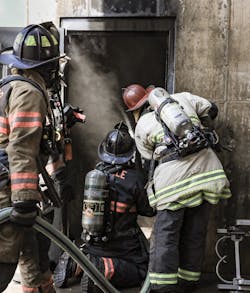
An unreasonable demand that often is placed on minimally staffed fire departments is for a crew of 2–4 firefighters to perform all fireground functions simultaneously. These departments would be wise to focus the majority of their efforts on suppressing the fire as quickly as possible. However, if there’s a known victim location or visible victim, their strategy could change to rescue from extinguishment.
Extinguish before rescue?
On the minimally staffed fireground, fire extinguishment quickly becomes the number one priority. Other fireground tasks, such as search, ventilation, RIT and salvage, must wait or be properly sequenced in order of completion based on the context of the fire and the available staffing that’s needed to complete those tasks.
This might seem counterintuitive to the operational thought process, considering that so many are familiar with the acronym RECEOVS (rescue, exposure, confine, extinguish, overhaul and ventilate, and search). The acronym was first referenced in 1953 by Lloyd Layman in “Fire Fighting Tactics.” Layman wrote, “Rescue includes those operations which are required to remove human beings from an involved building or other hazardous situation and convey them to a place of safety.” Many rationalize that the acronym beginning with “R” means that finding and removing occupants comes before all operations. Further reading in the book proves that this is far from the truth. Layman posed the question, “Do conditions demand their immediate removal?” and later noted, “In some instances, it may be advisable to attack the fire in order to control it until rescue operations can be completed.”
Extinguishment over rescue or vice versa can be made even more unclear for firefighters if they participated in training that wasn’t representative of the staffing levels that normally are attained.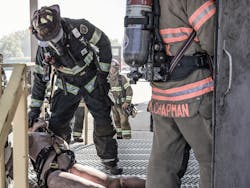
Training that misrepresents
In many rural communities where inadequate staffing in prevalent, training is regionalized or provided on a state level through a larger system. Although this is a fiscally responsible model in most cases, the relevance of equipment, staffing levels and capabilities varies greatly for each student.
It’s my observation that in these larger, more diverse settings, the training focuses on the numerous fireground operations happening simultaneously: Fire attack is initiated with the first crew while a next crew begins ventilation operations moments later; the primary search for occupants outside of the path to the fire isn’t far behind and is performed by yet another crew.
The task specificity to each crew begins to create a false mental map that must be corrected. If it isn’t, crews later might face situations that exceed their abilities, and they become overwhelmed. Furthermore, this correction must be more than a kitchen table discussion over a cup of coffee. Members must gain physical repetitions that are similar to the circumstances that they will encounter. If not, they will fall victim to a narrow focus on fire extinguishment, because they were trained that the other fireground tasks are handled by other firefighters. This leads to fire extinguishment being perceived as the climax of their involvement.
Something similar to climax of involvement is outlined by Lt. Col. Dave Grossman in “On Combat: The Psychology and Physiology of Deadly Conflict in War and Peace.” He references the amount of stress that’s experienced by both a police officer and a suspect who the officer is placing under arrest. The officer’s stress is significantly higher before the suspect is placed in handcuffs; the stress of the suspect increases on arrival at the jail. These two facts can lead to officers being caught off guard when a suspect attempts to flee or fight upon the sight of a jail cell.
As another example, Grossman references the military group that overtakes an enemy’s position and how that group is vulnerable to counterattacks because of the feeling that the group achieved its objective.
Firefighters aren’t exempt from the same phenomena, and those who operate on the fireground amid low staffing in most cases narrow their focus to the fire. However, they must not forget that the battle isn’t over merely because the flames vanished. They must not relax in this moment. There still can be unseen fire extension or, worse yet, unseen victims.
You must remember to stay vigilant throughout the entire incident, because maydays can happen at any point during an incident. Maydays, such as becoming trapped by debris and entanglements, happen approximately 35 percent of the time during the overhaul stage of fire attack.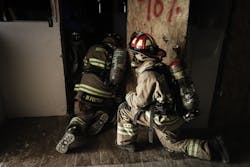
After “victory”
The physiological relaxation that’s noted above is known as parasympathetic backlash.
The autonomic nervous system (ANS) regulates bodily functions that are outside of voluntary control. The parasympathetic nervous system (PNS) is a subdivision of the ANS. The PNS is responsible for the restoration of our body to normal operating condition. It’s the driving force of recovery, because it slows the heart and respiratory rate while increasing digestion. Put another way it’s the “R & R” (rest and recovery) system.
The feelings that lead up to parasympathetic backlash are the product of the more widely understood sympathetic nervous system (SNS). We understand the SNS’s role as the driving force behind the fight-or-flight response. The automatic response that we feel in our body as we advance toward the fire is the SNS. Our heart and respiratory rates increase, and bodily functions, such as digestion and salivation, turn off.
In the military, they train for “consolidation and reorganization on the objective” after that moment of victory. This is a refocusing of attention to the now more immediately important tasks, such as securing a perimeter. In the understaffed fire attack, you must train to refocus yourself after darkening the seat of the fire or stopping the fire’s forward progress. This is where you must turn your attention to any potential victims, particularly those who are outside that might have been outside of the path that you used to advance to the fire.
Search
At this point, the attack crew made its way into the most thermally affected area. This is an ideal location to begin a primary search, absent of any definitive information on occupant location. This allows you to quickly search for those who were immediately in harm’s way because of the high heat exposure.
The officer or crew leader checks the fire area, preferably with a thermal imaging camera (TIC), to ensure that the fire is controlled and to observe any possible ventilation openings that can be utilized quickly to exhaust excess heat and toxic gases. This person then should turn attention toward searching and venting away from the fire. This might need to be done on one’s own. This search should take place until all rooms received a primary or another search crew is met.
The nozzle firefighter should hold this position and finish extinguishing the fire. If this firefighter is equipped with a TIC, the firefighter may use it to monitor the fire conditions, look for extension and stay oriented to the firefighter(s) who is searching. Fire extension and regrowth around the location of the firefighter(s) who is searching is the primary concern of the nozzle firefighter post-extinguishment—while also supporting ventilation with the hose stream (hydraulic ventilation). The nozzle firefighter must stay vigilant and continue to stay primarily focused on the thermal conditions and fire’s regrowth while providing protection for the victim and searching firefighters.
Although this scenario is far from ideal, it most assuredly is reality for many first-arriving engines. That said, you shouldn’t use it as an excuse to be reckless. This should be a calculated risk that’s taken after a size-up of the fire scene, resources and capabilities. The ability to incorporate other fire suppression tactics that place water ahead of the attack crew should be utilized when feasible and in the proper context.
No letdown
Although circumstances might differ from firehouse to firehouse, dedication to saving lives is our bonding mission. The number of firefighters who are available often requires one company to perform multiple functions. It’s important for these firefighters to be trained to prioritize the actions that are needed and to continually refocus their attention after one task is finished. You only should truly relax when you determine that the building is clear of any occupants.
About the Author
Joey Baxa
Joey Baxa has been a firefighter for 15 years. He currently holds the rank of captain with the Buckhannon, WV, Fire Department. Baxa also is an instructor with Insight Training LLC and is an adjunct instructor with West Virginia University Fire Service Extension.