RIT and Resources in Commercial Building Fires
Key Takeaways
- Fireground commanders must view NFPA 1710 standards as baselines, not as what ultimately might be required, at commercial building fires.
- Fireground commanders who respond to commercial building fires must anticipate water supply challenges and graduate to use forward lays, reverse lays and tankers.
- Fireground commanders always should deploy a dedicated RIT of four or more at commercial building fires. A two-person initial RIC should be considered as only a temporary measure until the full RIT is in place.
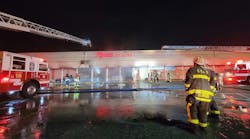
For commercial building fires, NFPA 1710: Standard for the Organization and Deployment of Fire Suppression Operations, Emergency Medical Operations, and Special Operations to the Public by Career Fire Departments provides a starting point, but it won’t prepare you for the challenges of a 40,000-sq.-ft. furniture store or a 100,000-sq.-ft. warehouse. Too many departments treat minimums as goals rather than baselines.
The staffing number on the response chart might meet the standard. However, when fire rolls across a truss roof and two companies are stretching, you realize that the standard doesn’t fight the fire for you. Fireground commanders must not settle for minimums. The difference between a successful operation and a tragedy is in the NFPA text’s application under pressure, on scene, with your firefighters.
Commercial fire reality
Commercial fires aren’t just bigger versions of house fires. They are hotter, faster and more complex and require more resources. Large open spaces that are filled with synthetic materials cause fires to grow quickly and weaken structures early. A lightweight truss or bar joist system that’s exposed to flames can fail in 10 minutes or sooner. Foundational texts, such as Francis Brannigan’s “Building Construction for the Fire Service,” have emphasized this exact point. During that same short window, you’re trying to stretch lines, search, ventilate and set up a water supply. In this environment, the decisions that are made by the first chief or company officer in the first two minutes shape the next two hours.
That’s why the fireground commander should arrive ready for a marathon, not a sprint. Command must plan for fire flow, staff rotations, RIT deployment and relief companies before the situation demands it. In “Command Post Location” (firehouse.com/21243635), I wrote about the need for flexible command presence and knowing when to be close enough to influence operations and when to step back to manage them. Commercial fires challenge that balance more than any other situation.
True starting point
NFPA 1710 5.2.4.2.1 requires 27 personnel on a full first-alarm assignment at a commercial occupancy (or 28 if an aerial is used). That’s the standard, but it’s also the bare minimum. You need that many firefighters to keep operations safe and coordinated in an open-air strip mall. That number doesn’t cover every challenge. You still might face delayed forcible entry, heavy roof loads or multiple fire compartments that are separated by masonry walls.
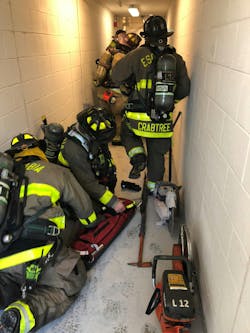
Those 27 members aren’t the maximum that you should consider. If your department sends fewer than 20 firefighters to a commercial first alarm, take specific action: enhance preplans, use aggressive mutual aid or establish automatic second-alarm policies. Set clear trigger points to signal a second alarm. Focus on managing water, coordination and time.
Water, apparatus, fire flow
At commercial fires, getting water to the fire is the real challenge. Big buildings need a lot of water, and that takes planning. The fireground commander must anticipate water supply challenges and graduate to use forward lays, reverse lays and tankers. Commercial buildings also pose access issues, such as roll-down doors, metal-bar gates and multiple roof layers. Every minute that’s spent forcing entry is another minute that the fire grows unchecked.
This is why bench depth matters. Firefighters don’t fail because they aren’t willing; they fail when the fire grows faster than the crew can handle. Make sure that you have extra staffing to relieve, rotate and reinforce companies. Without bench depth, the fire wins by wearing out your crews.
As discussed in “Water on the Fire” (firehouse.com/21287164), focus on building the Big Four—pump, hose, nozzle and water—as your base for suppression. In commercial fires, also prioritize apparatus placement and a steady water supply. Keeping these in place determines how long that you can stay on offense.
Real RIT for real fires
In commercial buildings, a two-person initial RIC isn’t enough. U.S. Fire Administration, NFPA 1407: Standard for Training Fire Service Rapid Intervention Crews, and National Institute for Occupational Safety and Health (NIOSH) data all indicate that a RIT should have at least four trained firefighters. Their sole responsibility is firefighter rescue. Use the IRIC only as a temporary measure until the full RIT is in place. The key recommendation: Always deploy a dedicated RIT of four or more in commercial buildings.
The logic is simple. Two firefighters can’t perform an interior rescue in, for example, a 50,000-sq.-ft. furniture store or a 60,000-sq.-ft. supermarket. Commercial RIT operations need enough members to handle air, disentanglement, packaging and removal. They must stay in touch with command and watch their own air supply.
The RIT must be equipped, not just assigned. Thermal imagers, RIT packs, rope, saws and air-management tools should be ready before a mayday call, not after.
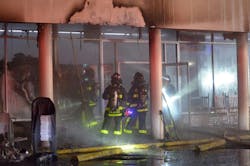
Fireground commanders must treat RIT as a proactive function in commercial occupancies, not just a backup. Establish, equip and stage RITs according to a building’s size and interior conditions. Remember: Until a fully prepared RIT is in place, you, as chief, are your crew’s only safety net.
Commercial RIT matters
For every commercial fire, address these key RIT elements: positioning, air supply, relief and rotation, clear marking and identification, and realistic training. Proactively adjust tactics as the emergency evolves. Anticipate the next challenge before it occurs.
- Positioning. Place RITs by building footprint. A single RIT on the A side of a 200-ft. deep warehouse can’t reach a firefighter who’s lost near the C side. Consider a RIT at all access or anticipated egress points for operations.
- Air supply. Track the rescue crew’s air consumption. Many RIT failures occurred because rescuers ran out of air before completing extrication. Assign a support team to manage and rotate RIT personnel.
- Depth and relief. Plan for RIT relief and rotation as you would for suppression companies. RIT fatigue is real, particularly during heavy extrication or air-delivery operations.
- Marking and identification. Every firefighter should be labeled on the mask, helmet, coat and SCBA.
- Training realism. RIT must train for low/zero-visibility, high-heat conditions. They should practice ID–Air–PASS simultaneously: identify the firefighter, confirm and deliver air, silence the alarm and notify command.
It's imperative that teams be trained to automate these actions. Fireground commanders: Debrief after every incident to identify areas for improvement. Treat each step as a formal, necessary part of commercial fire response.
Command, comms, collapse
Concrete, steel and heavy roof assemblies create difficult commercial fireground conditions. Once heat and flames reach the roof supports, failure can happen without warning. Every fireground commander should picture a countdown clock starting as soon as fire hits structural members. If suppression doesn’t make progress in 10–20 minutes, it’s time to reassess. Collapse follows a timeline.
Reduce the fireground commander’s span of control when needed. Assign division or group supervisors and reduce communication across the scene. Treat accountability as an active process; tag boards alone don’t track people. Do regular PARs and use face-to-face reports when possible. You alsocan utilize dispatch to provide incident timing notifications. In “Below 2,000: Saving Lives, Civilian Lives” (firehouse.com/21261205), I emphasized that timing is crucial to survival.
The same lesson applies here: Know when the timeline has shifted from rescue to preservation and make the change before the building forces you to.
Preplanning and training
Success on the commercial fireground starts long before the alarm. Preplanning is one of the most underused lifesaving tools. Walk through your strip malls, warehouses and medical offices. Know the roof construction, firewall placement, FDCs, hydrants and rear access routes. When you picture the risks, you’ll make smarter tactical decisions.
Training must match that same complexity. If your firefighters only train for single-family houses, they’ll treat every building the same way. Create RIT drills that challenge size-up, air management and low-visibility rescue in large spaces.
Fireground patterns
These lessons, which shape how we lead at commercial fires, were drafted in the sacrifice of our fallen brothers and sisters. Four major commercial fire fatality incidents—Charleston, SC (F2007-18), Worcester, MA (F1999-47), Phoenix, AZ (F2001-13) and Asheville, NC (F2011-18)—remain highly studied incidents that continue to shape the fire service. These events occurred in a furniture store, a storage warehouse, a grocery store and a medical facility, respectively. All of these types of buildings exist in nearly every city and town. Each incident revealed the same truth: When failure happens, it happens quickly.
After reviewing more than 50 formal recommendations across these four reports, patterns emerged. Some are obvious, some are surprising, but all point to a simple truth: Commercial fires don’t forgive gaps in command preparation or staffing. What follows are the two most powerful groupings of shared insight.
Five recommendations applied to all four incidents and reflect what this column emphasizes and what the fireground proves:
- The incident command system (ICS) must be clearly established, scalable and supported by assigned sectors and a command post. Fireground chaos grows when strategy lives on a radio and not on a board.
- The RIT must be deployed early, fully staffed and trained to perform. The message is consistent: Token IRICs aren’t rescue-ready.
- Real RIT, not IRIC, is the difference between having a team and having a rescue plan. Reports and real-world outcomes both prove that two-person IRICs are insufficient in large commercial spaces.
- Structured ICS with division support. ICS isn’t just a vest and a whiteboard. It’s positioning, delegation and tempo management across a multifront fireground.
- Live accountability. Tags don’t save lives; tracking people does. All four of the reports cited breakdowns in accountability.
Two critical areas don’t always make the top of the “NIOSH 5” list but are critical for successful outcomes in commercial occupancies:
- Water supply & apparatus planning. It isn’t enough to get water to the scene. You must get it to the fire. Positioning and flow must support time-on-task for long stretches in large structures.
- Preplan your district’s hazards. You can’t command what you never walked. Reports emphasize walkthroughs, roof awareness and layout familiarization.
Treat these findings as critical areas for improvement, not as blame. Commercial fires expose every system weakness. Focus on what you can control: thorough preparation, adequate staffing and disciplined command routines.
Study the NIOSH reports from the four incidents at the kitchen table today. Review every decision point, communication log, and lesson on RIT and command coordination. Absorb these reports and turn lessons into action.
More than minimum
Twenty-seven firefighters might meet the NFPA standard, but having 35 on scene—trained, coordinated and well-commanded—can mean the difference between chaos and control. Commercial fires need more than just compliance. They require a strong command presence, enough resources and a real RIT. Chiefs must think in layers: water, staffing, rotation and rescue.
Command & Control Success always has been about more than just managing radio traffic. It’s about leading firefighters in environments that reward preparation. We can’t control when the next commercial fire will test us, but we can control whether our firefighters are ready, our RITs are real, our command plans are solid, and our people have everything that they need to go home.
About the Author
 Curt Isakson
Curt Isakson
Curt “Ike” Isakson is a 30-plus-year veteran of the fire service. He worked for Escambia County, FL, Fire Rescue for 25 years. Isakson previously worked nine years for the Pensacola, FL, Fire Department, where he was assigned as a company officer on Heavy Rescue 31. Isakson currently is deputy fire chief of Fire & EMS for Bay County Fire-Rescue, which is in the Florida Panhandle. His fire service experience started at a young age as a junior firefighter with the Midway, FL, Fire District; he rose through the ranks to captain. Isakson's identification of the need for a series of special-interest fire conferences spawned the development of County Fire Tactics, which covers officer development, command officers, water on fire, high-rise operations, and leadership and tactics.