A Research-Driven Approach to High-Rise Fire Risks to Firefighters and Occupants
Key Takeaways
- Research that was conducted by the Montgomery County, MD, Fire & Rescue Service found that smoke spread is the primary life-threatening factor in fires in unsprinklered high-rise residential buildings and that traditional attack methods expose firefighters to extreme heat and toxic gases.
- Data showed that attacking a fire in an unsprinklered high-rise residential building from the floor below the flames reduces firefighter exposure and accelerates suppression.
- Research confirmed that smoke migration in unsprinklered high-rise residential building fires kills more residents than flames do. Deployable smoke curtains at doorways dramatically slow smoke spread.
Across the United States, fire departments face a persistent challenge: older, unsprinklered high-rise buildings that predate modern fire codes. These structures, which often were built decades ago, lack the most effective life-saving technology that’s available: automatic fire sprinklers. Montgomery County, MD, which is home to more than one million residents, is no exception.
Although the county mandates sprinklers in new construction, dozens of legacy residential high-rises remain without them. Fires that occur in these structures spread faster, behave unpredictably, and place both residents and first responders at greater risk. County leaders understand the life-saving value of sprinklers, but retrofitting is far more complex than passing a bill.
Research behind the risk
Montgomery County Fire & Rescue Service (MCFRS) asked a critical question: What do the data tell us about high-rise fires in unsprinklered buildings?
The department’s research team analyzed incident reports from local and national high-rise fires; smoke migration patterns that were documented during drills and real events; firefighter injury data that were linked to high-rise operations; and evacuation timelines under varying conditions.
The findings were clear. Smoke spread is the primary life-threatening factor in unsprinklered fires. Hallway and stairwell conditions deteriorate rapidly, often before suppression begins. Traditional attack methods expose firefighters to extreme heat and toxic gases.
This evidence drove the development of new tactics and tools that are designed to mitigate these risks.
Learning from the U.K.
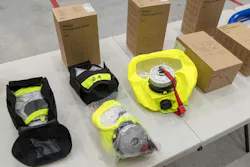
The department’s research didn’t stop at local data. MCFRS sent representatives to Chicago, New York City and the U.K. to attend high-rise fire safety seminars and symposiums, where among other things, European strategies for smoke control and evacuation were studied. One key takeaway: Smoke escape hoods, which are used widely throughout the European Union, dramatically improve survival rates during high-rise fires. MCFRS brought that knowledge home, adapted it for Montgomery County and launched one of the first large-scale community smoke hood programs that’s in the United States.
This international collaboration underscores a critical truth: Fire safety challenges are global, and solutions must be shared. By combining local data with global best practices, MCFRS is setting a new standard for research-driven innovation.
Why retrofitting is difficult
Retrofitting older concrete high-rises requires major infrastructure work: piping, demolition, system integration and resident displacement. Developers argue that the financial burden is enormous, and elected officials must weigh life safety against housing affordability. For many families, even modest rent increases can mean displacement.
To balance these pressures, Montgomery County enacted phased legislation that focuses on resident fire safety notifications, community education requirements, building-specific action plans, identification of higher-risk structures, and early-warning upgrades and oversight.
This approach improves safety now while the county pursues long-term sprinkler retrofits.
Innovation from research
While policymakers navigated economics, MCFRS refused to wait. Guided by research, the department developed and deployed tactical innovations that are particular to unsprinklered buildings.
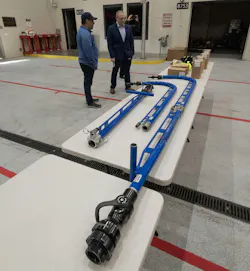
Floor-below nozzles. Data showed that attacking a fire from the floor below it reduces firefighter exposure and accelerates suppression. MCFRS engineered and trained crews on this method, which improved operational safety.
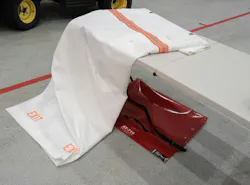
Smoke curtains. Research confirmed that smoke migration kills more residents than flames do. Deployable smoke curtains at doorways dramatically slow smoke spread, which buys time for evacuation and suppression.
Community smoke escape hoods. Evacuation studies revealed that residents often succumb to smoke before they reach safety. The MCFRS hood program—expanded through community partnerships—provides residents with critical protection during escape.
Measuring success
MCFRS continues to collect data on curtain deployment times and smoke-migration reduction; floor-below nozzle effectiveness in heat and smoke control; and resident survival rates that are linked to hood distribution.
Preliminary results show that curtains reduce smoke spread by as much as 60 percent in controlled drills. Floor-below tactics cut firefighter exposure time by 30 percent. Smoke hoods increase evacuation success rates significantly.
These metrics guide ongoing research and refinement. MCFRS’s strategy for the path forward includes expanding high-rise evacuation training; targeted outreach to high-risk buildings; partnerships to inform legislation; advocacy for equitable retrofit solutions; and enhanced firefighter safety initiatives.
The message is clear: Sprinklers save lives. Until every building has them, research-driven innovation will keep the community safe.
Legacy of impact: Melanie Diaz
The expansion of the Montgomery County Fire & Rescue Service smoke hood program was made possible through the advocacy of the Diaz family, who lost Melanie Diaz in a high-rise fire. The Diaz family's commitment transformed grief into purpose, to ensure that no other family faces the same tragedy. Melanie’s legacy now saves lives across Montgomery County.
Why Sprinklers Matter
- Reduce fire death risk by as much as 90 percent.
- Control or extinguish fires in 97 percent of cases.
- Limit smoke spread, which is the primary killer.
About the Author
 Corey Smedley
Corey Smedley
Corey Smedley is the fire chief for Montgomery County, MD, Fire & Rescue Service (MCFRS), which is one of the largest combination departments in the United States. He leads research-driven initiatives to improve firefighter safety and community resilience, focusing on fire prevention and life-saving innovations.