Fire Department Command Teams: Commercial Fires & Multi-Alarm Incidents
Key Takeaways
- Because commercial building fires and multi-alarm incidents are more complex than residential fires and very staffing intensive, the fireground commander (aka the supervising officer) must be able to use a thermal imaging camera, monitor/talk on the radio, and maintain situational awareness of ceiling height, heat, depth into the building and rules of air management.
- An incident operations officer directly manages the interior attack and the progress of fire companies that are engaged in the immediately dangerous to life and health environment at commercial building fires and multi-alarm incidents.
- The safety officer who is part of the command team at a commercial building fire or multi-alarm incident should be in full gear and evaluate the staffing, capability and staged location of the rapid intervention team.
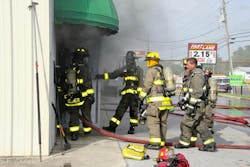
Command teams at commercial building fires and multi-alarm incidents are critical for command success. In a previous column in this space, we discussed NFPA 1710: Standard for the Organization and Deployment of Fire Suppression Operations, Emergency Medical Operations, and Special Operations to the Public by Career Fire Departments and how particular commercial fires require a minimum of 28 firefighters.
With the large number of firefighters and fire companies exceeding six fire companies, the span of control is definitely beyond one person commanding the overall incident.
I suggest when a command team grows that you consider how you delegate each team member based on the particular incident and not some standard format. Unlike residential fires, commercial building fires and multi-alarm incidents involve massive fire loads, complex layouts and high-stakes structural risks. To keep fire companies/firefighters safe and to keep the building from burning down, a strong command team isn’t just a check of a box or luxury; it’s critical.
Command team members
Commercial building fires are complex fires that require strong command presence and that have a strategic plan that’s realistic based on your staffing model or actual staffing capabilities. Often, when firefighters are injured or killed at commercial building fires, it's based on an unrealistic strategy, lack of experience compared with residential fires, and lack of proper staffing. There is a reason that NFPA 1710 starts at 28 firefighters for these challenging fires, and you can’t overlook this when building your command plan.
The fireground commander must take everything into consideration when rapidly deciding the strategic plan and assigning personnel. Two big considerations are span of control of the different tactical assignments and tracing the overall progress for the coordinated fire attack while meeting critical benchmarks. Two big benchmarks are the time that it will take to get water on the fire and the amount of water that will be required.
More times than not, a commercial building fire requires a larger attack handline and a decision on when this handline needs to go interior. This is very staffing intensive and requires a supervising officer who isn’t engaged in touching or moving the line. This officer must be able to utilize the thermal imaging camera and monitor/talk on the radio while maintaining situational awareness of ceiling height, heat, depth into the building and rules of air management (ROAM).
Most of the time, one of the first additions to command will be the incident operations officer/chief officer to directly manage the interior attack and the progress of the fire companies that are engaged in the immediately dangerous to life and health/interior environment. Some call this person the support officer. When possible, this individual should be an experienced chief officer who possesses solid command presence and the ability to quickly call for a retreat that will prompt all firefighters to immediately take the command and react properly.
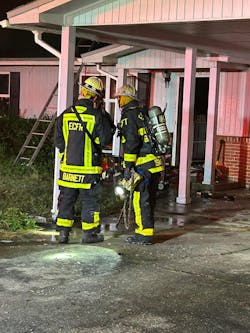
It’s critical to monitor for fire conditions and building stability. Commercial buildings normally have larger open floor plans that contribute to a higher probability of firefighters getting lost, caught and trapped. This is one of the big differences compared with a fire at a single-family residential building, where firefighters are more likely to get caught in a flashover/changing fire conditions.
The third position frequently is the safety officer. (Often, this third position is even filled at a house fire based on how aggressive companies usually must be and the reality that house fires more frequently prompt firefighter tunnel vision that results in members failing to see the rapidly changing fire conditions, which is one of the top focuses for the safety officer.) The safety officer should be in full gear, including an air pack, and evaluate the staffing, capability and staged location of the rapid intervention team (RIT).
(The RIT must be a minimum of four members who are trained in firefighter rescue per the U.S. Fire Administration. This is more than your Occupational Safety and Health Administration’s two-in, two-out for the early stages of a house fire.)
Commercial fire challenges
Commercial fires often occur in Type II (noncombustible) or Type V (lightweight wood) construction. The command team must observe consciously and acknowledge the bigger challenges of these types of buildings based on construction size and complexity. For example, lightweight trusses can fail in as few as 5–10 minutes under direct flame impingement. These trusses are sometimes a lot higher than the typical residential fire and are more difficult to size-up/read the actual fire that’s attacking them.
These buildings also can make radio-to-radio communications more challenging. I frequently have had to switch to the simplex radio system and bypass the repeaters. Also consider utilizing mobile/more powerful radios in the exterior. Sometimes, I chose the officer seat of the first-due company to utilize the mobile radio. I have found that holding the mic from the truck-mounted radio is much better than the portable—although I still have two portables to assist with the overall fire communications. (Every time that I deal with Type I/concrete high-rise buildings, I prefer to use a mobile radio.) Regardless, I still like the ability to directly see the building and what it’s telling me throughout the incident.
I don’t need to strictly rely on someone else who’s on the command team to relay this critical information. I also have placed chief officers in the lobby, on the fire floor, on the roof and in other parts of the building to enhance the radio communications.
Air supply
Commercial building fires require a lot of air for firefighters to reach the fire, attack the fire and get out with remaining air supply. This requires more firefighters that are equipped with SCBA and fire officers managing and hitting ROAM benchmarks to ensure that firefighters don’t run out of air.
Most departments now have RIT air packs that are assigned to all fire companies and chief officer vehicles.
You must consider utilizing these air supplies in a proactive way by placing them in a forward place, so there is no delay in them being utilized to mitigate a minor air supply issue that otherwise could become a significant mayday because a firefighter ran out of air.
A few years ago, I started assigning RIT air packs to the interior and upper floors. These RIT air packs are above and beyond the ones that are utilized by the actual RIT/firefighter rescue team. I also do the same thing with medical bags and AEDs. For a firefighter who’s in a large commercial building or a high-rise building, needing either air or medical attention could be beyond the 4–6 minutes that we know from our annual CPR training. So, be proactive and assign them as you assign members to the command team.
Offensive to defensive
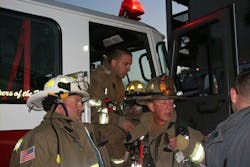
One of the most critical moments in a commercial building fire is the transition from offensive to defensive operations. An experienced, well-trained fireground commander who has the support of the command team recognizes when the fire has won the war against the building. The fireground commander must be decisive in calling for an emergency evacuation and a personnel accountability report before the building has become the strongest enemy. There’s no shame in a defensive stand that still protects the exposures and keeps the fire to the building of origin. The ultimate fireground priority is safety and “everyone goes home.” This includes civilians and firefighters alike.
On larger building fires that require a large fire flow, I assign a water supply officer to the command team. I have assigned very experienced and competent driver/operators to this position.
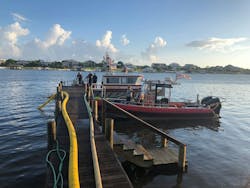
I also have assigned them their own fire channel to communicate the overall water supply on a different channel. This person on the command team, who evaluates the overall water supply options and capabilities, looks at different main sizes, drafting options, tender options and even the possibility of fire boats supporting the operation. I commanded numerous fires at which fire boats and portable water floating pumps made the difference in overall water supply.
About the Author
 Curt Isakson
Curt Isakson
Curt “Ike” Isakson is a 30-plus-year veteran of the fire service. He worked for Escambia County, FL, Fire Rescue for 25 years. Isakson previously worked nine years for the Pensacola, FL, Fire Department, where he was assigned as a company officer on Heavy Rescue 31. Isakson currently is deputy fire chief of Fire & EMS for Bay County Fire-Rescue, which is in the Florida Panhandle. His fire service experience started at a young age as a junior firefighter with the Midway, FL, Fire District; he rose through the ranks to captain. Isakson's identification of the need for a series of special-interest fire conferences spawned the development of County Fire Tactics, which covers officer development, command officers, water on fire, high-rise operations, and leadership and tactics.