Keys to a Fire Department Avoiding a Close Call at a Row-of-Stores Fire
Key Takeaways
- What fixes fire department normalization of deviance? Aggressive leadership that continually pushes every officer and member to continually train and learn.
- Firefighters must recognize that today’s fire behavior, construction, power/charging systems and more differ from what was learned in training that they received years ago.
- Systems that contribute to preplanning efforts are available for departments of any size budget, but even when funding isn’t available, preplanning can be done by members using phones, cameras, paper and pen.
The more that we do things wrong, the more that they can seem right. That’s known as normalization of deviance. This phenomenon occurs when people in most any organization become so insensitive to deviant (wrong) practices that the behavior no longer feels wrong. The wrong behavior becomes accepted—and “the way”—until what we knew was wrong comes back to bite us, sometimes very badly.
How do you fix normalization of deviance? By not allowing your department to veer away from continual qualified training, applying the best proven practices, and learning from outside of the organization and from subject matter experts. To do so requires aggressive leadership that continually pushes every officer and member to that training and learning. It never stops—nor can it—for any member who’s active within the department. You can’t show up for “game day” (a fire run) without participating in the “preseason” as well as all season long (between the incidents).
That’s how this fire in Oceanside, NY, can be summed up.
Row-of-stores fires are infrequent runs for most departments. Gordon Graham calls these low-frequency/high-risk events, but they are well within a department’s scope of success when the training never ends, for every member, every rank.
A row of stores, or strip mall, is a succession of businesses that have a common roof and are separated by partitioning walls that usually reach the ceiling, leaving the attic or cockloft open above the occupancies.
Saturday, Oct. 18, 2025, began for the Oceanside Fire Department (OFD), which is in Long Island, NY, with its four chief officers taking part in a battalion-wide chiefs drill that consisted of sector assignments and responsibilities for larger-scale incidents. The OFD is within the second battalion of the Nassau County Fire Service (a total of nine battalions with 70 departments).
Little did those chief officers know that by the end of the day, this training would come into use a lot sooner than anticipated.
My sincere thanks to the commissioners, chiefs, officers and members of the OFD and their mutual-aid partners. In particular, special thanks to the OFD officers and the mutual aid officers who are named within this account, led by OFD Chief of Department Sean Costigan and Assistant Chiefs Kevin Klein, Sean Lynch and Mark Sparberg.
Account from Klein and Lynch
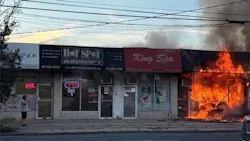
At 5:43 p.m., Nassau County Fire Communications dispatched the OFD to a reported building fire at a one-story taxpayer that consisted of four stores. The fire was in a vacuum cleaner sales and service store at the far right end of the row of stores. This call type gets all Oceanside companies and units due.
On a Saturday evening, we knew that we would get a good turnout.
Sparberg was only a few blocks away from the location and arrived within two minutes of the alarm. He observed fire coming out of the front windows of the fire building and gave the working fire signal and the size-up of a one-story commercial building of Type III construction with fire out the Alpha side and, importantly, some fire through the wall on the Delta side.
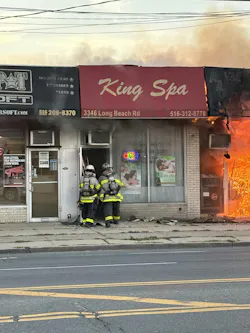
Klein arrived as the second-due chief officer. While still donning PPE at the back of his car, he observed fire coming out of the front windows and door of the original fire store, auto exposing into the soffit and extending across the front of the building into the exposure two storefront, a nail spa.
Klein contacted Costigan, who was en route, and advised him that there was fire in the cockloft and to transmit a second alarm, which would bring an additional three pumpers and two ladders from mutual-aid departments to the scene. Costigan transmitted the second alarm immediately.
Klein met Sparberg in front of the building and forced entry into exposure two. When Sparberg scanned that store with this thermal imaging camera, he observed high heat on the camera above the ceiling and smoke approximately four feet down from the ceiling. The two chiefs conferred and decided that Sparberg would be the primary fire store division chief and Klein would be the exposure division chief.
It should be noted that they had occupants in two stores (a bagel shop and an airsoft guns store). The nail spa was forced open, and it and the original fire store were searched by Klein. He and Sparberg didn’t have good information about the spa until the owner came to the scene and confirmed that the business was closed before the fire. (This occured after fire conditions allowed for a primary search by OFD members.)
Companies arrive
First-due Engine 246, which was led by Capt. Patrick Massimillo, arrived and stretched a 2½-inch line to the front of the original fire store and began to knock down the fire. Second-due Engine 249, which was led by Capt. Tyler Schmidt, stretched a second line right after and directed the company’s line also into that store. First-due truck, Tower Ladder 244, which was led by Capt. Matthew Regan, took the front of the stores and immediately went to work opening the adjoining stores and setting up to access the roof. Sparberg, Massimillo and the E246 members began to enter the store as fire conditions allowed.
Massimillo noticed that what was thought originally to be ordinary construction was, in fact, lightweight construction that consisted of Q decking over open web trusses. At the same time, the TL244 roof firefighter reported to the command post significant sagging in the center portion of the original fire store.
Sparberg, Massimillo and Regan were able to see truss ceiling joists that were visibly sagging from the interior, and an urgent radio report was given to notify all units on scene of their observations.
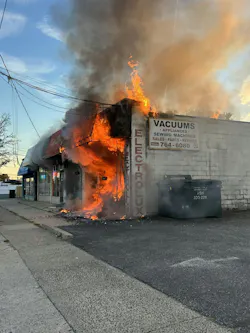
Based on the two radio reports, the first line was backed out of the store to the sidewalk. Lynch met Klein and Sparberg on the sidewalk, where the three chiefs had a face-to-face at the door. They agreed that the risk-versus-reward factor in the original fire store was no longer in their favor. It was decided that the operation would transition to an exterior attack on the original fire store using TL244 and Long Beach Fire Department (LBFD) Tower Ladder 2372 to knock down the bulk of the fire and concentrate on stopping the fire from extending any farther in the exposure two through the use of a third 2½-inch line that was stretched by the crew of Engine 243, which was led by Lt. Robert Sutton Jr.
At the command post, Costigan and Lynch kept track of incoming units, operating units’ status and need for relief, and the ongoing reports from the different divisions.
As this occurred, the Charlie sector chief, Rick DiGiacomo of the LBFD, was tasked with opening the rear of the stores and getting a line into the rear to knock down the visible fire.
Fire under control
After the bulk of the fire in the original fire store was knocked down using the tower ladders, members cautiously operated the one line at the original fire store from the Charlie side to extinguish the remaining pockets of fire and overhaul.
A third alarm eventually was transmitted as a means of bringing relief to the scene.
Incredibly, the fire was contained to the original fire store, with slight extension into the exposure two. There were no injuries to civilians or firefighters.
Training, experience, technology and coordination by command to the task levels played key roles in the decision to operate offensively to save the exposures while reading the signals that the original fire store was providing that members didn’t need to be inside to accomplish the goal that was set on arrival. The members of the OFD and the multiple departments that responded on mutual aid kept the fire from extending any farther than what was on fire on arrival.
Observations of Goldfeder
This fire was a positive combination of:
- Training. In addition to the regularly required company and department training, four OFD chief officers attended related training (including building construction and roof conditions) the morning of the fire.
- Experience. Although experience is gained to some extent through training, making runs over the years provides what’s needed for every firefighter who’s on the fireground. Particularly in volunteer departments, members can’t count on their training from decades ago to work in 2026. Critical factors that are related to a better understanding of fire behavior, what’s burning, construction, power/charging systems and more are different. That must be accepted, so “occasional” firefighters don’t create more risk in an already risky environment.
- Technology. Taxpayer money is spent so members can serve them the best way possible. Leaving equipment on the rig doesn’t do any good. At this fire, the immediate and continued use of thermal imaging identified critical factors that led to tactical orders (and changes) by commanders. As a part of technology, a simple-to use and accessible preplan system is highly valuable when turning out for most anything other than single-family dwellings.
- Preplanning. The OFD preplanned information for the row of stores, except for (ironically) the roof structure. This incident raised their awareness to include that. A good preplan can make a huge difference in dealing with the otherwise “unknowns,” and although it doesn’t replace size-up, searches, etc., it provides added information that saves time and lives. There are many simple systems at nearly any department budget. For the cases in which funding doesn’t exist, preplanning can be done by the members using phones, cameras, and a few cards or sheets of paper.
Preplans should include:
- Access routes: How to reach the building? How else to reach the building?
- Hazmat: Location around and in the building.
- Utility shutoffs: Where to turn off gas, water and power.
- Building layout/design: Details about the structure’s floor plans, including exits and access points, and construction type.
- Exposures: Where could the fire spread?
- Fire protection systems: Details on fire alarms and sprinklers.
- Water supply: Initial as well as secondary and more.
- Communication procedures: Any dead zones?
- Occupancy levels: Number of people who are in the building and the applicable times.
- Occupants who have special needs: Are there people who might need help during evacuation?
The combination of the aforementioned factors by the OFD resulted in significant savings for the stores that weren’t the original fire store. Additionally, the training, experience and command-level decision-making (based on input from the companies and bosses operating) resulted in the best-possible outcome: loss stopped, no civilian injuries and all members ready for the next run.
The Oceanside Fire Department
The Oceanside, NY, Fire Department covers six square miles of urban and suburban makeup on the south shore of Nassau County, Long Island. The department consists of four engine companies and a truck company; 210 volunteer firefighters who staff seven pumpers, two ladders and several support vehicles; and a fully paid EMS program of 50 medics who provide ALS coverage 24/7.
The OFD responds to about 2,200 fire and EMS alarms annually in a response area that consists of single-family houses, large multifamily dwellings, industrial facilities, eight schools and the Mount Sinai South Nassau hospital.
The department is led by a chief of department and three assistant chiefs. Its four engine companies and the truck company are led by a captain and three lieutenants.
About the Author
 Billy Goldfeder
Billy Goldfeder
BILLY GOLDFEDER, EFO, who is a Firehouse contributing editor, has been a firefighter since 1973 and a chief officer since 1982. He is deputy fire chief of the Loveland-Symmes Fire Department in Ohio, which is an ISO Class 1, CPSE and CAAS-accredited department. Goldfeder has served on numerous NFPA and International Association of Fire Chiefs (IAFC) committees. He is on the board of directors of the IAFC Safety, Health and Survival Section and the National Fallen Firefighters Foundation.