An Alternative Attic Fire Tactic for Fire Departments
Key Takeaways
- The challenges that firefighters face with the traditional tactics for an attic fire—delays in getting water on the fire, the demands of pulling interior ceiling, full ignition that can result from a roof ventilation hole and potential roof collapse—are minimized or eliminated when a piercing nozzle is pushed through a very small hole in the roof to flow 210 gpm of water in a sprinkler head-type pattern.
- Firefighters can deploy an attic reset nozzle to a location and leave it in place with the bail open and the water flow controlled from the ground/pumper.
- Roof operation firefighters can position multiple attic reset nozzles across a large area for extinguishment or to act as a fire stop/barrier.
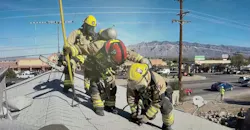
“Command from Engine 9. We completed the 360, and we have a working attic fire.” Upon hearing that transmission, what thoughts come to mind? Perhaps concern for the structural integrity of the roof and a collapse on interior crews? The tactics that are involved with extinguishment of an overhead/attic fire? The tactical decisions will be important to stop the fire from advancing and to keep crews safe.
In 2018, the Tucson, AZ, Fire Department deployed a new tactic: the attic reset. It calls for the deployment of a hoseline with a FlameFighter piercing nozzle to the roof to inject water into the attic space from above. This roof tactic is an alternative to the more traditional interior attic fire tactic that deploys a hoseline on the interior and attacks the fire from below, which can present challenges and dangers.
The TFD attic reset tactic evolved from National Institute of Standards and Technology (NIST) and Underwriters Laboratories (UL) research that recommends fast water on the fire and controlling the flow path, which the TFD has practiced since 2013.
Air flow path control
In 2013, four TFD members traveled to Spartanburg, SC, to attend a NIST live burn research event where experiments were conducted in eight different houses to demonstrate firefighting methods—individually and in combinations—for strategically ventilating and isolating fires to prevent, or at least delay, flashover.
At the time of the event, the TFD, like many departments, used offensive fire tactics that, essentially, had firefighters deploy a hoseline to make an attack/approach from the “unburned side” to avoid pushing fire into unburned areas of the structure. Roof operations included an early vertical ventilation hole that was intended to release heat and smoke for the benefit of the crews that were entering the structure.
The NIST research confirmed that initial application of water from an exterior position didn’t result in pushing fire into other areas of the structure and that any opening in the structure, whether natural or firefighter-produced (i.e., doors, windows and a roof ventilation hole), created an air flow path that feeds a ventilation-limited fire.
One of the more profound research burns that was observed tested the control of the air flow path of the fire. This research burn ignited a back bedroom to produce flames that shot out of the window on the Bravo side, as the fire had all of the air that it needed from an open front door. Then, the front door was closed, cutting off the air flow path. The fire intensity diminished, with the flames retreating back into the bedroom. The effects were similar to putting a lid on a burning candle.
The information that the TFD members gleaned from the Spartanburg research burns made it clear that the science supported getting fast water on a fire from an exterior position (don’t walk past active fire with a hoseline) and controlling the flow path were tactics that should be incorporated into the TFD to improve the survivability profile for victims and, at same time, to create a safer environment for firefighters.
Following the Spartanburg trip, TFD members were trained on the NIST research, and the “exterior reset” tactic was implemented. The exterior reset consisted of rapidly deploying an attack line and applying water exteriorly onto the fire (via a window, door, garage, etc.) to begin cooling the environment, to make it more tenable for potential victims as well as firefighters. Additionally, controlling the air flow path by not breaking windows and by shutting open doors—including those that are forced open by fire personnel—and not cutting a vertical ventilation hole until water is on the fire became important pieces of the TFD fireground strategy.
The success of these research-driven tactics took the TFD down the path of using these same concepts on attic fires.
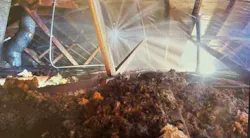
Traditional attic fire tactic
TFD Chief James Kearney, who attended the Spartanburg burns, helped to teach the exterior reset technique to TFD members and has since retired, had the idea of deploying a hoseline to the roof and injecting water directly into the attic space prior to pulling ceiling or cutting a vent hole.
At that time, the TFD, like the majority of U.S. departments, used the traditional attic fire tactics of deploying an attack line interior; attempting to locate the fire using a thermal imaging camera (TIC) and/or visually; pulling ceiling; and applying water from below. The challenges with this tactic can include:
Delay in getting to the correct interior position to effectively apply water on the attic fire. Interior fire conditions as well as physical obstacles/housekeeping might delay a crew in getting to an effective location below the attic fire. This is dangerous, because as NIST/UL research showed, fire can spread quickly (double every 100 seconds) and compromise the roof structure. TICs are helpful but might not give accurate assessment of conditions. For instance, a ventilation-limited fire can have heavy smoke (which is fuel) but no fire. It also can be difficult to see any changing conditions behind older lath and plaster, which could lead to a false sense of security.
Pulling interior ceiling. This can be a demanding task. The crew(s) must be in the correct room/position, and the appropriate tool must be brought inside initially. Many times, in older homes, the ceiling can be lath and plaster, which can be challenging to penetrate. Another problem can be the height of the ceiling. (The most common ceiling is 8 feet flat, but with modern residential construction, 10- and 12-foot ceilings are common. Commercial ceilings can be much taller.) Further, insulation or duct work might obstruct getting water on the correct location.
Ventilation on an attic fire. Attic fires often are time-confined and ventilation-limited. NIST showed that full ignition can result from a roof ventilation hole: The vent hole could provide the flow path that causes the attic fire to increase in intensity. The fire intensity also could be increased if an additional flow path is provided from the ceiling being pulled from below. A ventilation hole also could push wind into an attic space to potentially act as a bellow.
Roof Structure. The effects of fire on roof structures to cause collapses, particularly in lightweight construction, are a significant concern and unpredictable. Many years back, the Phoenix Fire Department conducted several test burns of single-family residences with four different burn scenarios of lightweight roof systems that were exposed to fire. The test house roofs were constructed of plywood and oriented strand board and exposed to fire.
The results were sobering. The makeshift weighted manikin firefighters that were positioned on the roof fell through at approximately 15 minutes after the start of the room-and-contents fire that spread into the attic space.
Utilizing the attic reset
The TFD attic reset tactic takes into consideration the above factors and the concerns for collapse on interior crews that are operating under a burning attic fire. It also combines the NIST/UL research of getting fast water onto the attic fire and controlling the air flow path. It targets the fire in the attic or void above the ceiling and looks to keep the fire in the compartment without a flow path. The tactic also can be supported by putting water into the gable end(s). The piercing nozzle can be used from a roof ladder or off the tip of an aerial if necessary.
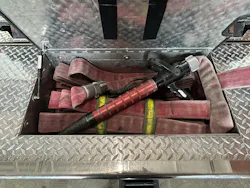
To implement the TFD attic reset, one-foot piercing nozzles were purchased and added to every pumper on the 150-foot 1¾-inch front bumper line. The nozzle is capable of flowing 210 gpm in a sprinkler head-type pattern, with very little nozzle reaction.
Typically, the attic reset tactic is the function of a ladder crew that deploys to the roof with its normal ventilation equipment and the attic reset hoseline. Crewmembers sound the roof as they exit the ladder and use the TIC—as well as support from personnel who are on the ground—to locate the area of the attic fire. Once the area is identified, a very small hole/breach is made in the roof with an axe or saw, and the piercing nozzle is inserted into the attic space. The very small hole/opening controls the flow path.
The nozzle is opened for 20–30 seconds as means of performing the attic reset.
The water from the nozzle sprays water in every direction and provides the
necessary cooling.
Additional flows can occur as needed in the original location, or the nozzle can be moved to a new location, depending on the change of conditions or information that’s provided by command/crews.
After the initial attic reset, water application crews that are assigned interior coordinate their work from below to then pull ceiling, access remaining fire and perform the primary search.
Once some fire control is initiated, vertical ventilation holes then can be initiated if requested by command and interior crews.
Since the implementation of the attic reset tactic, the TFD has come to realize additional tactical benefits:
- The attic reset nozzle can be deployed to a location and left in place with the bail open and the water flow controlled from the ground/pumper.
- Multiple attic reset nozzles can be deployed to a roof and positioned across a large area for extinguishment or to act as a fire stop/barrier, much like sprinklers that are positioned in a building. This is more effective than the trench cut roof opening, which as mentioned above, ultimately, creates a flow path.
Traditional nozzle for reset?
If the traditional combination nozzle is a department’s only option, it can be used for an attic reset on the roof.
However, there are a multiple reasons why the TFD found the FlameFighter piercing nozzle to be the better option for the procedure.
On a 1¾-inch line, the piercing nozzle will flow 210 gpm and with little to no
nozzle reaction.
The FlameFighter sprays water laterally in every direction and with extended reach, which is very effective in a compartment-type fire.
The piercing nozzle uses an impinging stream that produces solid water droplets that produce better steam conversion and very little air entrainment. A traditional fog nozzle draws/injects air, which is why this nozzle is used as an option for negative-pressure ventilation of smoke out of a window.
Science-based evolution
The attic fire can be one of the most dangerous situations that structural firefighters face. The extinguishment tactics that are used should reflect what scientific research has provided to the fire service. The TFD attic reset tactic has become a very effective option and proven to be successful but also has been an evolutionary journey that’s backed by science.
Product Spotlight
Apparatus & Tools Platform
Captium from IDEX Fire & Safety connects apparatus, pumps, rescue tools, electronics and diagnostics into a single operational view to help fire departments to identify issues earlier, simplify service coordination and maintain readiness across every asset. From the bay to the fireground, Captium keeps teams informed, connected and mission ready.
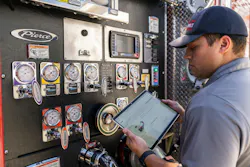
Flow Meter
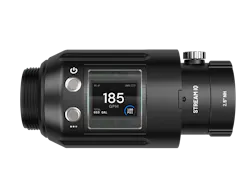
The STREAM IQ intelligent flow meter by HEN Technologies provides firefighters with accurate, real-time flow and pressure data directly on the line. By eliminating guesswork, STREAM IQ helps crews to validate nozzle performance, detect restrictions or line issues, and maintain proper flow rates during operations. It also supports training, testing, audits and documentation through connected reporting and analytics, which helps departments to improve operational accountability and fireground decision-making.
Hose
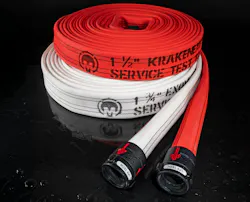
Mercedes Textiles’ new KrakenEXO LPX 1½-inch and ExoMetro LPX 1¾-inch hose offer superior nozzle handling on small-diameter, low-pressure attacks, to deliver 150–160 gpm at 50–75 psi with as much as 30 percent less weight than standard 1¾-inch hose. Patent-pending LPX Technology reinforces the nozzle end of the hose to minimize whip and kinking for increased control without sacrificing the lightweight packability and maneuverability of the rest of the line.
Product Spotlight
Apparatus & Tools Platform
Captium from IDEX Fire & Safety connects apparatus, pumps, rescue tools, electronics and diagnostics into a single operational view to help fire departments to identify issues earlier, simplify service coordination and maintain readiness across every asset. From the bay to the fireground, Captium keeps teams informed, connected and mission ready.
CAPTIUMCONNECT.COM
Flow Meter
The STREAM IQ intelligent flow meter by HEN Technologies provides firefighters with accurate, real-time flow and pressure data directly on the line. By eliminating guesswork, STREAM IQ helps crews to validate nozzle performance, detect restrictions or line issues, and maintain proper flow rates during operations. It also supports training, testing, audits and documentation through connected reporting and analytics, which helps departments to improve operational accountability and fireground decision-making.
HENTECHNOLOGIES.COM/STREAM-IQ
Hose
Mercedes Textiles’ new KrakenEXO LPX 1½-inch and ExoMetro LPX 1¾-inch hose offer superior nozzle handling on small-diameter, low-pressure attacks, to deliver 150–160 gpm at 50–75 psi with as much as 30 percent less weight than standard 1¾-inch hose. Patent-pending LPX Technology reinforces the nozzle end of the hose to minimize whip and kinking for increased control without sacrificing the lightweight packability and maneuverability of the rest of the line.
KNOWYOURHOSE.COM/LPX
About the Author
 Daniel Burke
Daniel Burke
Daniel Burke is a 32-year member of the Tucson, AZ, Fire Department (TFD) who currently works at the rank of battalion chief. Over his career, he has worked on the TFD special operations teams and focused operationally on incident command, accountability, fireground survival and rapid intervention crew operations. Burke holds a master's degree in organizational leadership from Northern Arizona University and a bachelor's degree in fire service management from Arizona State University.