Firefighter Rescue Lessons Learned from a Technical Rescue Drill
Key Takeaways
- The consensus opinion in terms of preferred order of rescue methods of the members of the Rochester, NY, Fire Department (RFD) Technical Rescue Team who participated in training to rescue a firefighter who was trapped in a structural building collapse was spreaders, bottle jack and medium-pressure rescue cushions.
- Although a basic tent of heavy lifting in conjunction with a structural collapse rescue is to "lift an inch then crib an inch," most of the participants in the RFD's structural collapse drill to rescue a firefighter believed that it's crucial in such a circumstance to make the lift and concurrently assign rescuers to pull the victim out to safety as quickly as possible.
- As previously reported in firefighter-down training scenarios, members who participated in the RFD's structural collapse drill to rescue a firefighter who was trapped in a building collapse scenario often experienced low-air alarms while they operated. This underscores the importance of enacting quick personnel relief.
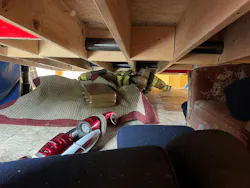
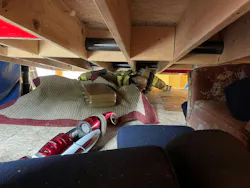
One component of the Rochester, NY, Fire Department’s 2022 Technical Rescue Team’s (TRT) annual structural collapse drill was to rescue a firefighter who was trapped in a building collapse scenario. The situation presented was a sloped floor-type collapse with a firefighter trapped by the weight of the collapsed floor. The scenario was conducted in a floor-collapse simulator at the training academy.
Drill participants were able to first view the situation under clear conditions and devise rescue plans before the collapse simulator was darkened and filled with cold smoke. Participants worked in a crew (total of eight members) and were required to wear full firefighting PPE and SCBA for the evolution. Members were allowed to stage equipment for their rescue plans at the entry door prior to the drill commencing.
The scenario was done in the context of the larger annual drill for the TRT/urban search and rescue technicians. Although not a common structural collapse training scenario, the scenario was added to the TRT’s structural collapse drill because of the occurrence of local and national events that involved structural collapse with a firefighter trapped.
The idea for this scenario emerged after a statement from Chief Curt Isakson at the Syracuse Heavy Rescue conference stuck with me: “The most difficult technical rescue we can respond to is a trapped firefighter.” The objective of this scenario was developed with that statement in mind and was crafted to require members to rescue a trapped firefighter (manikin) from simulated fire and structural collapse conditions.
Drill design
The trapped firefighter drill was set up with the following conditions:
- The prop was approximately 12 x 12 feet and consisted of three movable floors and a concrete lower floor.
- The situation found was a firefighter who was trapped by a collapsed upper floor.
- The “firefighter” was a 150-lb. manikin in full firefighting PPE and SCBA.
- For each evolution, the manikin was placed in the exact same spot—approximately in the middle, near the edge of the prop—and on its left side.
- The floor was set so that it fully rested on the manikin’s hips and SCBA.
- The training prop safeguards were set to ensure that the floor that firefighters were operating on was pinned in place and that the floor to be displaced could raise but wouldn’t lower any more than the initial height setting.
- Crews worked under the assumption that on-scene RIT had started care to the victim and provided air via the RIT pack.
- Crews worked under the assumption that firefighting efforts were being conducted by other units and/or the fire was under control.
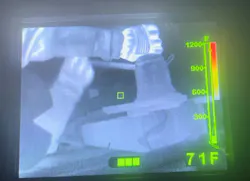
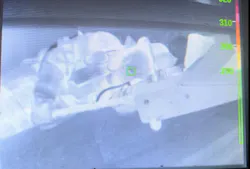
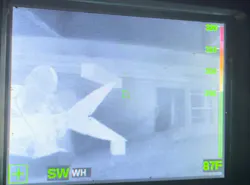
- The scenario was conducted under low/no visibility conditions, with all lights turned off and the area full of cold smoke.
- Members were able to see the trapped conditions before the scenario began.
- Members could limit themselves to the anticipated equipment that already would be on scene at a structure fire, or they could assume that the TRT rigs were called to the scene of the firefighter trapped and utilize rescue equipment from this cache.
- Members were allowed to stage equipment for their rescue plans at the collapse simulator entry door prior to the drill commencing.
- Each training session had the scenario run twice, with two companies assigned to each scenario. This allowed for a total of eight evolutions across four groups.
Each training session had the scenario run twice, with two companies assigned to each scenario. This allowed for a total of eight evolutions across four groups.
Most teams performed the scenario with the following considerations:
- The teams decided that the best rescue would be quick. Although a basic tenet of heavy lifting is to “lift an inch then crib an inch,” most believed that it was crucial to make the lift and concurrently assign members to pull the victim out to safety as quickly as possible.
- Because of space limitations and accountability concerns, most teams operated with four members working inside of the structure and four outside as runners and communicating at the entry door.
Rescue methods
- Low-pressure air bags. Rescue equipment used: Paratech three-ton, low-pressure trench cushions.
- Bottle jack. Rescue equipment used: 12-ton bottle jack
- Floor jack. Rescue equipment used: Three-ton floor jack with a height range of 4–18-1/8 inches.
- Battery-operated extrication spreaders. Rescue equipment used: HURST 32-inch spreaders.
- Battery-operated extrication ram. Rescue equipment used: Hurst 59-inch telescoping ram.
- Medium-pressure rescue air cushions. Rescue equipment used: Paratech 30-inch-diameter bag with 23-inch height.
Takeaway considerations
After the drills were completed, the participants discussed the different rescue attempts. The consensus opinion of the members ranked the preferred order of rescue methods as follows: 1) spreaders; 2) bottle jack; and 3) medium-pressure rescue cushions.
The quick and effective use of the spreaders impressed most participants but particularly the senior members. A recent departmentwide upgrade to battery-powered extrication tools allows for much quicker deployment. This is in contrast to the traditional apparatus-mounted extrication systems that require disconnecting tools and transporting a power plant and hydraulic hoses to the building.
The bottle jack system was considered a good choice because of its simple working principles and capability to fit into tight spaces.
The medium-pressure air bags were favored because of the ease of getting them into place and lifting. There was no need to coordinate the placement of cribbing nor was there a handle to lose, just the need to get the air bags into the area of the appropriate structural elements and call for the lift.
As previously reported in firefighter-down training scenarios, members experienced low-air alarms while they operated, which necessitated quick personnel relief. It’s evident that in the chaos of a trapped firefighter situation, rescuers could become low on air, lost or disoriented, which might necessitate their own mayday calls.
Lifting equipment must be positioned to ensure that there’s no pivoting of the collapsed floor from the trapped firefighter’s hips toward that individual’s head or legs. Also, because the drill took place in a floor-collapse simulator, we knew that the stability of the floor was good along the span of the joists, which is something that might not be the case during an actual rescue.
It would improve safety to position a quick T shore in the work area. A few teams positioned a single rescue support strut (both with and without headers/sole plates) in the work area.
In the absence of rescue tools to stabilize the area, consider what’s on hand. One crew attacked the problem by performing the lift with two members but then having a third firefighter push a couch further into the area to capture the lift as it occurred.
Basis for your own drill
The drill was intended to identify what technical rescue tools are best suited to rescue a firefighter who’s trapped in a collapsed structure. Through trial and error, methods that were better than others were identified. Use the results from this drill to further your own understanding of what tools work best for a firefighter who’s trapped in a collapse scenario.
Important notes: Some rescue equipment probably wasn’t intended to be used in the manner that we used it. Our goal was to determine what works best to remove a firefighter as safely and quickly as possible.
Data: To be clear, any data results of this training that factored into crews’ assessment of the various rescue attempts shouldn’t be considered complete. No research design guided the drill, but informal times were kept to differentiate and ascertain methods that worked better and faster than others. The times that were recorded were done in good faith and on an iPhone. Although close to accurate, the data weren’t recorded always perfectly.
About the Author
 Edward Tracey
Edward Tracey
Edward A. Tracey, Ed.D., is a 30-year member of the fire service who has served the past 20 years with the Rochester, NY, Fire Department. He serves as the Rescue Co. captain, including additional responsibilities tied to collaborative management of the department’s technical rescue training, response and typing programs. Tracey also serves as a fire service and technical rescue instructor for a statewide training system, sits on numerous curriculum development committees and serves as an adjunct professor. He has a doctoral degree in education from the University of Rochester, a master’s degree in public administration from SUNY Brockport and a bachelor’s degree in fire service administration from the University of New Haven.