Firefighter Preparation for CO2 Leak Incidents
Key Takeaways
- Fast-food restaurants and convenience stores often use a dewar to store carbon dioxide (CO2) that's used to carbonate their soda in their dispensers. Firefighters must be prepared to operate on scene of incidents where a dewar is used or at an incident that involves a leaking dewar.
- A CO2 leak often presents itself to firefighters via a "cloud" that results from the cold vapor condensing moisture in the air. Frost or condensation also can indicate a leak. Furthermore, a thermal imaging camera should be capable of detecting a change in the temperature of the air or of the piping at the leak point.
- Upon identification of a dewar on scene of an emergency, firefighters should close the gas supply valve that's on top of the dewar. However, it's critical to identify the correct valve among several that are on top of the dewar. If the supply valve isn't labeled, it can be identified by tracing the pipe or tube that supplies the CO2 to the building or soda dispensing system to the top of the dewar.
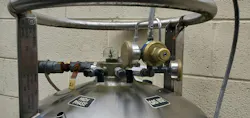
Many fast-food restaurants and convenience stores no longer use small cylinders of carbon dioxide (CO2) that are located below a soda machine to carbonate soda. They now store “bulk” CO2 in a large cylinder that’s called a dewar, which is a vacuum-insulated container that typically is used to hold low-temperature liquids, such as nitrogen. It’s more efficient to store CO2 as a liquid, because it takes less volume in that state. The dewar maintains the required pressure, and the high insulation value holds the temperature of the liquid cool enough to prevent the liquid from turning to gas. Once the liquid is released to atmospheric pressure and warms up, it becomes gas.
The dewar might be inside or outside of the building. The CO2 is distributed in tubing through the building to the beverage dispensers, where it’s mixed with syrup.
I only became aware of these systems being used for beverages in the past couple of years. There were some CO2 incidents that resulted in deaths at fast-food restaurants. The incidents weren’t recent, which I hope means that installations got safer because, I would imagine, they are more common now than when the incidents occurred.
What can firefighters do to prepare for an incident that involves CO2?
CO2 defined
CO2 is a colorless, odorless, nonflammable, generally nontoxic inert gas. It has a vapor density of 1.5, which tells us that it will sink, because it’s heavier than air (vapor density of 1.0). CO2 also has an immediately dangerous to life and health (IDLH) value of 40,000 ppm and displaces oxygen. Humans exhale CO2, firefighters use CO2 extinguishers for electrical fires, and it is dry ice in solid form. It’s an asphyxiant hazard at the IDLH value, because it will reduce the oxygen level to less than 1 percent.
CO2 can be toxic at the cell level but only in high concentrations. Being an asphyxiant is the main hazard that’s presented by CO2. Small rooms or enclosed spaces are the most hazardous locations. When using a meter, if high CO2 (low O2) levels are suspected, sampling should be done near the floor, because CO2 will accumulate there first. The higher vapor density also will make children and pets more susceptible to exposure.
Symptoms from mild exposure might present as drowsiness, headaches, dizziness, disorientation, trouble breathing or fatigue. Exposure to higher concentrations can create symptoms of an increased respiratory rate, tachycardia (fast heart rate), cardiac arrhythmias (abnormal heart rhythm) or impaired consciousness. Extremely high concentrations can result in convulsions, coma or death. If the amount of CO2 is significant enough, a person could be rendered unconscious in a matter of seconds. Because of this, many victims are unable to self-extricate and die. For this reason, it also is important that first responders don’t rush in to render aid if there is a possibility of a low O2 environment from a CO2 leak.
Prep for a CO2 incident
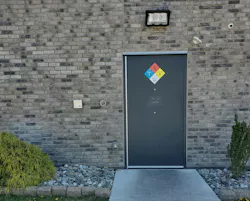
The first step in preparation for an incident that might involve CO2 is to know where these systems are installed. Make sure that you are out there in your first-due response area locating these systems. Make sure that your fire inspector or municipality enforcement knows the hazard that these systems present to firefighters and that they make you aware of their installation. Doors to rooms that house a dewar should be labeled to indicate the hazard. Some type of automated ventilation system and/or low-oxygen sensors that include alarms that alert to dangerous conditions are sensible requirements..
How to know there’s a leak
When there’s a CO2 leak, there probably will be a “cloud” visible as the cold vapor condenses moisture in the air. However, the cloud might not be present or be less visible in an environment that has extremely low humidity. Frost or condensation also could indicate a leak. A thermal imaging camera should be capable of detecting a change in the temperature of the air or of the piping at the leak point
If there’s a leak
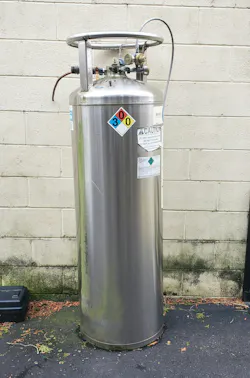
CO2 has a high expansion factor of 533 times its volume when converting from a liquid to a gas. A common exterior dewar is a 160-liter unit that measures 60 inches high by 20 inches in diameter and holds what equates to 3,382 cubic feet of gas. That volume of gas would fill a 21 x 21 x 8-foot room completely. However, we aren’t worried about a 0 percent oxygen room.
Our meters will alert at 19.5 percent O2 level, which is a little more than 1 percent below the normal O2 concentration of 20.8 percent. The CO2 would need to displace 5 percent of the room volume to lower the O2 level 1 percent. If the entire dewar discharges, it would make a 92 x 92 x 8-foot room an alarmable atmosphere. Compare those dimensions to the size of the building where you expect to find them.
Other factors work to our advantage. These include air leakage, ventilation and the amount of liquid that’s in the dewar, but firefighters must be informed and prepared.
If performing operations at a building that has a CO2 system, beware of fire that’s compromising the tubing that’s creating the leak. It also would be easy to damage the tubing when pulling ceilings or performing overhaul. However, we always wear our SCBA for attack and we wear SCBA and carry meters during overhaul, right? So, we always should be safe, right? Wrong. Imagine what would happen if you walked into a small janitor closet into which the CO2 leaked. We must be prepared.
How to be safe and effective
A proper 360-degree size-up should be performed on arrival. If a dewar is discovered, the officer should make crews aware of its presence and secure the cylinder or have a crew that’s assigned to securing utilities include the dewar as one of those utilities.
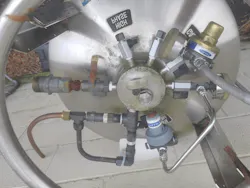
Close the gas supply valve that’s on top of the dewar to make sure that no CO2 can leave the cylinder. However, the cylinder heads can be very complex, and there will be multiple vales on the head of the dewar. You must identify the correct valve. Hopefully, the gas valve will be labeled. If not, the correct valve will be the one that’s located at the start of the pipe or tube that supplies the building.
Don’t close all of the valves “just in case,” thinking that you’re covering all of the bases. Disabling the relief valves can create an overpressurization of the container, and the container will fail violently.
If the tank can’t be isolated, assign someone to monitor it. You most likely will see frost forming if the tank is discharging a large volume to the piping system that’s being compromised.
Be sure that you don’t open the liquid valve accidentally. (It would be a good idea to require that the gas shutoff valve be labeled.)
Also, there’s a good chance that the dewar is leased from the company that will refill it, such as what’s done with propane. Require contact information to be provided on the cylinder, so you know who to call if you need assistance.
Use your gas meter. As previously mentioned, CO2 is heavier than air, so firefighters must “look” low and check basements.
If low O2 levels are found and high CO2 levels are expected, use positive pressure to ventilate the structure.
If a victim is located and low O2 levels are present, the victim should be removed from the environment as quickly and safely as possible. Get the individual to EMS for oxygen to be administered and so that any other required treatment can be provided.
Other circumstances
In additional to soda dispensers, CO2 systems might be found at cannabis grow facilities. The systems are used for enrichment and extraction processes.
Much of this conversation also applies to liquid nitrogen. Although probably not as common, its properties are similar, and the advancement and growing popularity of cryotherapy and cryosurgery might make these systems more prevalent in the future.
Firefighters must be aware of inert gas system locations and be able to deal with them before an incident occurs. If the system were compromised, it could make a bad situation worse. They present a significant hazard and can change the course of an incident in a short period of time. A successful and safe fireground relies on firefighters being able to identify these systems and mitigate any potential or active hazards that the systems present.
About the Author
 E.J. Henninger
E.J. Henninger
E.J. Henninger is the mission leader for Building Firefighter Development, which is a grassroots effort to educate the fire service about building systems from an engineering perspective. For 15 years, Henninger has served as a volunteer firefighter with a rural fire and rescue company. He has more than 25 years of professional experience in the engineering and design of fire protection systems.