Truck Company Ventilation at Residential Fires with a Commercial Mindset
Key Takeaways
- Considering the trend in the construction of larger houses, members of truck company crews must embrace the concept that the tactics that they employ at fires at strips malls, warehouses, office buildings, etc., particularly in regard to ventilation, often must be considered at residential fires.
- Crews that operate on the roof at a fire at modern houses, particularly of the larger square footage variety, must know that vertical ventilation cuts that produce larger openings compared with that which is taught in traditional training might be required.
- As is the case at commercial fires, officers at fires at large residences must anticipate collapse zones, smoke changes, fire progression and changing conditions.
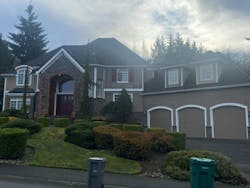
At first glance, a 1,300‑sq.‑ft. downtown retail shop and a sprawling 9,500‑sq.‑ft. residence that has vaulted ceilings and a five‑car garage seem worlds apart. However, when fire strikes, both demand the same thing: effective ventilation to control fire growth, protect occupants and keep firefighters safe.
Modern construction blurs the line between residential and commercial. Open floor plans, engineered trusses and synthetic fuel loads mean that today’s houses often behave more like commercial structures. To succeed, firefighters must bring a disciplined, coordinated and strategic commercial mindset to the residential fireground.
Ventilation matters more than ever
Ventilation isn’t just about “letting the smoke out.” It’s a tactical tool that shapes fire behavior, survivability and suppression effectiveness. Done correctly, it buys time, improves visibility and reduces hostile event risk. Done incorrectly, it can accelerate fire spread, collapse roofs and trap crews in lethal flow paths.
The stakes are higher in modern houses. Synthetic contents drive extreme heat release rates; open layouts reduce compartmentation, which allows rapid fire growth; lightweight trusses collapse faster than traditional rafters; and large volumes mimic commercial hazards, such as hidden severity.

In short, residential fires no longer are “small box” incidents. They demand the same rigor that firefighters apply to strip malls, warehouses and so forth.
Fuel‑limited vs. ventilation‑limited
Today, residential fires often are ventilation‑limited. Opening a door or window can trigger a hostile event by feeding oxygen into a starved fire.
Meanwhile, commercial fires might smolder unnoticed in large volumes, which then can result in them erupting violently. Collapse risk is acute considering lightweight bar‑joist roofs.
Flow path became something of a buzzword a few years ago. Make no mistake, fires always have had a flow path and always will; it’s simple physics.
The job of truck companies—the personnel who are assigned to ventilation—is to dictate the flow path and use it to improve conditions. Residential and commercial fire environments demand flow path discipline, to control how air enters and smoke exits. In houses, this might mean careful timing of window/door openings.
In a more direct fashion, truck companies can employ vertical ventilation to set the ventilation tone. In commercial settings, these members’ tactics can expand to include trench cuts, smoke indicator holes or possibly coordinated positive pressure ventilation (PPV). Increasingly, these lessons overlap.
Aligning objectives
Across residential and commercial settings, the goals remain consistent:
- Life safety: Both settings prioritize improving interior tenability for trapped occupants and firefighters.
- Fire control: Proper ventilation supports fire containment, allows efficient hoseline advancement and can minimize property damage.
- Access/egress: Ventilation tactics optimize smoke removal for safer searches and exits. Coordinated and well-communicated ventilation is a foundation of interior search.
- Property conservation: Commercial scenarios might place more emphasis on assets and operational continuity. In residential, the focus often remains on life safety.
The commercial mindset brings intentional goal alignment to the ventilation process. This reframes ventilation as a strategic tool, not a checklist item. Every opening must serve a coordinated objective.
Tactical execution
Vertical ventilation is favored in commercial buildings for releasing large volumes of smoke/heat. This includes large heat holes (3 x 8 feet, 4 x 8 feet or bigger) utilizing such methods as trench cuts and center‑rafter louvers.
Structural stability must be reassessed constantly. This requires LCES (lookouts, communications, escape routes, safety zones). The escape strategy for the roof team likely necessitates secondary ladders at a minimum and, possibly, “the working set,” which utilizes multiple ladders that are placed at key escape route locations.
Traditionally, smaller vertical ventilation cuts were favored at residential fires, but modern houses might require larger openings (4 x 8-foot openings are the starting point in the modern environment). Smoke indicator holes and diagnostic cuts—which are common tactics that are employed in commercial work—are increasingly relevant.
Opportunities to apply horizontal ventilation at commercial fires often is limited by few windows/doors. Exhaust openings must be oversized, so large roll-up doors might be utilized. This method has been proven to lead to negative outcomes when it’s utilized in a noncoordinated and/or noncommunicated manner. It might lead to an increasing likelihood of hostile events, which might culminate in unintended injuries or fatalities.
There are more options for horizontal ventilation at residential fires, but timing is critical. VEIS (vent, enter, isolate, search) emphasizes door control to dictate the flow path and to possibly prevent hostile events. Exhaust opening sizing and placement as well as proper placement and coordination are critical.
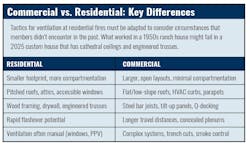
PPV is the least-favored method at commercial fires because of the interior volume of the structure. In many cases, multiple fans in “V” configuration might be required. Exhaust size and fire location must be confirmed prior to use.
PPV can be utilized at residential fires in proper situations; however, respect for AEIOU (attic fires, exhaust inadequate, imminent rescue, overpressurized, unable to locate fire) contraindicators must be followed.
Hydraulic ventilation is useful post‑knockdown in both settings, to clear smoke with a fog stream.
Strategic thinking
Situational awareness requires comprehensive pre-arrival assessment, a 360-degree size‑up on arrival and continuous reassessment. Officers must anticipate collapse zones, smoke changes, fire progression and changing conditions—particularly, unanticipated changes.
Resource allocation and crew assignment must be task-driven. This involves division or group assignments (i.e., roof, interior, search, exposure and backup). Multiple coordinated ladders must be considered for both action and escape. Apparatus must be positioned in locations to allow for rapid offensive/defensive shift.
Ventilation, suppression and search must be synchronized. Every crew must understand the overall strategy. Incident command must adapt based on real‑time reports from the interior, the roof and the exterior divisions and must maintain continuous flow of intelligence and flexibility.
In terms of risk management and adaptability, recognize when “routine” tactics become high risk. Substitute with limited-area or targeted tactics (e.g., targeted, limited-area search, or T-LAS) in commercial searches. Use RADE (read, anticipate, decide, execute) and/or OODA (observe, orient, decide, act), CAN (conditions, actions, needs) or other decision loops.
Decision frameworks should include structured go/no‑go criteria for vertical ventilation. CAN reports should be used for reassessment and might be expanded to CANA to include an air check for personnel.
Commercial mindset benefits
Benefits of applying the commercial mindset for ventilation include:
- Enhanced situational awareness. Every house fire treated as unique.
- Better coordination. Ventilation supports suppression, not undermines it.
- Improved search outcomes. Flow path control mirrors commercial targeted search.
- Risk‑informed property conservation. Smarter openings reduce unnecessary damage.
- Training culture. Scenario‑based drills, simulations and post‑incident reviews build judgment.
Applying commercial-style discipline for residential fires brings situational assessment and coordination to otherwise “routine” responses. This helps to avoid cookie-cutter and outdated tactics. Every house fire is treated as a unique incident that requires strategic assessment. It also reduces the risk of firefighter disorientation, collapse and hostile events by recognizing and responding to ventilation-limited conditions more tactically.
One should consider residential preplanning (e.g., high-density, multistory, open-concept newer houses) in the same manner as commercial preplanning, to account for access, compartmentation, construction features and potential hazards. Employ “decision deadlines.” If coordinated ventilation and suppression can’t be achieved in each tactical window, one must shift tactics, as would be done in a commercial fire.
As noted above, consider the use of cut sequences that usually are utilized in commercial operations. Diagnostic cuts, smoke indicator holes, center hallway cuts and firefighter access holes can be appropriate in these scenarios.
Finally, train for rapid adaptation when encountering “enclosed structure” warning signs (e.g., zero-visibility, limited egress, short time to flashover) in house fires. Don’t assume residential scale guarantees safety.
Challenges and risks
Overcomplication. Not every house fire needs trench cuts, but every house fire requires effective ventilation that’s placed correctly and in lockstep with overall incident command tactics.
Staffing limitations. Residential responses might lack truck company depth in some jurisdictions.
Training gaps. Requires buy‑in, repetition and acquired structures.
Cultural resistance. Tradition can be difficult to overcome. Incident command should listen to truck officers and/or members of the ventilation group.
The solution: train smarter, not harder. Use simulations, case studies and Fire Safety Research Institute research to demonstrate why coordination matters.
Bridging two worlds
Residential and commercial firefighting are converging. Houses are bigger, hotter and more complex than ever. By adopting a commercial mindset into residential structure ventilation, firefighters can elevate strategic focus, tactical safety and coordinated effectiveness. Discipline in size-up, coordination, risk assessment and tactical execution more effectively mitigates the evolving threats of modern fuel loads, building construction and fire behavior. However, a rigorous commitment to training, real-time decision-making and ongoing adaptation also is required. Challenges must be addressed through cultural shift, resourcing and the development of scalable decision frameworks. Through scenario-based drills, critical analysis of evolving research, and robust, clear communications, departments can ensure that ventilation, always a critical operation, becomes a tool not of tradition but of intentional, intelligence-driven action. It means treating every fire as unique, every opening as intentional, and every tactic as coordinated. The payoff is immense: Safer crews, stronger outcomes and a fire service that’s prepared for the evolving realities of the modern environment.
Product Spotlight
Ventilation Prop
Taylor’d Systems offers a cost-effective ventilation prop for realistic training. Available in an 8- or 12-foot width, it allows departments to train on various roof pitches that are adjusted easily by two people. Engineered with 2 x 6s and oriented stand board, the prop eliminates unnecessary metal components, supports higher load capacity and provides full cut zones for repeated cutting evolutions.
TAYLORD.COM
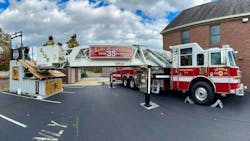
Hydraulically Driven Ventilator
MVU (Mobile Ventilation Unit) from Tempest is the original truck- or trailer-mounted hydraulically driven ventilator. It delivers as much as 150,000 cfm to clear smoke, heat and toxic gases in minutes from tunnels, warehouses and industrial complexes. The hydraulic scissor lift with 360-degree rotation puts airflow exactly where it’s needed. Optional misting adds cooling, decontamination and suppression. The ventilator is built for 24/7/365 operation and is hand-crafted in the United States.
TEMPEST.US.COM
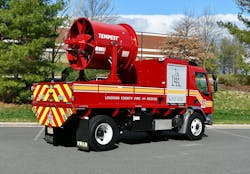
Battery-Powered Fans
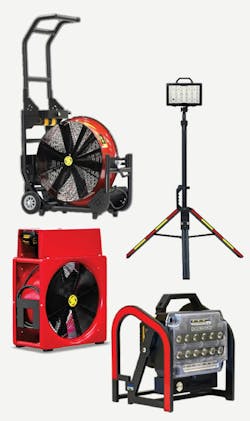
When it comes to fireground operations, having an arsenal of tools that run on the same battery platform can streamline coordinated efforts, allowing batteries to be swapped as needed while consolidating charging space. Whether a crew is running DeWalt, Makita, Milwaukee, HURST or Stihl tools, Super Vac offers a lineup of 16-, 18- and 20-inch fans that run off of these batteries, and Command Light powers its EOS compact light and Trident tripod light with virtually the same batteries.
COMMANDLIGHT.COM/#TEAMWORK
About the Author
 Steve Reno
Steve Reno
Steve Reno has more than 20 years of national HOT and classroom instruction expertise. He presented at Firehouse Expo, Firehouse World and the Cal State Instructors Symposium, among others. Reno is a driving force behind the acclaimed Firetown Truck Academy. His work with Firetown Training Specialists and Brass Shamrock Training has shaped innovative programs that elevate firefighter readiness nationwide.