Firefighter Training: Reinterpreting the ‘Irrelevant’
Key Takeaways
- One job of the reptilian part of the human brain pertains to survival instincts. Facets of firefighter training under physical and mental stress are stored there for use in conjunction with fight or flight.
- As with muscle memory, training the brain provides firefighters with unconscious abilities to react swiftly and efficiently on the fireground.
- Trust in the training process removes missplaced doubt about the validity of elements of drills, which can be lifesaving on the fireground.
It has been 14 years since I took the Firefighter Survival Train the Trainer course. I recall my first day and thinking of myself as very skilled and able. Why else was I selected for the opportunity, right?
Within two hours, I was humbled and embarrassed to the point that I didn’t feel worthy of being selected. It was clear that, compared with the instructors, my knowledge and skills were mediocre at best. Not acceptable.
Two negative, but effective, motivators throughout my life have been guilt and embarrassment—sad but true. I used them during the training and worked extra hard with my partner, going over and above what was required. By the completion of the course, I believed that I redeemed myself, although I still struggled with the protocol on calling a firefighter mayday. Every training evolution that we did included calling at least three. It was my single criticism of the training course. I felt it was excessive, slowed down the firefighter and was a training gimmick.
I still questioned its validity as I trained my firefighters in the same manner. I just didn’t get it—until one icy February night.
Where was the fire?
We responded to a Type 2-construction, two-story combination business/industrial plaza structure in our city’s industrial area. The end unit had heavy pressurized smoke coming out of masonry cracks and around the roof line. We knew that there was a decent burn happening in the interior, but we couldn’t see it.
We recently were warned by a Toronto high-rise firefighting expert that these scenarios warrant more safety precautions than visible flame showing. We needed the wet stuff on the red stuff quickly.
An entry was made into the office portion of the structure, with the hope of gaining access to all areas of the structure. After several unsuccessful attempts to gain access to the garage portion of the structure, we realized that the office area was a dead end.
We exited and immediately made a triangular cut into a huge, two-story, industrial garage door and made entry. Visibility was near zero, with minimal heat. We progressed forward, cooling the atmosphere with a straight stream until we reached the back of the building. Where was the damn fire?
I suddenly noticed an orange flicker up to my left and told my crew to follow me as we went toward it. We came upon a set of narrow stairs that lacked railings that led straight up to where the orange glow was. Convenient, I thought, as I crawled up the stairs for a quick recon before I called up the crew.
Finally, we found the red stuff, and I asked for the hoseline to be sent up to me. I gave it a quick 60-second blast to get a quick knock back and then called for my rookie (very first structure fire) to come up and take the nozzle and continue extinguishment. Visibility was now zero, with manageable but building heat conditions.
Automatic reaction
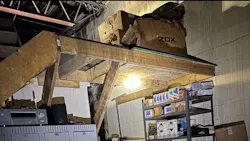
What I thought was a second floor was actually a storage mezzanine that was approximately 5 feet high and 40 x 20 feet. It was on fire and very tightly packed with rack upon rack of floor-to-ceiling plastic automotive parts. This stuff burns dirty and hot (think: automobile fire indoors).
I felt my rookie cross in front of me, and I handed over the nozzle. As I began to take up position behind the rookie, the line went limp. I then heard the sickening sound of something smashing through the floor, and I immediately knew that this was my rookie. I called down twice. Silence.
That’s when it happened. I suddenly heard my own voice calling a mayday over the radio as though I was listening to it and not actually saying it. It was flawless. On this night, something that I struggled with all week during my initial fire survival training came without a conscious thought: “Mayday, mayday, mayday. Second floor, Firefighter Wilson. We’ve had a firefighter fall through the floor. We need a ladder and an extra hoseline immediately.”
With response to the mayday now in the hands of the command officer, I turned my attention to my own immediate problems. The roof was an odd, extra thick steel structure and was only five feet from the ground. Supersaturated with heat, it literally was baking me. I’ve been hotter, but not like this.
The fire also needed to be dealt with. I opened the nozzle full bale and started painting the ceiling, floors and walls—everything that I could do to cool down the area and protect my firefighters from the flames.
I also directed a stream down through where I believed the floor breach was. (I assumed, because my rookie fell through the floor, that there was fire down there that needed to be knocked back, too.)
At this point, something else demanded my attention: I heard a low-air alarm clanging away below me. This was good news, I thought. My firefighter was alive, but now we’re in a low-air emergency. Elation passed instantly.
I still hadn’t made voice contact with my rookie and made an urgent radio call to command to indicate that I could hear a low-air alarm and that we needed RIT kit air immediately.
The clock was ticking, exactly as it had during training.
I continued full bale water application—floor, ceiling, sides and through the floor. I was afraid that the fire was creeping up unseen on myself and my downed firefighter. That’s when I heard my rookie’s voice yelling at us: “Lift me out! I’m right here!”
The third member of my crew shot into action and slid unseen in front of me. He had pulled out the rookie almost entirely before I got hands on, too. The RIT team arrived just as this happened, and we passed off the rookie to RIT to be assisted outside.
I also required assistance, because I started to enter the first phase of heat stress.
What needed to be done
My rookie managed to self-rescue by climbing up onto a refrigerator and poking up through the hole waist-high.
It was a close call, and we were lucky. Some moderate injuries aside, it was an eye-opening learning opportunity.
After the smoke cleared, we saw that what my rookie fell through wasn’t a hole that burned through the floor—although there were some holes farther along the mezzanine—but a manufactured 3 x 3-foot access hole that was created to pass storage up from the ground floor. No rails. No barriers. No edging. Nothing. Tough one for sure.
However, what surprised me was how something that I found so difficult during training came without a conscious thought when called upon: calling the mayday/LIPA (location, identification, problem, action). How did this happen? “A good question,” said the firefighter psychotherapist who I occasionally visit.
She says that there are two parts of your brain, and they don’t talk to each other: the frontal lobe, which is responsible for conscious rational thought, mathematics and problem solving, and the back part of the brain, which is ancient and reptilian. The latter’s job is to look for threats and react, to fight, flight or freeze. I have done all three on occasion in the fire service, and believe me, I was in full horror mode that night. I might have critically injured my rookie during that person’s response to a fire for the first time. However, somehow, that fear was pushed away. I recognized it and felt it but didn’t react to it. My only actions were what needed to be done.
My firefighter psychotherapist says that during our initial training, we were stressed by being low on air, blacked out, and challenged physically and mentally. This activated our reptilian brain. Anything that occurred during these moments of high stress was stored in a little box in the back of the brain to be used at some future time to fight, flight or freeze. This was fascinating stuff. This is why I gave no conscious thought to calling the mayday and LIPA. The back part of my brain opened the stress box that I was placed under during training and pulled out the mayday protocol, so much so that I even called myself “Firefighter Wilson,” something that I hadn’t said in years. (I have been a captain for the past eight years and was Firefighter Wilson 14 years ago when I took the training.)
Train the brain
Be cognizant that what we consider irrelevant training actually might have a point. The repetition, the manufactured stress and the seemingly harsh conditions all might be combining to train us in ways that we aren’t aware of.
I always believed in muscle memory. Now, I also am a believer in training the brain.
About the Author
 Shawn Wilson
Shawn Wilson
Shawn Wilson as served as a captain with Sarnia Fire Rescue Services in Sarnia, Ontario, Canada, for eight years, following an 11-year tenure as acting captain. He has been with the department for 28 years. Wilson has been a firefighter survival trainer for 14 years.