Creating Mental Bandwidth for the Fireground Through Common Firefighter Skills
Key Takeaways
- Mastering common skills reduces cognitive load during emergencies, allowing firefighters to focus on evolving fire conditions and strategic planning.
- Routine drills, such as apparatus positioning and masking up procedures, should be integrated into daily training to enhance proficiency.
- Deliberate repetition and deconstruction of common firefighting tasks are essential for achieving true mastery and improving overall fireground operations.
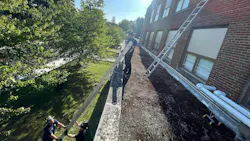
You're enroute to a fire with reported victims. Your company has been assigned to VES on Division 2. You climb out of the truck to grab the ladder. Running around the side of the apparatus, you lower the ladder rack, pulling and twisting each bracket to free the ladder. You pay close attention to make sure nothing gets hung up on the halyard. You take a moment to locate the balance point, move into position and grab the ladder down. Once you have it, you spin and head toward the structure. As you move, your attention stays on your footing, stepping over hoselines laid in the road, up over the curb, and into the yard. Navigating a fence, you focus on adjusting the way you carry the ladder to stay balanced.
Now you’re close enough that the ladder could reach the Division 2 windows. You lift your head toward them and realize it’s the first time you’ve actually put eyes on the structure. You have not sized it up. You don’t know which window is tactically advantageous. You haven’t even mentally prepared to VES.
Skills that firefighters are expected to do frequently, like deploying a ladder, masking up, or forcing a door are often labeled as basic. Once a firefighter believes they know how to perform them, those skills are practiced less frequently or worse, neglected altogether.
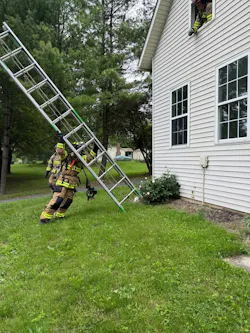
These so-called basic skills can consume a significant amount of mental bandwidth and bandwidth is already in short supply on the fireground. The fireground is non-stop, providing information that is constantly evolving. When a task requires conscious thought, it competes with our ability to detach from the situation to accurately size-up, read smoke, and evaluate building layout.
Basic skills or common skills?
The term “common skills” should replace “basic skills” in every firefighter’s vocabulary. Common skills need to be practiced consistently, so they become automatic. The more you practice and deconstruct one of these common skills, the more you realize that to achieve true mastery takes a time commitment and physical repetition.
If done correctly, the effort needed to turn a skill into an automatic process will illustrate how wrong we are to ever discount a skill as basic. When a skill becomes automatic, it no longer occupies mental bandwidth to perform it. The more mental bandwidth we can make available, the more it is then at our disposal for more mentally demanding tasks. When a common skill is trained with intent, it reveals just how advanced true execution can be.
Few firefighters reach a level where they can perform tasks so automatically that they require no conscious thought. That level of proficiency only comes from deliberate repetition; enough reps that the skill no longer competes for attention.
Training on every run
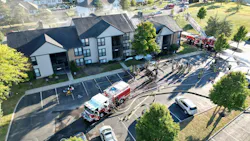
So, where can we find the time to get the reps required to turn common skills into automatic ones? Those reps are already available on almost every call and in the daily tasks we already perform. Fire apparatus positioning can be practiced the same way on routine responses as it is on a working fire. When positioning the apparatus like you are arriving to a fire every time, it becomes automatic when conditions are less forgiving. If you always position like it's a fire, it keeps the driver thinking about where to spot the truck. It forces the officer to complete a size-up and allows the backstep firefighter to evaluate what the stretch would look like from the driver's actual position.
The same applies to masking up. If mask-up drills are done every morning while checking your SCBA, the movement becomes routine instead of rushed. It all comes down to making the mechanics of a task automatic. When effort is consistently applied to these common skills, firefighters can stop playing catch-up on the fireground and start getting ahead of the situation. Apply this process to everything you do, not just truck positioning, throwing ladders or mask-up drills. Get the reps that remove common skills from the equation.
When you reflect after a fire and realize you do not immediately remember performing a common skill, like throwing a ladder, it should not be because stress overloaded your senses. If you do not recall throwing the ladder, it should be because you were not thinking about the mechanics of deployment; that skill is so automatic that your attention was already inside, mapping the floor plan and preparing for what came next. When common skills are deliberately practiced in advance, they create the situational awareness that puts you ahead of the fire instead of behind it.
Building your skills once at a time
Raising the level of training doesn’t require large blocks of time. A small amount of deliberate work done consistently adds up. Over the course of a month, those repetitions remove tasks from the equation and allow firefighters to focus on reading conditions, planning next moves, and managing the large volume of information presented on every fire scene. Constant repetition of the same movements allows those skills to be broken down and refined to a mastery level.
Here are a few of the common skills that should be trained through repetition to the point of mastery:
- Preconnected hoseline deployment
- Masking up
- Conventional forcible entry
- Ladder deployment
- Search movement and mechanics First-due interview

These are not the only skills that matter, but they are the types of tasks that, when mastered, allow firefighters to slow the situation down and expand their situational awareness while widening our field of vision.
The less mental energy required to perform the task, the more attention can be given to decision-making under pressure. Everyone has heard “We don’t rise to the occasion; we fall to our level of training.” If the level we fall to still requires mental bandwidth to perform common skills, that is where focus will remain while on the fireground.
About the Author
 Tyler Gleeson
Tyler Gleeson
Tyler Gleeson is a lieutenant with the Truro Township Fire Department in Central Ohio. Gleeson has a passion for company-level training, where he focuses on attention to detail, and fireground performance.