The Fire Department Truck Company Playbook
Key Takeaways
- The fireground tasks of a truck company involve so many variables that it’s impossible to have a particular plan for every situation that will be encountered. Instead, officers can bundle multiple possible situations within a fire department’s response district to create generalized scenarios.
- A first step in the creation of one fire department’s truck company playbook was the development of tool assignments for house fires, which was expandable to apartment and commercial fires.
- When a four-person truck company crew is split into two teams for a house fire, pairing a member who lacks experience with the officer means that the job of the driver, who acts serves as an acting officer, is easier.
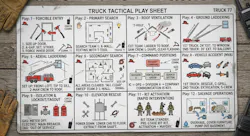
When responding as the truck company to any structure fire, having a clear plan begins with identifying your primary responsibilities, so you can develop a practical playbook of tasks that addresses the immediate priorities and true challenges on scene.
Much like when a football team gets into the red zone and a circumstance can present itself differently depending on the down and distance, time on the clock and the hash that you’re on, not to mention the personnel who are in the game, truck companies get into situations that are familiar but have many variables.
Don’t forget that the defense has a say, too. Even if our territory is nothing but the same footprint of cookie-cutter homes, from incident to incident, the fire gets a vote. We don’t know whether there will be smoke, fire or both, much less where they are showing from scene to scene.
Now add the different factors that even houses that look like each other can possess.
There are far too many variables in our job to have specific plans for every single situation. We must clump situations together into generalized scenarios and run the play.
Playbook mentality
For the endless multitude of possible scenes that truck officers could be assigned, they must break a scene down into a simple playbook that’s based on their response area. One of the biggest challenges that I faced early as a truck officer was knowing when and where to deploy a specific task. I understood what my tasks were, but when making decisions on scene, I was overwhelmed by balancing proper timing, what tools to bring and how to perform all of the tasks in concert. Invariably, I defaulted to what was standard, even if it wasn’t progressive.
I was the new guy but also the one who was in charge. I wanted to know how to be better and more efficient and how to set up the crew to be ahead of the incident.
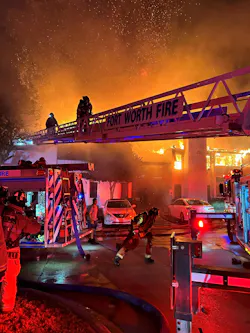
Let me say that the playbook mentality and tool assignments aren’t my creation, but I convinced myself that the jobs that my company would be tasked to do were too diverse and dynamic to have formal tool assignments, much less formal plays to run. Shockingly, I was surprised time and again by different scenarios that required the same tools.
Some candid feedback from another officer during a hot wash led me to explore tool assignments for my truck. With the help of my crew, we got to work. We developed tool assignments that were based on our territory profile. The overriding goal was to have all of the tools that were necessary for the most common tasks at a house fire off of the truck without having to make a return trip. Once we found a base formation, we then trialed what we could grab effectively.
We put the tool assignments into practice in training and on real incidents and found our base assignments to be a good foundation on house fires and expandable to the wider world of apartment and commercial fires.
We then expanded into preassigned tasks. Our study of search tactics, ventilation, truck spotting, aerial use, laddering and forcible entry was instrumental in the development of our Truck Company Operations Manual. We’ve had this manual instituted for more than two years and have captured a great deal of departmentwide experience and knowledge, so future truck company officers won’t have to start over when they promote.
Split-team model
At the time when my crew and I were developing formal tool assignments, a single-family dwelling fire brought a lone truck company along with its complement of engines and chiefs, which left a lot of work to be done by four people. Our experimentation forced us to distill our tool assignments and tasks to the bare necessities. We ran a split-team model, which means splitting our crew of four into two teams. The left side of the truck was the outside team; the right side was the inside team. These monikers—inside and outside—were our radio designations when calling command or each other. The split-team model worked well for our territory, which primarily consisted of single-family dwellings, small strip commercial buildings and apartments.
To operate as a split team, there must be deep trust in your crew. By and large, the driver is an acting officer for the incident. You must trust this person to make good decisions as, if you will, a disciple of the officer. To get this person to that level takes training, discussion and accountability. A truck officer must not turn a person loose on the first day and just expect the individual to be able to make good decisions. Taking that person to a controlled environment and having the individual walk you through a task that the individual will need to perform is a good start.
For this reason, I was very particular about who I allowed to drive my ladder truck. Requiring some tenure before being the truck driver usually afforded more experience and, therefore, a reasonable assumption that the individual could deal with the added responsibility.
Tenure of the outside team was very important to me when dealing with utility control. Except for rare occasions, electricity and gas services weren’t higher priorities than search and ventilation. However, dealing with residential power or determining whether the power was too much to control without assistance from the power company required some experience and tenure.
An additional byproduct of the split-team model at my station was that new members never rode the left side of the truck if I could help it. This meant that when a rookie was on our truck, that person always was with me inside searching. In this way, that person’s lack of experience could be shored up with the person who has overall responsibility of the crew: me.
This rule made the driver’s job easier, because that person’s partner rarely was a rookie who needed constant oversight. Where this all came into play was in the two basic tactics of the truck company: search and ventilation.
Consolidated-team model
In the past three years, my department added a second truck to all house fires and a third truck to apartment and commercial fires. The additional staffing allows truck officers to consolidate their crew on scene and go all in on a single task rather than stretching themselves thin.
The first truck that’s on scene has a choice between the two basics and has a play already written for how that looks. Whatever the officer elects to perform, the opposite task is assumed by the second-arriving truck.
The third truck company for apartments and commercial buildings was designed to front load the aerial capabilities, because these incidents tend to strike a multi-alarm response. The third truck can be flexed by the incident commander to provide a rapid intervention crew or additional personnel for search and evacuation or vertical ventilation.
A distinct advantage of this model over the split-team model is flexibility. If you remove a member from one of the truck crews for a task, you still can perform your assignment. The split-team model depends heavily on having at least four members. Take one away and you must revert to performing a single task and, therefore, lose all flexibility.
The consolidated-team model also allows more flexibility for where people ride. As noted above, if in a split-team mindset, I felt a responsibility that the new person on the job be in the fire and supervised by me. With the consolidated team model, regardless of a new member’s position, that person will be with the officer and supervised.
Basics: search and ventilation
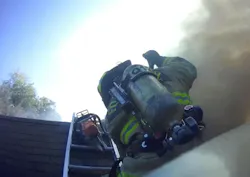
The split-team concept was the base formation that answered how a single truck company could undertake search and ventilation simultaneously. Therein lies its primary value. Search, ventilation and extinguishment aren’t only tasks; they are the tasks on the fireground. Other tasks, such as ladders, forcible entry, utility control and water supply, support the accomplishment of search, ventilation and extinguishment. For the truck company, search and ventilation are the two basics.
Search is the reason that we exist. It solves the life-safety problem. Everything that we work to accomplish on the fireground supports the search. I picture search as the top of the pyramid, with ventilation and extinguishment supporting it from below. With efficient hoseline placement and/or ventilation, we easily can make our search (read: life-hazard) problem go away.
Much like search, ventilation can be accomplished in numerous ways. My directive to my outside team always was to consider vertical ventilation and then move to other tasks. There are many opinions about vertical ventilation, but mine was that it’s incredibly effective and it works.
One of my most controversial philosophies as truck officer was not flexing my second firefighter to my search team when we had a report of victims trapped. My justification was two-pronged. First, we should arrive at every fire with the expectation of victims trapped and should run our play as we usually do. Second, ventilation aids both search and fire attack: We are taking the smoke problem and the fire problem away from the victims simultaneously. If I took a third person with me, I lost the ability to vent with correct timing.
Keeping it simple
As a truck officer, my philosophy followed a simple maxim: If I couldn’t explain it quickly and clearly at 2 a.m. to someone who I never worked with, then it was too complicated. Keeping things simple, clear and concise not only helps your communication but also your crew’s receipt of the message. Starting with a baseline play in the playbook for rookies lets you throw in more additions when you have your experienced crew.
Case in point: Before I promoted to battalion chief, a senior truck member was testing whether he could perform a vent-enter-search while the driver donned PPE and prior to going aloft for vertical ventilation. This play was a great one to run, but without our normal players in the lineup, it ran the risk of causing confusion and overcomplicating the play. We agreed that the senior ember was empowered to do so if he discussed it with his fellow outside teammate. If we had a hodgepodge crew for the shift, we reverted to the simplest version of operations.
Playbook adjustments
Your playbook will depend very much on your territory. Mine was built around wood-frame houses, apartments and flat-roof commercial buildings. In whatever way that you build your playbook, play to the strengths of your crew and the reality of the buildings.
About the Author
 Jake Henderson
Jake Henderson
Jake Henderson is a battalion chief for the Fort Worth, TX, Fire Department, where he has served for 20 years. Currently, Henderson is assigned to Battalion 1 after serving for nearly a decade as a truck captain. He holds an associate degree in fire protection from Weatherford College, a bachelor’s degree in emergency management administration from West Texas A&M and a Master Firefighter Certification.