SCBA Maze Helps Firefighters Build Confidence and Competence Under Pressure
Key Takeaways
- The design allows for a mobile prop that provides training officers with a number of firefighter SCBA training ideas.
- It is constructed from lightweight plywood panels with customizable openings to simulate different emergency scenarios.
- The prop Includes features like entanglement hazards and adjustable panel sizes to increase training complexity.

As a training officer, have you ever needed something a little different—yet the same—when it comes to conducting firefighter self-contained breathing apparatus (SCBA) competence and confidence training?
Here's a prop mock-up will go a long way toward helping if you have been wanting something new, easy to put together, and readily transportable to area firehouses or fire academies to test and train every firefighter’s ability to reduce their profile, don and doff SCBA and hone their disentanglement skills.
A while back, I thought of several typical profile shapes that a firefighter could encounter during an emergency. I quickly came up with three and then recalled a fourth that I had to personally pass through during a weekend training event, “Firehouse on the Road,” in Virginia Beach, VA, some years ago.
Building the training prop
This training exercise involves a specially built box. Each 4-foot-by-4-foot panel has an opening.
Panel 1 has a 14½-inch opening, which is the space typically found in a 16-inch on-center wood framed wall. Panel 2 has a 10-inch slot across the bottom, at the floor. Panel 3 has a right triangle at the corner. And Panel 4, cut the center of the panel in the shape of a cloverleaf.
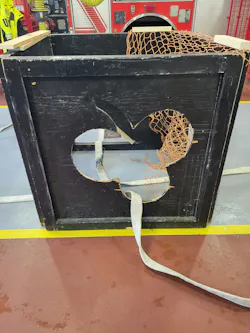
The construction is simple, with each 4-foot-by-4-foot panel made of ¾-inch plywood, framed out with 2-foot-by-4-foot lumber. You will glue and screw the panels after the openings are made, in order to increase rigidity.
Next, stand the panels up in the form of a box and install some heavy duty hinges on the inside, with the hinge pin on the inside as well. Once all the panels have been secured together in the shape of a box, remove the hinge pins from opposite sides of the box, but keep them handy. You now have two sets of panels that are married at the hinges, and that fold onto one another.
To make the box, simply open up the panels and replace the hinge pins.
I painted the prope mine black to mimic zero visibility.
Drill ideas
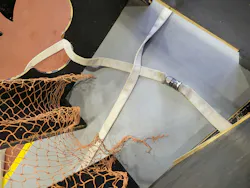
For a typical drill, you would lace a 50-foot length of 1½- in an infinity loop through the openings in the box and place the coupling under the cross-over inside the box. All firefighters are in full turn-out gear and on air. Have them put their hoods on backwards to limit visibility in their SCBA facepieces. Then, place the box about five feet from a wall and turn the lights out.
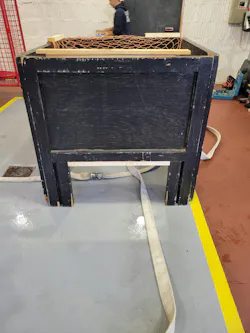
As part of the drill, have each firefighter search along the wall, one at a time, until they find the hose laced through the box.
It is important to stress that the hoseline is only a guide and the hoseline is not to be pulled on. The objective here is to have your firefighter finesse their way through each opening, but not to push with their legs or pull with their arms against the box walls.
If a firefighter cannot fit through the opening, they are to doff their SCBA, while maintaining control of the left harness strap where the SCBA hose originates. Once they pass through that panel, they should correctly don the SCBA and continue on. Some firefighters may have to do this through all four panels.
If you have smaller firefighters, screw a section of 2-foot-by-4-foot or 1-foot-by-4-foot lumber on the flat against the right triangle and floor slot panels to reduce the size opening.
I have made the openings to accommodate the average firefighter, but sometimes found it necessary to make these quick changes to the panel dimensions. Panel 1, however, will remain unchanged and is used for the reverse swim or wall dive techniques.
As the firefighter comes across the coupling, ask them in which direction they are traveling (bumps to the pump, or deeper into the fire).
Also, you can incorporate an entanglement hazard using some fish-netting that is draped over the top and held by an observer. You may add some insulated flex duct work, or an open folding chair for additional challenges, or add your own surprises to it.
The small prop offers a variety of training ideas and the mobility allows many firefighters to refine their skills.
About the Author
Dale Gentek
Dale Gentek is a 30-year retired captain from the Wildwood, NJ, Fire Department. He is a 43-year volunteer firefighter currently serving in Villas, NJ, Fire Co. #1. Gentek is a Level 2 instructor for the State of New Jersey, has a Level 3 Pro-Board instructor from the Maryland Fire Rescue Institute, and a 26-year member of New Jersey Task Force 1 where is a rescue specialist.