Close Calls: Firefighter Burned During Live-Fire Training
Key Takeaways
- Multiple operational, procedural and cultural factors contributed to a firefighter sustaining burn injuries during a live-fire training evolution.
- The staged opening of basement doors and windows and use of positive pressure ventilation fans during a live-fire training evolution at a department’s training academy burn building increased the burning rate and the heat and velocity in the exhaust portion of flow paths, to contribute to a trainee sustaining burn injuries.
- Insufficient understanding of PPE burn dynamics—particularly, the importance of air gaps and the impact of compression—left personnel who were participating in live-fire training more vulnerable to thermal injury.
I always have had the attitude that any training is good training, and I continue to stand by that. Things certainly changed since I started in 1973 (when our instructors used coffee cans that were filled with gasoline to create “realistic” scenarios), and we have learned a great deal since then.
When I say any training, it’s important that we have instructors who are qualified to do that training, who operate based on best practices and who are focused on the goal of training those who are involved.
Tragically, much of our learning throughout North America (as well as laws, standards and policy changes) has been on the backs of and memories of fallen firefighters, including those who died in well-intentioned live-fire training events, such as Michigan Firefighters Marsha Baczynski, Robert Gregory and Thomas Phelps, Colorado Firefighters William Duran and Scott Smith, New York Firefighter Bradley Golden, Florida Lt. John Mickel and Firefighter Dallas Begg, and Pennsylvania Capt. Robert Gallardy. (Mickel and Begg’s and Gallardy’s stories are shared in “30 Fires You Must Know.”)
My sincere thanks to Fairfax County, VA, Fire and Rescue Department (FCFRD) Fire Chief John Butler and Battalion Chief Matt Tamillow, Fire Safety Research Institute’s (FSRI) Dan Madrzykowski and all of those who were affected by this incident for their cooperation. Additional kudos to the FCFRD for identifying the facts and openly sharing them so that all fire departments and training staff can learn.
The incident and initial findings
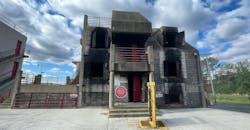
On Oct. 13, 2024, an FCFRD firefighter sustained burn injuries during a live-fire training evolution at the department’s training academy. The evolution involved a firefighter entering the burn building with a 2.5-gallon pressurized water can (PWC). The firefighter’s goal was to move from the first level down to the basement and suppress three different fuel packages along the path.
In response, Butler initiated a comprehensive investigation to understand what happened, to identify contributing factors and to improve safety protocols. The department formed a Significant Incident Investigation Team (SIIT) and brought in FSRI’s fire safety experts to support the SIIT. The team was tasked with examining the circumstances surrounding the injury, identifying contributing factors and recommending corrective actions.
The investigation began with extensive interviews with participants and instructors, a review of operational and training policies, and an analysis of the training event’s planning and execution. This identified multiple operational, procedural and cultural factors that contributed to the incident. FSRI researchers conducted a series of live-fire experiments to recreate the conditions of the incident and to investigate how different variables influenced the thermal environment inside of the burn building.
Unclear leadership roles between Battalion 406 personnel and the Field Training Section (FTS) caused uncoordinated changes in the training plan. A PWC was introduced without fully reassessing the training’s fuel loads or evaluating its effect on fire conditions. FTS instructors didn’t adjust instruction or strategy in response to repeated performance issues, and a positive pressure ventilation (PPV) fan was used to intensify fire behavior.
Additionally, no single, authoritative live-fire training policy was followed consistently, which resulted in inconsistent practices. Investigators identified a pattern of noncompliance with safety protocols, possibly stemming from a history of relatively few injuries. This complacency was evident in last-minute modifications to the training plan, the failure to align fuel loads with the PWC’s capabilities, inconsistent rehab procedures and delayed reporting of the burn injury.
Using science
In the final phase of the investigation, the SIIT collaborated with FSRI in May 2025 to conduct a series of controlled burn experiments at the FCFRD’s Fire & Rescue Academy (FRA) Class A burn building. The objective was to replicate the conditions of the Oct. 13 incident under controlled circumstances; validate a burn sequence matrix for future training; capture quantitative fire behavior data; and compare those findings to the operational capabilities of the suppression equipment that was used during the drill.
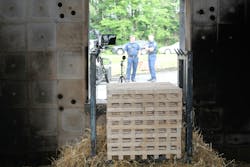
The experimental setup reproduced the original fuel package sizes and distribution: seven pallets on the first floor in FRA Room 103 (Quad C), five pallets in the basement’s Room B04 (Quad D) and 10 pallets in Room B03 (Quad C). Ventilation conditions were duplicated, beginning with ignition while the first-floor Bravo door was open and the basement was closed, followed by the sequential opening of the basement double doors and the W-2 window. A PPV fan was positioned to blow into W-2 during the experiment. A 2.5-gallon PWC was used to suppress the fire under conditions like those of the original drill.
To capture data, FSRI deployed thermocouple arrays, heat flux sensors, and strategically placed video and thermal imaging cameras. This instrumentation recorded temperature profiles at multiple heights within the burn rooms, basement stairway and adjacent spaces; measured heat flux at critical entry and egress points, including the basement and first-floor stairway landings; and documented ventilation-driven flow path dynamics as changes to ventilation were introduced.
Testing-revealed findings
- Fuel loads exceeded suppression capacity. Recorded basement and stairway landing temperatures approached 500 degrees Fahrenheit at one foot above the floor, with heat flux levels in the stairway reaching approximately 15 kW2. Under these conditions, the PWC’s 2.7-gpm flow rate and theoretical 700 kW heat absorption capability were insufficient to control the fire load of the fuel package that was located in the basement, which had an estimated peak heat release rate of 4,000 kW.
- Ventilation significantly influenced fire growth. The staged opening of basement doors and windows, combined with PPV fan use, increased the burning rate and increased the heat and velocity in the exhaust portion of the flow paths, particularly in the basement stairway.
- Operational implications. The mismatch between fuel package sizing and suppression equipment capability was a critical factor in creating an uncontrolled fire environment. Ventilation changes during active suppression further contributed to rapid heat rise and hazardous flow path conditions.
These controlled burn experiments were conducted after the completion of interviews, document reviews and policy analysis. Their results provided objective, data-driven confirmation of earlier investigative findings and measurable insight into the fire dynamics that were present during the incident. With this comprehensive investigative record complete, the SIIT finalized its analysis and identified the following critical factors pertaining to the incident:
- Last-minute modifications to the training plan without adequate review.
- Failure to adjust fuel loads to match the PWC’s operational capabilities.
- No single, authoritative live-fire training policy was consistently followed, which resulted in inconsistent practices.
- The history of relatively few injuries contributed to complacency and noncompliance with safety protocols.
- Overreliance on the assumption that a training environment minimizes risk.
- Complacency was evident in the inconsistent application of rehab procedures and the delayed reporting of the burn injury.
- Insufficient understanding of PPE burn dynamics—particularly, the importance of air gaps and the impact of compression—left personnel more vulnerable to thermal injury.
- Limited understanding of the effect of fuel package size and the resulting fire dynamics or thermal conditions within the training building.
Every reader is urged to access the report and associated videos at fairfaxcounty.gov/fire-ems/siit.
Comments from Goldfeder
Most, if not all, of any fire department’s original policies (or national standards) have a history of coming from an incident that didn’t turn out well. For example, in 1982, firefighters from Boulder, CO, conducted drills in an acquired structure. The training officer ignited various materials to create a more realistic environment. After a few evolutions, the rooms and materials inside became preheated. When the last crew entered the structure, conditions rapidly deteriorated, trapping the firefighters inside. Duran and Smith died from extensive burn injuries. NFPA 1403: Standard on Live Fire Training Evolutions was born in 1986. Although its original focus was on acquired structures, it applies to all live-fire training.
The FCFRD has a very solid and professional reputation at all levels of what it does. Its USAR team is world-renowned for the work that it does. Day to day, the FCFRD’s companies, like all of ours, answer calls with positive results. However, sometimes all of us get comfortable; something that’s been discussed in this column previously can creep in: normalization of deviance.
Developed by American sociologist Diane Vaughan, essentially, normalization of deviance is the process in which deviance from correct or proper behavior or rules/policy becomes culturally normalized. The original example that was cited by Vaughan is the events that led to the Challenger space shuttle disaster in 1986, but the concept also has been applied to aviation safety, clinical medicine practice and everyday human behavior slippage (“Oh, I’ll just run this traffic light quickly”). Bottom line, we sometimes intentionally or unintentionally blow off the rules and standards, and the more that we do it, the more that we get comfortable, until one day …
Can we eliminate normalization of deviance? It’s a rather human thing, so it’s easy to fall off that wagon, but there certainly are ways to minimize it.
Training. Both initial and ongoing, training that’s conducted must be clearly understood by everyone at every level. This includes understanding what’s expected, what the policy is and what the desired outcomes are … and what they aren’t.
Clear responsibility and ownership. This is certainly critical at the company officer level but at all levels, where the “trust but verify” concept comes in. It’s the job of the chief who is overseeing the company officer to ensure that what’s expected to get done is getting done. This is no different than the company officer ensuring that the crews are getting their work done: “Yes, I trust you, and part of my job is to verify that things are being done as expected.”
Communicate. Stop assuming that people understand (or remember) your expectations. Stop assuming that everything will be fine just because you don’t want to annoy anyone. Communicate to them, remind them, and reinforce them. That’s the officer’s job.
Furthermore, share lessons learned and related close calls, both internally and externally, to your members and your mutual-aid partners. Detailed and documented “what happened” reports are important to operational consistency, because they act as a guide to help your members to stay on track and accomplish what’s expected.
Controlling the deviation
Deviation, or creep, from expectations, standards and policies is human. However, when the right people are put into the right positions, and those people take ownership and truly care about the people, standards and policies—along with those who affirm the roles and responsibilities—that deviation can be greatly controlled.
Checklist of Contributing Factors
An investigation by the Fairfax County, VA, Fire and Rescue Department’s Significant Incident Investigation Team and Fire Safety Research Institute examined the circumstances surrounding the burn injuries that were sustained by a firefighter during live-fire training. Factors that contributed to the event that the investigation found include:
- Ambiguity in leadership and decision-making.
- Last-minute modifications to the training plan.
- Inconsistent training objectives for water can (PWC) use.
- Failure to adjust fuel loads after adding PWC to the plan.
- Improper application of positive pressure ventilation fans during evolutions.
- Failure to monitor interior conditions during live-fire training.
- Lack of approved training plan documentation.
- Lack of widely understood and established department guidelines for live-fire training.
- Assumptions about the safety of training scenarios.
- Normalization of deviance in live-fire training.
- Absence of structured rehabilitation, medical assessment and decontamination procedures.
- Lack of clarity regarding hurt vs. injured.
- Creation of a unidirectional flow.
- Minimal Field Training Section instructor qualifications.
- Knowledge gaps in structural PPE functionality and burn dynamics.
- Injured firefighter was left unsupported after his initial treatment and admittance to the hospital.
Key Recommendations
Following the investigation into the Oct. 13, 2024, incident in which a firefighter suffered burn injuries during a live-fire training, the following best practices emerged:
- Establish a formal process for reviewing and approving training plan modifications.
- Conduct pre-drill briefings to ensure clarity of objectives and roles.
- Standardize training on the use of and understanding the capabilities of pressurized water cans.
- Adjust fuel loads to match training objectives and suppression capabilities.
- Improve documentation and oversight of live-fire training scenarios.
- Reinforce a culture of safety and accountability across all training operations.
- Enhance understanding of PPE performance and thermal exposure risks.
- Strengthen rehab and medical assessment protocols during training.
Fairfax County Fire and Rescue Department
Located in a suburb of Washington, D.C., the Fairfax County, VA, Fire and Rescue Department (FCFRD) consists of 39 fire stations that are spread across the county’s 406 square miles and serves a population of 1.16 million residents. With more than 1,400 uniformed staff, 300 civilian employees, and 350 operational and administrative volunteers, the FCFRD is the largest fire department in the Commonwealth of Virginia. It responds to approximately 130,000 incidents annually.
About the Author
 Billy Goldfeder
Billy Goldfeder
BILLY GOLDFEDER, EFO, who is a Firehouse contributing editor, has been a firefighter since 1973 and a chief officer since 1982. He is deputy fire chief of the Loveland-Symmes Fire Department in Ohio, which is an ISO Class 1, CPSE and CAAS-accredited department. Goldfeder has served on numerous NFPA and International Association of Fire Chiefs (IAFC) committees. He is on the board of directors of the IAFC Safety, Health and Survival Section and the National Fallen Firefighters Foundation.