Solar Farm Wildfire Strategies & Tactics
Key Takeaways
- Preplanning for how firefighters should attack a fire at a solar farm includes understanding how to deenergize the solar systems and figuring out appropriate fire line cutoffs to stop the moving fire.
- Firefighter training for a solar farm fire must include collaboration with the solar farm management, including for that entity to provide access to the property and to certain roads that are within the access line.
- Pre-established water sources via draft sites, on-site tanks and refill locations must be considered by fire departments that would respond if a vegetation fire were to occur at a solar farm.
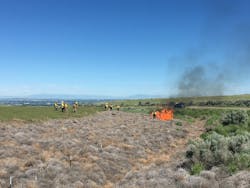
With the increase in solar energy farms across the United States, so, too, comes an increase in the wildland fire potential in an unforgiving hot bed of energy. Is your department prepared for this distinct wildland urban interface (WUI) threat? Do you have particular strategies and tactics in place to deal with the solar farm fire that involves vegetation as it runs across the landscape and threatens homes and businesses?
The past & the present
Thirty years ago, few, if any, wildland fire management agencies or fire service organizations imagined the extensive growth of the WUI involving the issue of solar farm and energy systems as wildland fire fuel. On the whole, fire service personnel who belonged to municipal fire departments and districts limited themselves to saving structures and having limited interaction with initial attack wildland fires. Generally, apparatus and training for municipal fire service organizations mostly were limited in their scope.
Today, look across the landscape anywhere in the United States and across the rest of the world and one can see energy farms that eat up areas that once were managed farmland or open access lands. For example, hundreds of acres of corn fields are gone and in their place are sprawling high-energy fields. A single 30-acre solar farm can produce enough energy for approximately 1,000 homes, often generating megawatts of power—as much as 1,000 times more than that of residential systems.
Furthermore, solar systems aren’t just farm plots anymore. As people across the United States move to the country, many take their electric vehicle with them. Many times, that means finding a renewable energy source to charge it. Thus, solar panels aren’t only on the top of homes; large residential panels now are located in the backyard of WUI property.
With that much energy surging through wires, things are bound to go wrong. A solar farm doesn’t catch fire every day, but when it does, inherent safety risks are associated with wildland fire responses.
Complicated circumstance
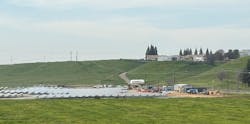
If you Google “solar farm fires,” numerous articles immediately result, and almost every article involves a vegetation fire response. With so much power moving through, a firefighter simply can’t walk up to the system and shut it off. The potential for accidental electrocution is as great as the intake of the toxic smoke that burns off of these panels.
Sadly, not all energy companies take pride in the maintenance of the grid in relation to powerlines above the treetops. The same can be said for those who operate solar farms that are located within grasslands. Often, the associated solar farm fire is a cumulation of all pieces of the puzzle connecting. Dry grass isn’t mowed or fields of the farm aren’t maintained. Fire line breaks around the solar farms are nonexistent. No preplanning for wildland fire responses was conducted by the utility or solar farm company. The local fire department wasn’t invited to participate during the planning phase. God forbid that firefighters encounter windy conditions—or worse yet, red flag wildland fire conditions—during a response.
The associated hazards of the grass burning underneath the panels also causes the panel to burn. Unfortunately, the positivity of energy systems also creates negativity. The burning panels are made of chemicals that can create toxins that are extremely hard on the human body, and they create a hazmat response issue that must be contended with.
Will the smoke layover from these potential fire sites cause respiratory problems for the residents and businesses, and if so, how will you mitigate problems before they happen? Instead of reducing weight by wearing just wildland fire PPE, you must incorporate SCBA, a hazmat team, and a significant amount of other acronymized agencies to deal with the issue.
Strategies and tactics
Now is the time to have discussions with the powers that be to help to identify response plans and apparatus assignments. Understanding how to deenergize solar systems (e.g., cover up the panel) to figuring out appropriate fire line cutoffs to stopping the moving fire (for example, pre-season dozer lines) should be done now—not when the fire is running toward homes and businesses. Being proactive isn’t always the typical fire department thought process; however, in this case, it absolutely must be.
Have your personnel been trained to suppress wildland fires, let alone wildland fires in a solar farm? Part of that training can be department equipment-related, and part of that training must be in connection with solar farm management, including access to the property and certain roads that are within its access line. For example, is there a sprinkler system in place to manage fires?
In addition, participating in National Wildfire Coordinating Group (NWCG) training on the basics of wildland firefighting is an excellent resource that can be found among state and federal wildland fire partners. They, too, have a high chance of responding to solar farms that have threats to their specific areas. Bringing response partners to the site with you in a controlled training environment is far better than having to figure it out on the fly. For instance, these areas, like any, can present unique challenges at night that aren’t considered in the daylight.
Training for fires that involve solar farms has certain complexities that many firefighters might not even be aware of. Here’s where good relationships with the solar farm management or property owners are vital. In addition to providing access to the property, these entities might have equipment that’s specific to fire suppression or can help in other relatable ways.
Even more important in the relationship is the solar farm companies’ and power companies’ capability to provide your agency with potential apparatus.
If they provide apparatus and other equipment, is there training that’s particular to its use? An additional consideration is in the hands of the title of that apparatus. Is it allowed to go to any fire or only a fire that’s tied to the solar farm?
Pre-established water sources via draft sites, on-site tanks or refill locations must be considered in dealing with vegetation fires in the solar farm area. Having run cards that include water tenders that provide that water support in suppression efforts is huge in decreasing time for response and suppression.
Have neighboring firefighters, fire service leadership, and mutual/automatic-aid partners been informed of the associated problems and risks? As noted above, one of the key pieces of the response is preseason relationship-building. Meeting face to face in the training environment is far more appropriate than meeting via a radio in the heat of battle.
Understanding electrical hazards, response risks, preseason vegetation management, water resources, and even potential aerial firefighting and what that does to solar farms is critical to the fire at a solar farm.
Will you let the solar farm burn and then attack the fire once it comes out of the property line? Maybe there’s a lack of initial attack resources, and letting the fire come to a harden road area will work better in decreasing risk of the response. Also, many of these areas hopefully have done some significant prescribed fire management program prior to the fire season. If not, the fuel load can dictate fire intensity.
AI & the solar farm fire
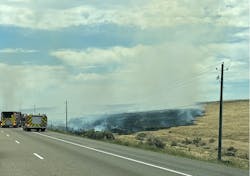
Is your fire response area working with the utility company to use artificial intelligence (AI) technology for rapid fire notification to the public safety answering point to get resources rolling sooner rather than later? Some of those items that need further evaluation could tie into additional relationships with programs and agencies that have access to panoramic cameras or AI fire-sensing equipment. Often one door opening means more doors opening for a response in the solar farm fire.
This also is a newfound grant or donation opportunity with local, state or federal response partners. As you look through issues of the past, those moments come because of new problems. So, presenting a solar farm fire issue can provide an opportunity to find new and unique ways to solve response issues, preseason mitigation measures (buy or rent wildfire fuel goats) or even acquire training that needs funding.
Positives, not negatives
All of the questions that are noted above should be asked before it’s too late. Answers must make safety sense, not focus on dollars and cents. Developing tactical plans, operational radio channels and predetermined trigger points to engage or not engage are ways to help to decrease later response-associated costs.
Part of the problem that’s associated with any wildland fire isn’t the suppression of the fire; it’s dealing with all of the parties that are at the table that have a stake in the game of its suppression: private landowners, management companies, local, state and federal jurisdiction overlap, and the list goes on and on. A primary response piece must be the unified command presence. That will solve a lot of problems on the forefront and prepare you and your response partners in the long run.
Solar farm fires are a problem that only will increase. In the end, be smart on your strategy and tactics associated with solar farm fires. Look for positives in the suppression outcome instead of experiencing negatives.
Product Spotlight
Vehicle-Mounted TIC
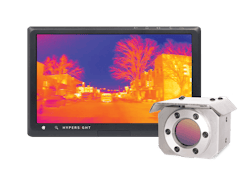
HyperSight 640ARFF from RPX Technologies is a vehicle-mounted thermal imaging camera (TIC) that has a rugged pan-tilt base. Built around the advisory circular 150/5210-19B for aircraft rescue & fire fighting (ARFF) operations, the system lets crews see through smoke from inside of the apparatus cab, scan for victims and obstacles, and direct streams with precision, without exposing personnel to dangerous site conditions.
High-Pressure Pump
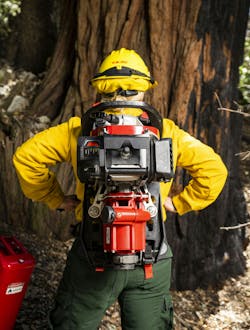
The MARK-3 Watson Edition high-pressure pump from Waterax builds on the legacy of the original MARK-3 to deliver a best-in-class power-to-weight ratio for wildland firefighting. Precision-engineered for extreme conditions, the pump offers exceptional reliability, performance and portability for initial attack, extended operations and vehicle-mounted applications.
Wildland Apparatus
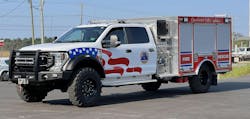
CET’s light truck division was awarded registration with Sourcewell and Canoe Procurement Group of Canada (Canoe) for firefighting apparatus. Take advantage to make your fire apparatus purchase easier across North America by using the company’s contract (#082025-CET).
Wildland Turret
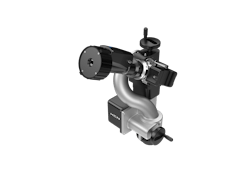
The TITAN PRIME precision wildland turret from HEN Technologies delivers wide blade pattern coverage with full horizontal and vertical rotation for controlled water application. Large droplets provide improved reach, penetration and cooling, with automatic flow adjustment from 500–1,000 gpm. Real-time gpm, psi and total water flow data, combined with a detachable remote controller, provide accurate, mobile and safer operation.
Product Spotlight
Wildland Apparatus
CET’s light truck division was awarded registration with Sourcewell and Canoe Procurement Group of Canada (Canoe) for firefighting apparatus. Take advantage to make your fire apparatus purchase easier across North America by using the company’s contract (#082025-CET).
FIRE-PUMP.COM
Wildland Turret
The TITAN PRIME precision wildland turret from HEN Technologies delivers wide blade pattern coverage with full horizontal and vertical rotation for controlled water application. Large droplets provide improved reach, penetration and cooling, with automatic flow adjustment from 500–1,000 gpm. Real-time gpm, psi and total water flow data, combined with a detachable remote controller, provide accurate, mobile and safer operation.
HENTECHNOLOGIES.COM/TITAN-ELITE
Vehicle-Mounted TIC
HyperSight 640ARFF from RPX Technologies is a vehicle-mounted thermal imaging camera (TIC) that has a rugged pan-tilt base. Built around the advisory circular 150/5210-19B for aircraft rescue & fire fighting (ARFF) operations, the system lets crews see through smoke from inside of the apparatus cab, scan for victims and obstacles, and direct streams with precision, without exposing personnel to dangerous site conditions.
RPXTECH.COM
High-Pressure Pump
The MARK-3 Watson Edition high-pressure pump from Waterax builds on the legacy of the original MARK-3 to deliver a best-in-class power-to-weight ratio for wildland firefighting. Precision-engineered for extreme conditions, the pump offers exceptional reliability, performance and portability for initial attack, extended operations and vehicle-mounted applications.
WATERAX.COM
About the Author
 Bill Arsenault
Bill Arsenault
Bill Arsenault is a 34-year veteran of emergency services. He has been a part of municipal fire services and EMS organizations. After 25 years of service in Idaho, Arsenault was offered the chance to become a part of CAL FIRE and currently works in the Fresno-Kings Unit. He is a graduate of the National Fire Academy (NFA) Managing Officer Program and an NFA instructor, holds numerous International Fire Service Accreditation Congress and National Wildfire Coordinating Group certifications, and has degrees in fire service leadership, wildland fire management and structural fire science. Arsenault is a decorated combat veteran from the U.S. Army.