Partnership Aims to Reduce Wildfire Severity in Ashland, OR, Watershed
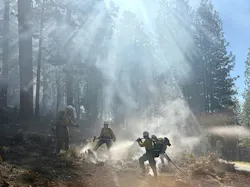
On a cool morning in late April, blackened ground smoldered under ponderosa pines in the Rogue River-Siskiyou National Forest.
The air at the southern Oregon site in the vast Ashland watershed had a mild scent of smoke from low, controlled fires that had been methodically set in previous days to remove flammable debris from forest floors.
From a distance, a group of fire and natural resource experts from across the country watched professional crews patrolling with firefighting tools like Pulaskis, shovels and hoses to mop up hotspots in a region where a predicted drier, hotter fire season has residents on edge.
The visitors included officials from Washington, D.C., and elected tribal council leaders from the West Coast. They came to witness treatments to reduce wildfire severity conducted through a successful collaboration that other communities have adopted.
As wildfires in the West grow more frequent and destructive, some cities increasingly regard the forests on their outskirts as a potential threat. More are taking proactive steps to support healthy ecosystems that can resist catastrophic wildfires.
It’s complex, costly work, and since 2010, Ashland has shared the responsibility for protecting its city with the U.S. Forest Service and two nonprofits The Nature Conservancy and Lomakatsi Restoration Project, which advocate for fire management practices similar to those Indigenous people used over thousands of years to maintain open forests.
Ashland’s shared stewardship was the first of its kind. And decision-makers are paying attention.
Ellen Shultzabarger, associate deputy chief of the U.S. Forest Service, was among the officials watching the work in Ashland on April 29.
She said there is much to learn from this partnership’s success, and a real opportunity to replicate this framework in forests across the country.
“This project is a model of shared stewardship: working across land ownerships, recognizing the unique contributions each partner brings, and maintaining strong support and clear communication within the community,” she said.
Forest Service fire ecologist Lindsey Negherbon, who was responsible for planning, organizing and safely executing the prescribed burns, led the fire and forestry crews.
Working the ground were firefighters with private contractor Grayback Forestry and Ashland-based Lomakatsi, a nonprofit that trains crews and conducts ecosystem restoration across Oregon and Northern California.
Lomakatsi has long been a foundation of Ashland’s wildfire mitigation work. Marko Bey, a former tree planter working on federal lands, founded the tribally affiliated nonprofit in 1995.
Years of collaborative work through the Ashland Forest Resiliency Project partnership have resulted in $35 million invested in forest health, fuel reduction, community engagement and multiparty monitoring. That work is being tested this year.
Sparse snowpack, historic climate-driven heat and drought, and tree die-off caused by disease and insects make Ashland, surrounded by dense conifer forests, even more at risk of devastating fire.
Fire season started on May 15, two weeks earlier than in previous years, and is projected to stretch into October.
Forecasters predict an El Niño weather pattern may arrive earlier than typical, which could increase temperatures and lightning storms into the fall.
Considering all of Ashland’s factors, including a high density of older housing not built to current fire code and overgrown landscapes despite years of city-supported free and low-cost cleanup, the Forest Service says Ashland has a higher wildfire risk than 97% of U.S. communities.
To reduce the city’s vulnerability, the Ashland City Council last year unanimously approved the Community Wildfire Protection Plan.
The approval came in 2025, five years after the 2020 Almeda fire, which was human-caused and fueled by riparian vegetation along the Bear Creek Greenway and traveled from Ashland north through Talent and Phoenix to Medford.
The ambitious 10-year project aims to expand ecological restoration efforts in surrounding forests and have 90% of all properties in Ashland — about 11,000 housing units, commercial buildings and facilities — ember-resistant by 2036.
“It’s certainly a lofty goal, but when we first started the Ashland Forest Resiliency Project, we had a goal of treating 7,600 acres” in 10 years, said Chris Chambers, forestry officer at Ashland Fire & Rescue. ”We got to 14,000 acres.”
The Ashland Forest Resiliency Project collaborative, created as a replicable model, continues through the broader Ashland Forest All-Lands Restoration Project.
More partners have joined to protect public and private land within the 58,000-acre footprint in the Ashland watershed and its surrounding wildland urban interface, where development meets wildland vegetation.
The city categorized itself as being entirely within the wildland urban interface.
Prescribed fire is one tool to lower the risks. But in rare circumstances, a prescribed burn can become a wildfire as happened May 7 on Pine Mountain in Deschutes County where 2,589 acres burned.
‘Good’ fire
The practice of controlled burning has deep historical roots in the region.
Before gold prospectors arrived in 1852, Shasta, Takelma and Athabaskan peoples strategically burned forest understory in the Rogue Basin.
Regular fire intervals stopped after 1856 as settlers sought to protect new communities.
Lomakatsi has been reintroducing prescribed fire for more than 30 years.
A regular fire regime removes noxious weeds and cycles nutrients back into the soil. Fire is also used to propagate First Foods like camas, medicines and raw materials to weave baskets, said Belinda Brown of Lomakatsi.
Brown, a member of the Kosealekte Band of the Pit River Tribe and Northern Paiute descendant, leads the nonprofit’s Tribal Partnerships Program, which contributes to forest and watershed restoration across tribal trust and ancestral lands.
At the gathering near the newly burned understory, Kerry Metlen, a Nature Conservancy forest ecologist based in Ashland, held up a thick cross section of a ponderosa pine tree.
He used the tree rings to date a pattern of fire scars. He pointed to scars starting in 1498 and recurring in 1507, 1520, 1582, up to 1810, when the tree died after surviving 18 fires.
Metlen said research shows strategic thinning, prescribed burning and mechanical treatments on 25% of a given landscape can result in a 70% reduction in the severity of wildfire risk across that landscape.
Years of work went into preparing the 40-acre site in the Ashland watershed for the slow, controlled burn.
The crews removed small- to medium-sized trees, often Douglas-firs, to protect larger, older pines and oaks that anchor the forest ecosystem, according to Bey of Lomakatsi.
When smaller trees removed as part of forest health prescriptions have commercial value, Lomakatsi hires timber operators to transport the trees to local mills.
Last year, the city of Ashland funded a 400-acre helicopter logging project to remove dead, dying and densely packed Douglas-firs from the watershed. Timber sales from the project generated about $450,000, offsetting part of the $1.4 million cost, said Chambers.
Lomakatsi’s crews, including its Inter-Tribal Oregon Conservation Corps working at the Ashland watershed site, understand controlled “good fire” as a natural, cleansing and regenerative way to improve watershed and forest health.
The young corps members in yellow fire-retardant clothing were newly certified to work in fuels reduction and prescribed fire operations after completing hands-on training and intensive coursework.
The firefighter type 2 crew members also passed a physical fitness test required for the arduous work.
Participants, age 16-30, in Lomakatsi’s Tribal Ecological Forestry Training Program are paid to train for careers in wildland fire and natural resource management.
Bey sees Lomakatsi’s work as restoring watersheds and forests, protecting communities and creating jobs.
Last year, 65 Lomakatsi tribal and rural corps members accomplished more than 8,000 acres of ecological stewardship activities working across ancestral lands on public, tribal trust and private land.
Seneca Hescock, 22, joined the Lomakatsi team in July 2022 and first earned certifications as a firefighter type 2. He is now a tribal forestry technician. The enrolled member of the Klamath Tribes and descendant of the northern Paiute peoples often works on ancestral lands.
Hescock decided to become a wildland firefighter after his hometown of Chiloquin was almost destroyed in the 242 fire that began the same Labor Day weekend as the 2020 Almeda fire.
“It’s a high risk job, but I wanted to do something for the forest that provides for me,” said Hescock. “With my crew, a lot of us have spent our lives camping, fishing and gathering in the woods.”
His work, removing timber and brush in dense areas, and enhancing the older standing trees and native vegetation, also allows firefighters and engines access in case there is a fire.
“Some of our job is educating people, who only know of mega fires, that prescribed fire is not an element of destruction,” Hescock said. “It can prevent bigger fires.”
A photo on Lomakatsi’s website shows where the 2018 Taylor Creek-Klondike fire stopped after burning more than 175,000 acres of federal and private forests in Curry and Josephine counties. The stopping point was the area Lomakatsi strategically cleared with Forest Service crews in the Rogue River-Siskiyou National Forest.
Low-intensity fires in a prepared site stay low to the ground and are permitted only when strict conditions are met, including moist air, low winds and dry fuel.
A fire that could burn dangerously in the middle of a dry, hot summer moves differently — more predictably — in cool, low-wind conditions.
“When people go on our field tours it convinces them about the value of thinning and controlled burning,” said Brown in the Lomakatsi shuttle van to the Ashland watershed site.
In her youth, Brown was a reforestation contractor. Brown’s company, Fire Tech West, consulted on the 2002 Biscuit Fire that burned nearly 500,000 acres in the Rogue River–Siskiyou National Forest.
“It used to be that people did what they needed to do to put the fire out, but with the Biscuit Fire, that’s when people started to become more aware that we’re losing our forests,“ said Brown.
Seven years later, a more effective approach to wildfire prevention was adopted by the federal government.
In 2009, Congress established the Collaborative Forest Landscape Restoration Program to encourage collaborative, science-based restoration. “Different agencies, insurance industry, municipalities slowly started coming together to figure out how to help make a community safe,” said Brown.
Watershed protection
At a reception the night before the April 29 field tour organized by Lomakatsi, Ashland Mayor Tonya Graham told the group gathered that her city, a “community built on the side of a forested mountain,” has long understood the critical need for protecting its watershed.
Today, more than 10,500 households rely on the health of adjacent public wildland for drinking water.
Ashland’s history of protecting the municipal watershed dates to a petition from the city to the federal government to establish the Ashland Forest Reserve in 1893.
A century later, the first collaborative Ashland Forest plan was written in 1992. Later, the 2004 community wildfire protection plan came after years of the “sometimes difficult journey” to find middle ground between the logging industry and environmentalists, said Graham.
In 2010, this effort became the Ashland Forest Resiliency Project, with core funding and matching investments provided by the U.S. Forest Service, the city of Ashland, Lomakatsi Restoration Project, The Nature Conservancy and the state of Oregon.
Since 2013, Ashland residents have paid about $7 a month with their water bill toward a community risk reduction fund. The roughly $2 million raised every two years goes toward removing fire fuels.
Following Graham was speaker Molly Juillerat, forest supervisor for the Rogue River-Siskiyou National Forest in southwest Oregon and Northern California.
“The work that we’re able to do together is added value across all lands,” Juillerat said. “We’ve been able to learn together from our mistakes, from our successes, put people to work and train kids. We’re all better for it as a community.”
Over the years, the Ashland watershed project has been visited by U.S. Forest Service undersecretaries, county and national leadership with the U.S. Department of Interior and other policy makers.
“We’ve hosted field tours with our partners, and that’s the importance of sharing the work,” said Bey.
Lomakatsi inviting officials to tour treated sites helps officials see that ideas born in Ashland can be replicated for fire adaptive forests across Oregon and beyond.
“The April field tours were a stage for conversations on much larger issues like shared stewardship,” said Bey.
In a statement celebrating the nonprofit’s 30th anniversary last year, Bey cited the strength of the nonprofit’s relationships among tribes, government agencies, nonprofits, industry, academic institutions, landowners and funders.
“We know that it takes all hands on deck to overcome the many challenges facing our ecosystems and communities, and that our work will never be complete,” said Bey. “After all, we are the perpetual stewards of these beautiful lands we are fortunate to call home.”
©2026 Advance Local Media LLC. Visit oregonlive.com. Distributed by Tribune Content Agency, LLC.