Eight Rangers in Canoes Paddling to Evacuate Campers in Remote MN Boundary Waters Wilderness as Fires Threaten
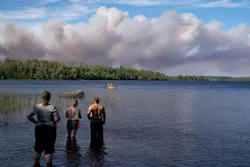
It will take U.S. Forest Service rangers at least a week to clear visitors from the million-acre Boundary Waters Canoe Area Wilderness after the agency ordered the area closed beginning at 12:01 a.m. Tuesday, July 14.
“Our goal is to make sure that people can have a reasonably safe experience in the Boundary Waters and to protect the safety of our firefighters,” said Drew Stroberg, acting Superior National Forest supervisor. “Right now we don’t feel as though we can [without closing the BWCAW].”
The rare closure and evacuation order came Monday as more than a dozen forest fires in and around the Superior National Forest grew amid hot, dry conditions with no rain in sight.
Here is what we know about the evacuation plan, which began Friday when the Forest Service closed entry points along the Echo Trail northwest of Ely but now has a new scale and urgency.
Eight rangers leading evacuation
Four teams, two to a canoe, are paddling through the BWCAW to notify campers and other visitors that they need to exit. The rangers have been at it since Friday when the wildfire threat triggered a partial closure at entry points north and west of Ely toward Crane Lake.
Their approach is consistent with the non-motorized ethic of the BWCAW. Travel largely is nonmotorized by federal law. Motorboats, including towboats, are allowed on a few lakes along the outskirts. Stroberg said the agency could use motorized craft to reach visitors only on those lakes.
A vast wilderness to search
There is a lot of ground to cover and campsites to visit. The BWCAW extends about 150 miles along the U.S.-Canadian border. There are more than 2,000 designated campsites and also hiking trails.
“There are a lot of lakes in the Boundary Waters, lots of portages, lots of area to cover,” Stroberg said. “With the resources we have, we estimate that it would take us approximately a week.”
Steve Piragis, an outfitter in Ely for more than 40 years, said the rangers have a few things working in their favor but “it’s hard to know” how the evacuation plan will play out.
While rangers need to visit campsites, campers will encounter other visitors who alert them to the closure. Plus, Piragis added, rangers have some main routes with numerous sites that will make their work more efficient.
“I don’t see it being a big problem unless someone is in a really remote place,” Piragis said.
The rangers are “firefighter-qualified,” Stroberg added. “We’re not just sending anybody in there.”
An uncertain head count
Agency officials said they do not know how many people remained in the backcountry as of Monday afternoon. About 150,000 people visit the wilderness every year, according to the Forest Service.
An Ely outfitter said Monday morning that he was confident that most, if not all, of the visitors near the most significant BWCAW fires were cleared out by rangers over the weekend.
While the agency is closing the rest of the BWCAW, Jason Zabokrtsky, owner of Ely Outfitting Co., said visitors to other parts of the wilderness “are not in any sort of imminent threat situation.”
More assistance is possible
Stroberg said the agency is trying to secure more help with the evacuation.
Nick Petrack, the Superior National Forest’s fire management officer, said float planes could be used if there is an “imminent threat” to wilderness visitors.
“We do have the capability … everything is a case-by-case basis,” he added.
Late Monday, St. Louis County Sheriff Gordon Ramsay said several people had to be rescued by boat and by air near the Camp Fire.
Effects of federal cuts unclear
Some U.S. lawmakers, environmentalists and former Forest Service staffers have expressed fears that recent federal cuts could hurt the agency’s ability to fight fires on Forest Service land such as the Superior National Forest and its BWCAW.
The Forest Service cut more than 5,800 employees — or approximately 16% of its overall staff — last year as part of the Trump administration’s efforts to cut federal spending. President Trump also proposed in his 2027 budget to decrease the agency’s discretionary budget by as much as 75%, according to one think tank’s analysis.
In a May interview with PBS, former Forest Service Chief Michael Dombeck said the Trump administration’s recent changes to the agency created a “chaotic” atmosphere for staffers.
It’s unclear if those cuts have affected the Forest Service’s response to the BWCAW fires this week, including how many rangers are assigned to evacuating the wilderness.
However, Forest Service spokesperson Christine Kolinski acknowledged Monday that the agency has reached out to former Minnesota employees for help.
“We are actively trying through our existing staff to reaching out to former staff that have retired or moved to another position off-forest that still have firefighting skills and credentials area,” she added. “I have seen two so far.”
©2026 The Minnesota Star Tribune. Visit startribune.com. Distributed by Tribune Content Agency, LLC